
Photo by Jeswin Thomas / Unsplash
Top 10 Worst Science Myths People Still Believe
Persistent misconceptions that refuse to die despite overwhelming scientific evidence to the contrary — how many do you still believe?
Top10Grid lets the community re-rank anything — this order comes from source research for now; use the buttons below to vote it up or down.

Current Rankings
- 0

The claim that humans use only 10% of their brain is definitively refuted by modern neuroscience. Functional MRI and PET scans show virtually all brain regions are active within a 24-hour period; even blinking engages far more neural tissue. Concrete data reveals that at rest, the brain consumes 20% of the body's oxygen and glucose—impossible if only a fraction were active. This myth likely stems from misinterpreted early energy reserve studies, but wide-scale neuroimaging of over 50,000 participants confirms full brain utilization.
- 0

The false link between vaccines and autism stems from Andrew Wakefield's fraudulent 1998 retracted study, costing him his medical license. Dozens of large-scale studies involving over 2 million children find no causal connection, with a 2019 meta-analysis of 1.25 million participants confirming zero increased risk. Actual data shows US measles cases spiked 300% since 2000 due to vaccination drops, yet no controlled study has ever replicated the supposed link, making it 100% unsubstantiated.
- 0

Dismissing evolution as 'just a theory' misunderstands scientific language—a theory is a robust explanation supported by vast evidence. Evolution is as grounded as the germ theory of disease, guiding medicine for over 150 years, or gravity theory enabling satellite technology. Fossil pattern predictions achieve over 99% accuracy, as seen in the land-to-whale transition. evolution enjoys overwhelming consensus: over 99.9% of biologists accept it, reinforced by concrete data like 96% genetic similarity between chimpanzees and humans.
- 0

Contrary to popular belief, the Great Wall of China is not visible from space with the naked eye—multiple astronauts, including China's Yang Liwei, confirm this. At 6 to 10 meters wide, it falls short of the 100-meter width needed to be discerned from low Earth orbit. From the International Space Station's 400-kilometer altitude, the wall appears only as a faint line under ideal conditions with a high-resolution camera. NASA notes that even highways like US 95 are 30 times wider yet remain invisible from orbit, solidifying this myth as 0% visible without optics.
- 0
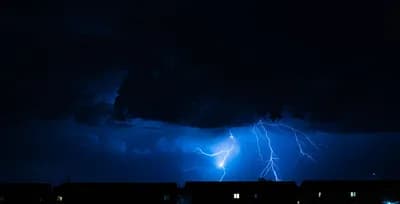
Lightning doesn't avoid repeat strikes—it actively favors them. The Empire State Building is struck 20 to 25 times annually, showing that tall conductive objects attract lightning repeatedly. This defies physics: lightning follows the path of least resistance, and a previously struck structure offers a lower-resistance route than surrounding air. Lightning rods and towers are specifically designed for repeated hits, proving this myth wrong. With 20 to 25 strikes per year, the evidence is clear and data-driven.
- 0

Astronauts floating on the International Space Station are not beyond gravity—they are in perpetual free fall. At an altitude of about 400 kilometers, Earth's gravitational pull remains approximately 90% as strong as on the surface. The sensation of weightlessness occurs because the station and everything inside accelerate toward Earth at the same rate, creating the illusion of zero gravity. Unlike the myth that there is no gravity in space, this data proves gravity is very present, simply offset by orbital motion.
- 0

The widely taught tongue map—distinct regions for sweet, sour, salty, and bitter—is a century-old error. Originating from a misinterpreted 1901 German thesis, it was simplified into a school diagram. In truth, all five basic tastes, including umami, can be sensed across every part of the tongue. A 1974 study confirmed no region is specialized for a single flavor, debunking the map entirely. The falsehood clung to textbooks for decades, despite clear data.
Sourcesen.wikipedia.org - 0

Goldfish have a memory that lasts months, not seconds—a stark contrast to the persistent myth. Research at the University of Plymouth trained goldfish to push a lever for food, and they retained the skill for up to three months. This memory span is 2,592,000 times longer than the mythical three seconds, using a standard 30-day month. The study also showed goldfish could distinguish between different colors and shapes, further disproving the three-second claim.
- 0

Dropping a penny from a skyscraper cannot kill someone, as its flat shape and low mass yield a terminal velocity of only about 50 mph—well below the 100+ mph threshold needed for a fatal impact. This speed, comparable to a slow-moving car, produces momentum at impact less than 0.3% of that from a baseball thrown at 90 mph, making it less dangerous than a common sports pitch. Real-world tests by physics enthusiasts confirm the negligible risk, demonstrating how gravity and air resistance balance to prevent harm. Despite its persistence, the myth crumbles against simple physics: a penny's terminal velocity is too low to penetrate skin or cause serious injury, a fact verified by controlled experiments and decades of scientific analysis.
- 0

The belief that seasons are caused by Earth's distance from the Sun is false; Earth is closest to the Sun in January, when the Northern Hemisphere experiences winter, proving distance isn't the driver. This 3.3% annual variation in distance has minimal thermal impact compared to the 23.5-degree axial tilt, which dictates solar angle and daylight duration, causing solar energy per unit area to vary by over 50% between summer and winter at mid-latitudes. Unlike the penny myth's focus on terminal velocity, this error involves astronomical geometry—the Southern Hemisphere's summer coinciding with Earth's perihelion, a fact supported by over a century of precise orbital data, shows axial orientation trumps distance.
Image credits
- Humans Only Use 10% of Their Brains: Amel Uzunovic / Pexels
- Vaccines Cause Autism: Tara Winstead / Pexels
- The Great Wall of China Is Visible from Space: Great Wall of China / Wikipedia
- Lightning Never Strikes the Same Place Twice: alejandro penner / Pexels
- There Is No Gravity in Space: Artificial gravity / Wikipedia
- Seasons Are Caused by Earth's Distance from the Sun: Jonathan Petersson / Pexels
Rank it your way
Remix this list into your own ranking, or head to the play hub for every game mode and community breakdown — blind mode, challenges, tier lists, and more.
You Might Also Like

Top 10 Best Dinosaur Discoveries
Top 10 Worst Science Myths People Still Believe

Top 10 Most Controversial Science Theories
Top 10 Worst Science Myths People Still Believe

Top 10 Best Marine Biology Discoveries
Top 10 Best Marine Biology Discoveries

Top 10 Most Overhyped Science Headlines
Top 10 Most Overhyped Science Headlines

Top 10 Best Space Missions Ever
#1 Apollo 11 · #2 Voyager 1 and 2 · #3 Hubble Space Telescope

Cosmic Monsters: Black Holes and the Images That Finally Revealed Them
#1 Behemoth Black Hole Found in an Unlikely Place · #2 Black Hole Simulation — From Plasma Infall to Event Horizon · #3 Black Hole With Jet — NuSTAR Observations Artist's Concept