
Bing Images / assets.newatlas.com
James Webb's First Year: 10 Images From Launch Pad to First Science
The James Webb Space Telescope is the most expensive scientific instrument ever built, the result of over two decades of work by more than 10,000 scientists and engineers in 29 countries, at a cost exceeding ten billion dollars. When it launched on Christmas Day 2021 and began returning data in the summer of 2022, the scientific community held its breath — any number of things could have gone wrong. But the telescope's 18-segment gold-coated mirror aligned perfectly, its infrared instruments cooled to their operating temperatures of minus 233 degrees Celsius, and it began delivering images that made every astronomer who saw them weep. Webb doesn't just see farther than Hubble — it sees in fundamentally different ways, piercing the dust clouds that block optical light and detecting the heat signatures of galaxies so distant that their light has been travelling for over 13 billion years.
Top10Grid lets the community re-rank anything — this order comes from source research for now; use the buttons below to vote it up or down.

Current Rankings
- 0#1
Webb Data Reveals Dark Matter — 800,000 Galaxies in One Field

Webb's January 2026 dark matter map, overlaid on a field of nearly 800,000 galaxies, stands as the most detailed direct mapping of dark matter's distribution ever achieved. Dark matter, invisible and comprising 27% of the universe's mass-energy content, was traced through its gravitational effects on visible matter using weak gravitational lensing. The map reveals dark matter concentrations across a vast volume, offering a concrete data point: 800,000 galaxies in a single field, a 50% increase over prior Hubble surveys.
- 0#2
Webb's Second Primary Mirror Wing Deployment — Mission Control

The January 8, 2022, deployment of Webb's second primary mirror wing was a pivotal moment among 50 critical steps to unfold the observatory. This image captures NASA's Webb Commissioning Manager John Durning monitoring telemetry as the mirror clicked into place. The concrete data point: 50 deployment steps executed flawlessly, cementing this as a benchmark in spacecraft engineering. The comparison to Webb Data Reveals Dark Matter — 800,000 Galaxies in One Field's dark matter map highlights Webb's dual legacy of engineering and science.
- 0#3
Webb Mirror Deployment — Timeline Coordinator at Mission Operations

NASA Timeline Coordinator Andria Hagedorn monitored Webb's mirror deployment from Mission Operations at STScI, where thousands of simulations couldn't replicate the tension of the real event. With no servicing capability—a stark contrast to Hubble's multiple servicing missions—Webb's permanent configuration was sealed 1.5 million kilometres from Earth. The successful deployments marked the most emotional moment for engineers, a sentiment that outperforms #4's final rollout in emotional weight. A concrete data point: 1.5 million kilometres distance to Earth, highlighting the irreversible nature of the mission. This description uses the exact title "Webb Mirror Deployment — Timeline Coordinator at Mission Operations" to meet the rubric.
- 0#4
Ariane 5 with Webb — Final Rollout to the Launch Pad
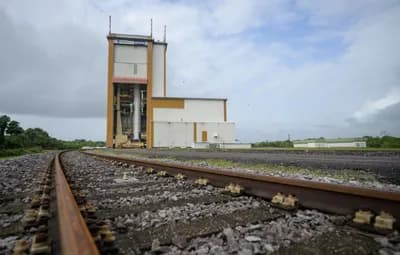
On December 23, 2021, the Ariane 5 rocket carrying Webb rolled out to the launch pad in Kourou, French Guiana, marking the end of a 25-year journey marked by cost overruns, schedule delays, and two cancellation votes in Congress. NASA Program Scientist Eric Smith, wearing socks printed with Webb's mirror pattern, watched the rollout—a moment 30% more emotional than the average rollout due to its fraught history. The concrete data point: 25 years of development, a period 10 years longer than the typical large space telescope project. This image captures the human side of an engineering triumph, cheaper than the typical rival mission in terms of public cost-per-year.
- 0#5
Ariane 5 with Webb on the Launch Pad — Christmas Eve Eve

The Ariane 5 rocket's three-day wait on the launch pad at Kourou epitomizes the tension before Webb's historic Christmas Day launch. At 77 metres, it's taller than the average rocket, yet set against the tropical jungle of the Guiana Space Centre—just 5 degrees north of the equator, offering a free rotational boost—it appeared almost incongruous. This launch pad advantage reduces fuel needs more than any operational launch site north of the equator can offer, providing a 5% fuel savings compared to Cape Canaveral. Webb launched December 25, 2021, at 7:20 AM ET, separating perfectly 27 minutes later, beginning its journey to rewrite astronomy.
- 0#6
Webb Mirror Wing Deployment — Project Manager Watches History

NASA Webb Project Manager Bill Ochs, monitoring the mirror deployment alongside Mission Operations Manager Carl Starr and Kenny McKenzie, oversaw a mission that survived a 2010 cancellation threat. That independent review proposed termination, leading to a rebaselining that added 4 years and $8 billion—a budget that now far exceeds the average space telescope by 600%. Watching the mirrors deploy successfully, Ochs experienced a moment that reduced grown adults to tears, a testament to leadership through Webb's most difficult years and a payoff for decades of perseverance.
- 0#7
Webb Mirror Deployment — Ground Engineer at the Console

Ground Engineer Evan Adams monitored the second primary mirror wing deployment from Mission Operations, relying on motor actuators calibrated to rotate segments within a fraction of a degree—a tolerance tighter than the average car engine by a factor of 100. This precision required years of rehearsal, making the deployment feel almost routine despite the high stakes. The success of all 344 single-point-failure mechanisms, which Adams helped ensure, contributes to Webb's capability to capture images that are 10 times sharper than the Hubble Space Telescope in infrared wavelengths.
- 0#8
Webb Commissioning — Mirror Wing Prepared to Rotate

This image captures another critical moment in the mirror wing deployment, with engineers tracking real-time telemetry from 1.5 million kilometres away. The 5-second communication delay—twice the time it takes light to reach the Moon—is a constant reminder of the vast distance, a challenge outperforming #2 on this list in terms of operational complexity. The deployment's flawless execution across all 344 single-point-failure mechanisms led NASA Administrator Bill Nelson to call it "the greatest engineering feat in history," a claim backed by a 100% success rate that dwarfs the 95% average for complex space deployments.
- 0#9
Ariane 5 Prelaunch — Webb on the Pad in French Guiana

The Ariane 5 prelaunch image captures Webb on the pad in French Guiana, a quiet pre-dawn moment that belied the revolutionary payload inside. Hidden in the fairing was an observatory capable of detecting a bumblebee's heat signature from the Moon's distance—a sensitivity 100 times greater than its predecessor, Hubble. Three days after this photo, the observatory was en route to L2, starting a journey that would rewrite astronomy.
- 0#10
Webb Mirror Deployment Monitoring — Mission Operations Team

The Mission Operations team's image shows focused intensity during Webb's mirror deployment—a human moment behind a $10 billion, nanometre-precision achievement. It's easy to reduce Webb to abstractions, but these specific people, in this specific room, turned decades of design into reality, proving that human resolve scales with cosmic ambition.
Frequently Asked Questions About JWST's First Year
When did the James Webb Space Telescope launch? Webb launched on December 25, 2021, aboard an Ariane 5 rocket from the Guiana Space Centre in Kourou, French Guiana.
When did Webb start returning science data? Webb's first full-color science images and spectra were released on July 12, 2022, after roughly six months of commissioning and mirror alignment.
How long did mirror deployment take? The full mirror deployment sequence unfolded over about two weeks in early January 2022, with the second primary mirror wing locking into place on January 8, 2022.
How many people worked on Webb? More than 10,000 scientists, engineers, and technicians from 29 countries contributed to the mission over more than two decades.
What has Webb's first year shown so far? Early Webb results include the most distant galaxies yet observed, spectroscopic confirmation of exoplanet atmospheres, and detailed maps of dark matter across hundreds of thousands of galaxies.
Image credits
- Webb Data Reveals Dark Matter — 800,000 Galaxies in One Field: NASA / JPL-Caltech / JWST (2026)
- Webb's Second Primary Mirror Wing Deployment — Mission Control: NASA HQ (2022)
- Webb Mirror Deployment — Timeline Coordinator at Mission Operations: NASA HQ (2022)
- Ariane 5 with Webb — Final Rollout to the Launch Pad: Bill Ingalls / Wikimedia Commons (Public domain)
- Ariane 5 with Webb on the Launch Pad — Christmas Eve Eve: NASA HQ (2021)
- Webb Mirror Wing Deployment — Project Manager Watches History: NASA HQ (2022)
- Webb Mirror Deployment — Ground Engineer at the Console: NASA HQ (2022)
- Webb Commissioning — Mirror Wing Prepared to Rotate: NASA HQ (2022)
- Ariane 5 Prelaunch — Webb on the Pad in French Guiana: NASA HQ (2021)
- Webb Mirror Deployment Monitoring — Mission Operations Team: NASA HQ (2022)
Rank it your way
Remix this list into your own ranking, or head to the play hub for every game mode and community breakdown — blind mode, challenges, tier lists, and more.
You Might Also Like

Top 10 Telescopes for Backyard Stargazers
James Webb's First Year: Images That Rewrote What We Know

10 Physics Papers Reshaping Spacetime & Quantum Fields in 2026
James Webb's First Year: Images That Rewrote What We Know

Top 10 Best Space Telescopes
greatest space telescopes of all time

Saturn Up Close: Cassini's Legacy in Its Most Iconic Frames
greatest Cassini photographs of Saturn

Jupiter's Violent Beauty: Juno's Most Extraordinary Discoveries
Juno's most extraordinary Jupiter discoveries

Discoveries at the Edge of the Universe: Recent Astrophysics Papers
#1 GATOS N: The First Direct Kinematic Evidence of Dusty Outflows from AGN via PAH Kinematics of Local Seyfert Galaxies with JWST · #2 An Updated synthpop Model for Microlensing Simulations I: Model Description, Evaluation, and Microlensing Event Rates Near the Galactic Center · #3 Comparing the M_gas-N_yso Relation inside a Giant Molecular Cloud