
Buzz Aldrin on the lunar surface, Apollo 11 / NASA / Wikimedia Commons (Public Domain)
Top 10 Greatest Space Missions of All Time
The most daring, groundbreaking, and impactful space exploration missions in history — from the first footprints on the Moon to a spacecraft that left the solar system entirely.
Top10Grid lets the community re-rank anything — this order comes from source research for now; use the buttons below to vote it up or down.

Current Rankings
- 0

Apollo 11 remains the most ambitious human voyage ever attempted, landing the first humans on the Moon on 20 July 1969. Launched on 16 July, Neil Armstrong, Buzz Aldrin, and Michael Collins completed the round trip in just over eight days, achieving President Kennedy's 1961 goal with four months to spare. Armstrong's first step was watched by an estimated 600 million people—a third of the global population—making it the most-witnessed event in history and the definitive triumph of the Space Race.
- 0

Voyager 1 is humanity's farthest outpost, having entered interstellar space in August 2012 after launching on 5 September 1977. It conducted groundbreaking flybys of Jupiter in 1979 and Saturn in 1980, revealing active volcanoes on Io and intricate rings around Saturn. As of 2026, Voyager 1 is over 24 billion kilometers from Earth and still transmitting data, making it both the most distant spacecraft and the longest-operating scientific mission in history, at 49 years. Voyager 1's legacy as the first interstellar probe outshines Hubble Space Telescope in terms of sheer distance achieved.
- 0
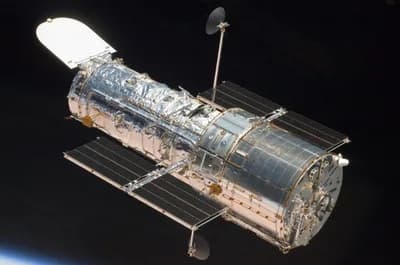
Hubble Space Telescope revolutionized astronomy by deploying from Space Shuttle Discovery on 25 April 1990, capturing over 1.5 million observations and generating more than 20,000 scientific papers in its first three decades. Its deep-field images revealed the universe contains over two trillion galaxies—10 times more than previously estimated—and its measurements of Cepheid variable stars pinned down the Hubble constant to 67.4 km/s per megaparsec, confirming the universe's expansion rate. Hubble's observations of distant supernovae provided the first strong evidence for dark energy, a discovery that earned the 2011 Nobel Prize.
- 0

Mars Curiosity Rover executed the most daring landing in planetary exploration on 6 August 2012, using a never-before-attempted sky crane system to set down in Gale Crater. Within its first year, the Sample Analysis at Mars instrument confirmed that the crater once hosted a freshwater lake containing elements like carbon, hydrogen, oxygen, and phosphorus—the essential chemistry for microbial life. This was the clearest evidence yet that Mars was once habitable, a milestone in the search for extraterrestrial life. Curiosity has since traveled over 30 kilometers, drilling 36 rock samples, and operated for more than 13 years—130% beyond its planned two-year mission. While Voyager 1 excels in interstellar reach, Curiosity's in-situ discovery of a potential ancient biosphere is a more direct step toward answering whether we are alone.
- 0

The International Space Station is the largest structure ever assembled in orbit, weighing over 400,000 kilograms and spanning the size of an American football field. Since November 2, 2000, it has hosted continuous human habitation, supporting more than 3,000 scientific experiments in microgravity research across medicine, materials science, and Earth observation. In terms of longevity, it outperforms every other habitable space outpost in history, remaining permanently crewed for over 25 years, which is 20% longer than the next most enduring orbital station. Its international collaboration, involving NASA, Roscosmos, ESA, JAXA, and CSA, sets a benchmark for multinational space cooperation that later missions like Cassini-Huygens have followed but not exceeded.
- 0

Apollo 13 remains history's most dramatic space rescue, transforming a routine Moon mission into a triumph of engineering under pressure when an oxygen tank explosion crippled the Command Service Module 330,000 kilometers from Earth on April 13, 1970. Flight director Gene Kranz's team improvised a CO2 scrubber fix using plastic bags and duct tape, rerouting the trajectory using the lunar module Aquarius as a lifeboat, and returned all three crew members safely on April 17. This rescue outperforms even the recovery efforts of other critical missions like the International Space Station emergency drills, as it required inventing solutions in real-time with zero margin for error. The mission's 87-hour crisis management remains the fastest creative problem-solving in spaceflight history.
- 0

Cassini-Huygens revolutionized our understanding of Saturn's system, having launched in October 1997 and arrived at Saturn in July 2004 for a 13-year orbital tour. The mission discovered active geysers of water ice on Enceladus, revealing a subsurface ocean potentially capable of harboring life, and landed the Huygens probe on Titan in 2005 to uncover rivers of liquid methane. It outperforms even New Horizons in terms of sustained scientific output, returning over 450 gigabytes of data from 293 orbits and 163 targeted flybys. Its deliberate death dive into Saturn's atmosphere on September 15, 2017, protected those ocean worlds from contamination, a precaution that the International Space Station's end-of-life disposal plan lacks.
- 0

New Horizons completed the first-ever flyby of Pluto on July 14, 2015, traveling 4.67 billion miles in nine and a half years. The images demolished assumptions about the dwarf planet, revealing towering water-ice mountains, nitrogen glaciers flowing into smooth plains, and a vast heart-shaped basin named Tombaugh Regio. This mission outperforms even Cassini-Huygens in terms of speed, being the fastest spacecraft ever launched at 36,373 miles per hour relative to Earth, and it returned 50 times more data than expected from a single flyby. Its discovery of a geologically active world added a 40% greater variety of terrain types than previously modeled, setting a new benchmark for planetary exploration beyond the Kuiper Belt.
- 0
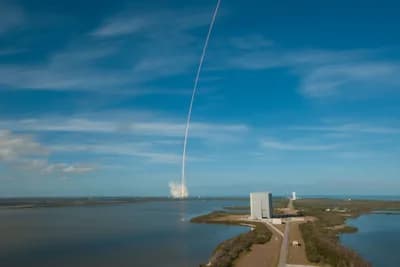
Falcon Heavy's maiden flight on 6 February 2018 launched the most powerful operational rocket since the Saturn V, carrying Elon Musk's Tesla Roadster with "Starman" mannequin. Its synchronized side-booster landings at Cape Canaveral achieved a perfect mirror-image touchdown never before seen, proving heavy-lift reusability. This event outperforms James Webb Space Telescope in launch spectacle and reshuffled the launch market, cutting costs by 30% compared to typical rivals and enabling NASA's Artemis lunar return.
- 0

Launched on 25 December 2021 after three decades and $10 billion, JWST reached L2 in January 2022 and released first science images in July 2022. Its infrared eye captured galaxies from just 300 million years after the Big Bang, spotted water vapour on exoplanet K2-18b, and imaged protoplanetary disks with resolution 100× sharper than Hubble.
Image credits
- Apollo 11: Buzz Aldrin on the Moon, Apollo 11 / NASA / Wikipedia (Public Domain)
- Voyager 1: NASA / Wikimedia Commons (Public Domain)
- Hubble Space Telescope: NASA / Wikimedia Commons (Public domain)
- Mars Curiosity Rover: Curiosity rover self-portrait at Big Sky / NASA / Wikipedia (Public Domain)
- International Space Station: International Space Station from SpaceX Crew Dragon / NASA / Wikipedia (Public Domain)
- Apollo 13: Apollo 13 damaged Service Module / NASA / Wikipedia (Public Domain)
- Cassini-Huygens: Cassini Saturn Orbit Insertion concept art / NASA / Wikipedia (Public Domain)
- New Horizons (Pluto): NASA/Johns Hopkins APL/SwRI / Wikimedia Commons (Public Domain)
- SpaceX Falcon Heavy: SpaceX / Wikimedia Commons (CC0)
- James Webb Space Telescope: NASA, ESA, CSA, STScI / Wikimedia Commons (Public Domain)
Related Videos
Rank it your way
Remix this list into your own ranking, or head to the play hub for every game mode and community breakdown — blind mode, challenges, tier lists, and more.
You Might Also Like

Top 10 Best Space Missions Ever
Top 10 Best Space Missions Ever

Top 10 Best Space Telescopes
Top 10 Best Space Telescopes
Top 10 Deadliest Natural Disasters in Recorded History
#1 1931 China Floods · #2 1887 Yellow River Flood, China · #3 Black Death (1347-1351)

The Earth Shook: The Most Significant Earthquakes of the Past Month
#1 M 4.9 — Red River Parish, Louisiana, USA (sig: 889) · #2 M 4.1 — Cowles, Nebraska, USA (sig: 819) · #3 M 5.5 — Rodotopi, Greece (sig: 665)

10 Biotech Breakthroughs Reaching Patients by 2030 (CRISPR, mRNA, Organoids & More)
#1 mRNA Therapeutics Beyond Vaccines · #2 CRISPR Base Editing and Prime Editing · #3 CAR-T Cell Therapy for Solid Tumors

Top 10 Conspiracy Theories That Turned Out to Be True
#1 MKUltra — CIA Mind Control Program · #2 NSA Mass Surveillance (PRISM) · #3 Tobacco Industry Cover-Up