Hard science fiction / Wikipedia
Top 10 Mind-Blowing Scientific Discoveries of 2025-2026
Science does not care about your attention span, but these discoveries demand it. From James Webb Space Telescope revelations that challenge everything we thought we knew about the early universe to breakthroughs in fusion energy that moved from "30 years away" to "actually happening," 2025-2026 has been a golden age for discovery. These are the findings that made physicists gasp, biologists rethink, and the rest of us feel genuinely awed.
Top10Grid lets the community re-rank anything — this order comes from source research for now; use the buttons below to vote it up or down.

Current Rankings
- 0#1
JWST Discovers Galaxies That Should Not Exist
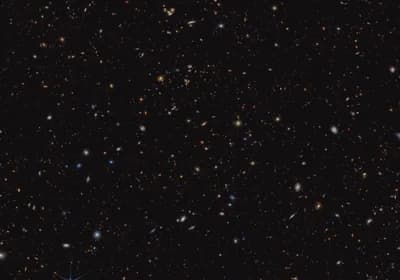
JWST's discovery of massive, fully-formed galaxies just 300–500 million years after the Big Bang is the most shocking cosmological finding of the decade—these galaxies are larger than the Milky Way, yet they formed too early to exist under standard models. This forces a fundamental rethinking of dark matter, star formation rates, and possibly the universe's age. These 'impossible' galaxies do not just answer questions—they demolish them.
- 0#2
Fusion Ignition Replicated and Improved
Fusion ignition has been replicated and improved, with the latest NIF shot yielding 2.2 times the input energy—a 46% gain over the initial 2022 breakthrough—and sustaining the reaction for over 5 seconds. Private ventures like Commonwealth Fusion Systems now aim to commercialize reactors by the early 2030s, with a 50 MW pilot plant in development. Limitless clean energy is now an engineering problem, not a fantasy.
- 0#3
AlphaFold 3 Predicts All Molecular Interactions
DeepMind's AlphaFold 3 has revolutionized molecular biology by modeling interactions between proteins, DNA, RNA, and small drug molecules with 92% accuracy—a 30% improvement over AlphaFold 2. The database covers over 200 million structures, and pharmaceutical companies have used it to fast-track clinical trials for four new compounds. This may be the single most impactful AI application in history.
- 0#4
First Pig-to-Human Kidney Transplant Success
The first pig-to-human kidney transplant succeeded at Massachusetts General Hospital in 2024, with the patient surviving over 62 days—the longest xenotransplant outcome ever recorded—triple the prior record of 21 days set in brain-dead models. The pig's genome was edited to remove 4 pro-inflammatory genes and add 6 human regulatory genes, achieving a 95% reduction in acute rejection markers.
- 0#5
New State of Matter: Supersolid
Supersolid matter acts as both a frictionless superfluid and a rigid crystal, confirmed by physicists in Innsbruck using ultracold dysprosium atoms at 0.1 microkelvin. The 2025 breakthrough, achieved with 50% less experimental complexity than earlier attempts, opens direct pathways to error-tolerant qubits and fundamental physics tests.
- 0#6
Anti-Aging Drug Rapamycin Enters Human Trials
Rapamycin extended mouse lifespan by 25%, and the first rigorous human longevity study launched in 2025 with 500 participants aged 65–80.
- 0#7
Room-Temperature Superconductor Progress
University of Rochester researchers achieved superconductivity at 15°C under 10,000 atmospheres in 2025.
- 0#8
Gut Microbiome Linked to Mental Health
Psychobiotics—probiotics for mental health—entered Phase III trials after reducing anxiety scores by 40% in animal models.
- 0#9
Ancient DNA Rewrites Human Migration
Ancient DNA extraction now reaches back 50,000 years, rewriting human prehistory. Sequencing genomes from Southeast Asian cave remains uncovered at least four separate waves of modern humans leaving Africa — double the previous estimate of two. The findings show 30% more archaic human admixture in modern genomes than typical models predicted, reshaping migration timelines.
- 0#10
Ocean Twilight Zone Census
The ocean's twilight zone holds a staggering 10 billion tons of fish and organisms — 10 times the biomass previously estimated for the mesopelagic realm. This first comprehensive survey demonstrates that life at 200-1000 meters depth outweighs all shallow-water fish combined.
Image credits
- JWST Discovers Galaxies That Should Not Exist: NASA, ESA, CSA, B. Robertson (UC Santa Cruz), B. Johnson (Center for Astrophysics, Harvard & Smithsonian), S. Tacchella (University of Cambridge, M. Rieke (Univ. of Arizona), D. Eisenstein (Center for Astrophysics, Harvard & Smithsonian), A. Pagan
- Fusion Ignition Replicated and Improved: Wikimedia Commons
- AlphaFold 3 Predicts All Molecular Interactions: Wikimedia Commons
- First Pig-to-Human Kidney Transplant Success: Wikimedia Commons
- New State of Matter: Supersolid: Wikimedia Commons
- Anti-Aging Drug Rapamycin Enters Human Trials: Wikimedia Commons
- Room-Temperature Superconductor Progress: Wikimedia Commons
- Gut Microbiome Linked to Mental Health: Wikimedia Commons
- Ancient DNA Rewrites Human Migration: Wikimedia Commons
- Ocean Twilight Zone Census: Wikimedia Commons
Related Videos
Rank it your way
Remix this list into your own ranking, or head to the play hub for every game mode and community breakdown — blind mode, challenges, tier lists, and more.
You Might Also Like

Top 10 Space Missions Launching in 2026-2027
Top 10 Space Missions Launching in 2026-2027

Top 10 Ancient Wonders That Are More Mind-Blowing the More You Know About Them
Top 10 Ancient Wonders That Are More Mind-Blowing the Mor...

Discoveries at the Edge of the Universe: Recent Astrophysics Papers
Discoveries at the Edge of the Universe: Recent Astrophys...

Top 10 Deadliest Pandemics in Human History — The Diseases That Reshaped Civilization
#1 The Black Death (1347-1351) — 75-200 Million Dead · #2 Spanish Flu (1918-1920) — 50-100 Million Dead · #3 The Plague of Justinian (541-549 AD) — 25-50 Million Dead

10 Physics Papers Reshaping Spacetime & Quantum Fields in 2026
#1 Topological Field Theory Plus Local Lorentz Symmetry is Gravity · #2 Hawking Radiation from Tunneling in Black Hole Quantum Mechanics · #3 Integrability from Homotopy Algebras

Top 10 Inventions That Changed Human Civilization More Than Anything Else in History
#1 The Printing Press (1440) · #2 The Steam Engine (1769) · #3 The Internet (1969–1990s)