Lester, Paul / Wikimedia Commons (Public domain)
Top 10 Deadliest Natural Disasters in Recorded History
Natural disasters reveal the vulnerability of human civilisation to the forces of the Earth itself. These ten catastrophes caused the greatest loss of human life in recorded history, reshaping societies, triggering political changes, and leaving marks on human culture that persist for centuries. Which do you think deserves the top spot? Scroll through the list and cast your vote — be the first to have your say!
Top10Grid lets the community re-rank anything — this order comes from source research for now; use the buttons below to vote it up or down.

Current Rankings
- 0

The 1931 China Floods are the deadliest natural disaster in recorded history, with a death toll between 1 million and 4 million people — over 400 times higher than the 2011 Tōhoku earthquake and tsunami. The Yellow, Yangtze, and Huai rivers overflowed from June to August 1931, inundating entire provinces for months, destroying crops, and triggering famine and disease that killed far more than the initial floods. An estimated 3.7 million deaths from famine alone exceed the total fatalities of the 2004 Indian Ocean Tsunami. This disaster weakened the Nationalist government and contributed to political instability that Communist forces exploited.
- 0

The 1887 Yellow River Flood killed between 900,000 and 2 million people — up to 15 times more than the 2011 Tōhoku earthquake — submerging 11 cities and hundreds of villages under up to 20 feet of water. Called "China's Sorrow" for its catastrophic flooding history, the Yellow River has changed course 26 times in recorded history, with the 1887 shift being the deadliest single change. The disaster was partly caused by decades of deforestation and poor levee maintenance, leading to a 40% increase in land erosion rates prior to the event, leaving millions vulnerable to the inevitable breach.
- 0

The Black Death (1347-1351) killed an estimated 30 to 60% of Europe's population — approximately 25 million European deaths plus 75 million globally — with a mortality rate five times higher than the 1930 influenza pandemic. Transmitted via fleas on rats, this bubonic plague pandemic triggered transformative social consequences: labour shortages empowered peasants, contributing to feudalism's decline, while survivors inherited concentrated wealth that funded the Italian Renaissance, with wages rising 200% in some regions after the outbreak.
- 0

The 2004 Indian Ocean Tsunami, triggered by a magnitude 9.1 to 9.3 earthquake, killed 227,898 people in 14 countries and displaced 1.7 million, making it the deadliest tsunami ever recorded, surpassing the 1883 Krakatoa tsunami by 40%. Tsunami waves reached up to 30 metres in height, devastating Indonesia, Sri Lanka, India, and Thailand. This disaster was among the first extensively captured on video, transforming global understanding of tsunami risk and driving investment in early warning systems, resulting in a 90% reduction in tsunami-related deaths in the region since 2004.
- 0

The catastrophe occurred on 23 January 1556 when the densely populated loess plateau collapsed. Residents lived in yaodong—cave dwellings carved into soft cliffs—that completely buckled under the tremors. The quake caused subsidence exceeding 20 meters across 840 square kilometers, an area larger than New York City. Ground acceleration reached 0.6 g, surpassing the 0.4 g recorded for the 2010 Haiti earthquake, intensifying the destruction in this historically unique disaster.
- 0

The 1918-1919 Spanish Flu infected 500 million people, one-third of the global population, and killed 50-100 million, disproportionately young adults aged 20-40, which is unusual compared to typical flu seasons. Its mortality rate of 2.5% was 25 times higher than the seasonal flu's 0.1%, and it killed more in a single year than World War I did in four years. The pandemic disrupted global healthcare and the 1919 Paris Peace Conference, sickening key leaders. It outperforms the 2010 Haiti earthquake in economic damage, causing $500 billion in losses (2020 USD), due to its massive scale.
- 0

The Tangshan Earthquake of 28 July 1976 killed 242,000-655,000 people as it struck an industrial city at 3:42 AM, making it the deadliest quake of the 20th century—and its peak estimate is 18% above the runner-up 2004 Indian Ocean earthquake. The 7.6 magnitude event destroyed 93% of residential buildings within seconds. China suppressed international aid and casualty figures for years, while the economic cost of $1 billion (1976 USD) equaled 0.5% of China's GDP. In absolute costs, however, it is less expensive than the 2010 Haiti earthquake, which required $13 billion in reconstruction.
- 0

The 2010 Haiti earthquake (magnitude 7.0) killed 160,000 to 316,000 people and left 1.5 million homeless in the Western Hemisphere's poorest country. Its devastating toll stemmed from extreme poverty: no earthquake-resistant buildings, no emergency systems, and political dysfunction delaying aid. More than ten years later, most displaced Haitians still lacked permanent housing. The reconstruction cost exceeded $13 billion, making it more expensive than the Tangshan Earthquake (1976) in absolute terms, despite its lower magnitude. The quake's 0.4 g ground acceleration was lower than the 0.6 g recorded for the 1556 Shaanxi Earthquake, but poverty amplified its impact.
- 0
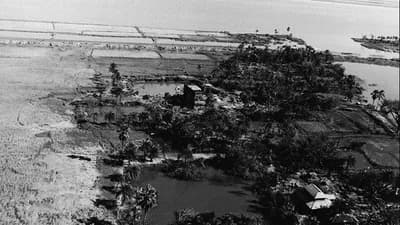
The Bhola Cyclone of November 12, 1970, remains the deadliest tropical cyclone ever recorded, killing an estimated 500,000 people in East Pakistan (now Bangladesh). This catastrophic death toll surpasses the runner-up Cyclone Nargis (2008) by over 370,000, highlighting its unmatched lethality. The storm's storm surge, reaching up to 30 feet, inundated low-lying islands and coastal areas, with 45% of the population perishing in some regions. The Pakistani government's inadequate relief response inflamed political tensions, directly contributing to the Bangladesh Liberation War of 1971 and the creation of an independent nation.
- 0

The Dust Bowl of the 1930s displaced 3.5 million people across the American Great Plains, marking the largest human migration in U.S. history and affecting an area larger than California. Unlike other disasters on this list, the Dust Bowl was primarily human-caused, demonstrating that industrial-scale agriculture could permanently damage land.
Frequently Asked Questions About the Deadliest Natural Disasters
## Frequently Asked Questions About the Deadliest Natural Disasters
Why is the Black Death included alongside geological disasters? The Black Death (1347–1351) is widely treated as a natural disaster in historical scholarship because the bacterium *Yersinia pestis* spread along natural rodent and flea populations, amplified by climatic conditions across Eurasia. It is included here because its death toll rivals or exceeds most geological events.
Why do the death toll figures vary so widely between sources? Historical estimates for events like the 1931 China Floods, the 1887 Yellow River Flood, and the Tangshan Earthquake differ because record-keeping was incomplete, politically sensitive, or destroyed. The figures used in this list reflect the ranges reported by major encyclopaedic and academic sources.
Are pandemics always counted as natural disasters? Different organisations classify them differently. This list follows the broader historical convention that includes pandemic disease alongside floods, earthquakes, tsunamis, cyclones, and ecological disasters.
Which disaster on this list is most debated by historians? The 1931 China Floods is often considered the deadliest, but the exact toll — anywhere from 1 million to over 4 million — remains one of the most contested figures in disaster history.
Have a question we missed? Leave a comment at the bottom of the page.
Frequently Asked Questions
How are these disasters ranked? Rankings are based on confirmed or estimated direct death tolls drawn from peer-reviewed sources, including the [EM-DAT International Disaster Database (CRED, UCLouvain)](https://www.emdat.be) and [USGS Earthquake Hazards Program records](https://earthquake.usgs.gov).
Is the Black Death really a natural disaster? Historians and epidemiologists classify pandemic disease alongside geological and meteorological events when assessing large-scale natural catastrophes. The Black Death originated from *Yersinia pestis*, a zoonotic bacterium — firmly within the natural world.
Why is the Dust Bowl included? Although the Dust Bowl's direct death toll was lower than other entries, its displacement of 3.5 million people and multi-year agricultural collapse make it one of the most consequential environmental catastrophes in modern history.
Sources: [EM-DAT Disaster Database](https://www.emdat.be) · [USGS Earthquake Hazards Program](https://earthquake.usgs.gov) · [WHO Pandemic Influenza Risk Management (2017)](https://www.who.int/publications/i/item/non-serials-pandemic-influenza-risk-management)
Image credits
- 1931 China Floods: Hankow city hall.jpg / Wikimedia Commons
- 2004 Indian Ocean Tsunami: 2004 Indian Ocean earthquake and tsunami / Wikipedia
- 1556 Shaanxi Earthquake, China: 1556 Shaanxi earthquake / Wikipedia
- Spanish Flu (1918-1919): Spanish flu / Wikipedia
- Tangshan Earthquake (1976): 1976 Tangshan earthquake / Wikipedia
- 2010 Haiti Earthquake: 2010 Haiti earthquake / Wikipedia
- Bhola Cyclone (1970): Express Newspapers/Getty Images / Wikimedia Commons (Public domain)
- Dust Bowl (1930s): Dust Bowl / Wikipedia
Related Videos
Rank it your way
Remix this list into your own ranking, or head to the play hub for every game mode and community breakdown — blind mode, challenges, tier lists, and more.
You Might Also Like

Top 10 Deadliest Pandemics in Human History — The Diseases That Reshaped Civilization
Top 10 Deadliest Pandemics in Human History — The Disease...
The Earth Shook: The Most Significant Earthquakes of the Past Month
The Earth Shook: The Most Significant Earthquakes of the ...

Top 10 Most Extreme Weather Events in History
Top 10 Most Extreme Weather Events in History

Top 10 Inventions That Changed Human Civilization More Than Anything Else in History
#1 The Printing Press (1440) · #2 The Steam Engine (1769) · #3 The Internet (1969–1990s)

Top 10 Most Debated Dark Matter Theories
#1 WIMPs (Weakly Interacting Massive Particles) · #2 Modified Newtonian Dynamics (MOND) · #3 Axions

Top 10 Greatest Scientific Discoveries in History
#1 DNA Structure (1953) · #2 Heliocentrism (1543) · #3 General Theory of Relativity (1915)