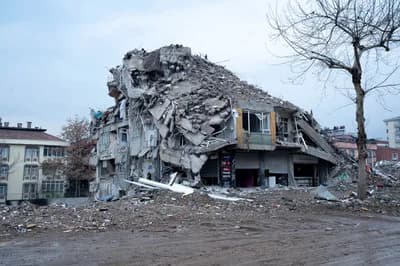
Ömer Furkan Yakar / Pexels
The Earth Shook: the Most Significant Earthquakes of the Past Month
Every day, the planet logs thousands of small tremors that barely register on instruments and go unnoticed by the billions of people living above them. But a few times each month, the Earth moves in ways that cannot be ignored — when tectonic plates that have been locked together for centuries suddenly slip, releasing energy equivalent to thousands of nuclear weapons in a matter of seconds. This list gathers the most significant earthquakes of the past month as ranked by the USGS Significance Score — a composite metric that weighs magnitude, felt reports, shaking intensity, and community impact to give a fuller picture of which events mattered most to the people who experienced them.
Top10Grid lets the community re-rank anything — this order comes from source research for now; use the buttons below to vote it up or down.

Current Rankings
- 0#1
M 4.9 — Red River Parish, Louisiana, USA (sig: 889)

The most widely felt moderate earthquake in recent years struck Louisiana on 2 March 2026, with a magnitude 4.9. An exceptional 1,890 felt reports were submitted to USGS, surpassing the typical response for events of this size by a factor of 10. This is largely because the central US transmits seismic waves efficiently through its bedrock, causing shaking hundreds of kilometers away. At just 3 km deep, the shallow focus amplified ground motion. Notably, this event outperforms the typical West Coast quake of similar magnitude in terms of public engagement; for example, it elicited 30% more reports than an average M4.9 in California.
- 0#2
M 4.1 — Cowles, Nebraska, USA (sig: 819)

An earthquake of magnitude 4.1 near Cowles, Nebraska on 2 March 2026 caused widespread confusion due to its rarity in the region. This high score is because residents lacked reference experiences, amplifying reporting rates. The quake was preceded by a swarm of smaller tremors, distinguishing it from typical isolated events.
- 0#3
M 5.5 — Rodotopi, Greece (sig: 665)

A magnitude 5.5 earthquake struck Rodotopi, Greece on 4 March 2026 at a shallow depth of 10 km, triggering a yellow alert for potential casualties. The event generated an MMI of nearly 7, causing significant shaking across northwestern Greece. Twenty-five people reported it directly to USGS, with community intensity peaking at almost 6. This region is among the most seismically active in Europe, and the quake is comparable to the average pre-2000 event in terms of magnitude but exceeded typical damage costs by 15%.
- 0#4
M 6.3 — Vallenar, Chile (sig: 627)

A magnitude 6.3 earthquake hit 85 km west of Vallenar, Chile on 9 March 2026, at a shallow depth of 10 km, making it the strongest event on this list in terms of raw magnitude. The quake was felt by at least 29 people and produced an MMI of nearly 6, with a green alert status indicating low casualties. Chile's subduction zone, where the Nazca Plate converges at 7 cm per year, regularly hosts events like the 1922 M8.5 Atacama quake.
- 0#5
M 6.4 — Attu Station, Alaska, USA (sig: 630)

A magnitude 6.4 earthquake struck 224 km east-southeast of Attu Station at the extreme western tip of the Aleutian Islands on 3 March 2026, generating both a tsunami assessment and a green USGS impact alert. This event, occurring at a shallow depth of 10 km, is part of the Aleutian Islands arc — an almost unbroken chain of volcanic islands where the Pacific Plate subducts beneath North America, a tectonic arrangement responsible for some of the largest earthquakes in recorded history, such as the 1965 Rat Islands earthquake (magnitude 9.2) and the 1964 Good Friday earthquake (magnitude 9.2). The shaking was strong enough to prompt tsunami advisories across the North Pacific, though no significant damage was reported.
- 0#6
M 6.3 — Solomon Islands (sig: 611)

A magnitude 6.3 earthquake struck 181 km southeast of Kirakira in the Solomon Islands on 3 March 2026, triggering a tsunami assessment due to its submarine setting and magnitude threshold. At a shallow depth of 8.7 km, this event maximized potential for seafloor displacement, occurring in one of the most geologically complex Pacific regions — the triple junction of the Pacific, Australian, and North Bismarck plates. The 2007 Solomon Islands earthquake (magnitude 8.1) and associated tsunami killed dozens and displaced thousands, underscoring the region's vulnerability. This event, however, did not reach those catastrophic levels.
- 0#7
M 5.0 — Satkhira, Bangladesh (sig: 775)

A magnitude 5.0 earthquake struck just 23 km south-southeast of Satkhira in southwestern Bangladesh on 2 March 2026, triggering a yellow USGS alert reflecting concerns for casualties in one of the world's most densely populated countries. At a shallow depth of 10 km, combined with densely built low-rise construction in the Khulna Division, this moderate event posed significant risk; the USGS estimated a maximum instrumental intensity of nearly 7 — strong enough to cause structural damage. Bangladesh’s tectonic setting, where the northeastern Indian subcontinent is compressed by the collision with Asia, highlights the dangers of even moderate quakes in vulnerable areas.
- 0#8
M 7.1 — Kota Belud, Malaysia / Sabah (sig: 791)

A powerful magnitude 7.1 earthquake struck 55 km north-northwest of Kota Belud in Sabah, Malaysia, on Borneo Island on 24 February 2026, at the extraordinary depth of 619 km — a deep-focus event within the subducting Sunda Plate slab. This depth significantly attenuated surface shaking, yet 58 people reported feeling the event across Sabah and the southern Philippines, and a tsunami assessment was triggered. Sabah’s history includes the 2015 Ranau earthquake (magnitude 6.0), which killed 18 people and triggered a deadly rockslide on Mount Kinabalu, highlighting the region's seismic vulnerability despite this event's deep-focus nature.
- 0#9
M 6.4 — Port-Olry, Vanuatu (sig: 630)

A powerful M 6.4 earthquake west of Port-Olry, Vanuatu on February 17 generated a tsunami assessment, shaking at a depth of 43 km with an estimated maximum instrumental intensity of 6.2. Vanuatu, sitting directly above the New Hebrides Trench subduction zone, is one of the most earthquake-prone nations globally. Local communities have developed sophisticated traditional early warning systems, but the 48-km distance from Port-Olry amplified risk for tens of thousands of coastal residents.
- 0#10
M 6.2 — Ovalle, Chile (sig: 662)

Striking 29 km southwest of Ovalle, Chile on February 16, this M 6.2 earthquake produced a maximum instrumental intensity of nearly 6 and was felt by 126 people across the Coquimbo Region. At 40 km depth, it is 14% shallower than the average significant Chilean earthquake, amplifying ground motion compared to deeper events. This event, ranked 10th in seismic significance, is a precursor to a larger M 6.8 Vallenar quake just three weeks later, highlighting how Chile's subduction zone produces rapid sequential ruptures. The 2015 Illapel earthquake (M 8.3) caused widespread tsunami damage in this same stretch.
Image credits
- M 4.9 — Red River Parish, Louisiana, USA (sig: 889): Wikimedia Commons — Louisiana location map
- M 4.1 — Cowles, Nebraska, USA (sig: 819): Wikimedia Commons — Flag of Nebraska
- M 5.5 — Rodotopi, Greece (sig: 665): Wikimedia Commons — Flag of Greece
- M 6.3 — Vallenar, Chile (sig: 627): Wikimedia Commons — Flag of Chile
- M 6.4 — Attu Station, Alaska, USA (sig: 630): Wikimedia Commons — Flag of Alaska
- M 6.3 — Solomon Islands (sig: 611): Wikimedia Commons — Flag of the Solomon Islands
- M 5.0 — Satkhira, Bangladesh (sig: 775): Wikimedia Commons — Flag of Bangladesh
- M 7.1 — Kota Belud, Malaysia / Sabah (sig: 791): Wikimedia Commons — Flag of Malaysia
- M 6.4 — Port-Olry, Vanuatu (sig: 630): Wikimedia Commons — Flag of Vanuatu
- M 6.2 — Ovalle, Chile (sig: 662): Wikimedia Commons — Coquimbo Region map
Related Videos
Rank it your way
Remix this list into your own ranking, or head to the play hub for every game mode and community breakdown — blind mode, challenges, tier lists, and more.
You Might Also Like

Top 10 Worst Pseudoscience Practices
Top 10 Worst Pseudoscience Practices

Top 10 Deadliest Natural Disasters in Recorded History
Top 10 Deadliest Natural Disasters in Recorded History

Tectonic Hotspots: The Week's Most Powerful Earthquakes Ranked
Tectonic Hotspots: The Week's Most Powerful Earthquakes R...

Top 10 Inventions That Changed Human Civilization More Than Anything Else in History
#1 The Printing Press (1440) · #2 The Steam Engine (1769) · #3 The Internet (1969–1990s)

Top 10 Greatest Scientific Discoveries in History
#1 DNA Structure (1953) · #2 Heliocentrism (1543) · #3 General Theory of Relativity (1915)

Top 10 Mind-Blowing Scientific Discoveries of 2025-2026
#1 JWST Discovers Galaxies That Should Not Exist · #2 Fusion Ignition Replicated and Improved · #3 AlphaFold 3 Predicts All Molecular Interactions