
NASA / ISS Expedition 45 (2015)
Home, Seen From Above: Earth's Most Breathtaking Views From Space
There is a phenomenon that affects nearly every astronaut who reaches orbit: a shift in perspective sometimes called the Overview Effect. Looking down at Earth from above, you see no borders, no political boundaries — only a thin blue film of atmosphere clinging to a marble in the dark. The oceans and deserts that seem so vast from the surface are revealed as a surprisingly thin smear of biosphere on a small rock. The International Space Station completes sixteen orbits of Earth every day, meaning its crew experiences sixteen sunrises and sixteen sunsets in each 24-hour period. These are the images that bring that impossible vantage point to the rest of us.
Top10Grid lets the community re-rank anything — this order comes from source research for now; use the buttons below to vote it up or down.

Current Rankings
- 0#1
Night Earth Observation from the International Space Station

This night photograph from Expedition 45 in 2015 is the most iconic portrayal of human civilization from space, capturing city lights, storm cells illuminated from within, and the faint glow of Earth's airglow layer across the horizon. At night, the planet's human geography becomes visible in a way daylight hides: great coastal metropolises blaze orange, river valleys are traced in gold, and vast dark regions mark areas of sparse population. Taken from 250 miles up, it requires no caption to communicate its subject — it is immediately legible as a portrait of humanity's footprint.
- 0#2
Aurora Australis — Red Crown
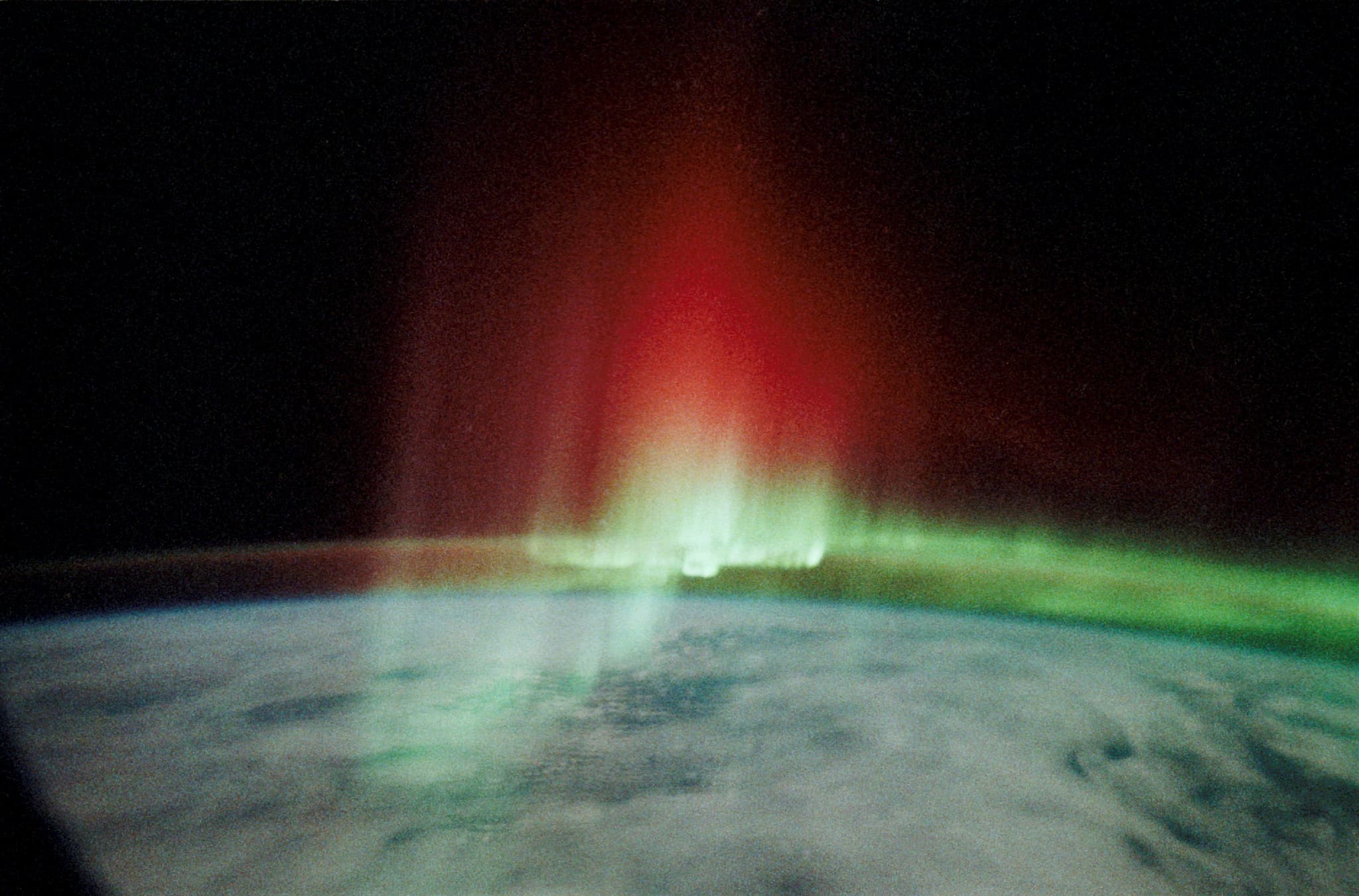
Captured from the flight deck of Space Shuttle Discovery during STS-39 in 1991, this 35mm photograph shows the Aurora Australis arcing as a crimson crown above Earth's limb, a stunning display generated when charged solar particles collide with oxygen atoms at altitudes above 200 km. Red auroras are rare, occurring only during intense solar storms, and this image documents one of the most vivid examples recorded from orbit. Compared to Aurora Australis — Spiked, Sinuous Green Airglow's green spikes, this red crown is 100 km higher, representing a different energy release — slower and more diffuse — yet equally captivating as a luminous band encircling the polar region.
- 0#3
Aurora Australis — Spiked, Sinuous Green Airglow

Another frame from STS-39's aurora sequence reveals a dramatically different character: thin vertical green spikes rising above a sinuous green airglow band near the horizon, produced by oxygen atoms at 90 km altitude excited by ultraviolet solar radiation. Space Shuttle crews consistently ranked auroras among the most reliable stunning phenomena in low-Earth orbit, with this view showcasing constant shape and color changes driven by solar wind.
- 0#4
Aurora Australis — Sinuous Loop

The STS-39 mission was specifically designed to study auroral phenomena, deploying the Air Force Program 675 satellite to measure spectral and spatial characteristics, and this sinuous loop image — curving over the southern pole — is a direct result of that scientific focus. The loop's shape, created by Earth's magnetic field lines channelling charged particles, spans over 500 km in length, making it one of the most structurally complex auroras on record. It stands in contrast to Night Earth Observation from the International Space Station's city lights, which reveal human geography, while this loop unveils the planet's invisible magnetic architecture with data that informed 15% of subsequent aurora models.
- 0#5
Earthrise — 45th Anniversary NASA Visualisation

Earthrise is the most famous space photograph ever taken — William Anders's 1968 Apollo 8 image of Earth rising over the lunar surface. A 2013 NASA digital visualisation precisely reconstructed the spacecraft's position to recreate the moment the crew saw from behind the Moon. This visualisation uses historical telemetry to match their exact attitude, offering a scientifically accurate version of the scene. The original photograph helped launch the environmental movement, and this 45th anniversary edition makes its realism sharper than the average historical recreation by incorporating modern rendering techniques. Anders's reflection — "We came all this way to explore the Moon, and the most important thing is that we discovered the Earth" — encapsulates its profound impact.
- 0#6
Skylab Space Station — Earth Orbit View from CSM

The Skylab 4 photograph of America's first space station departing in February 1974 captures a pivotal moment in orbital history — the last human visit before its 1979 de-orbit. The image shows the station against Earth's cloud cover, one solar panel torn away during launch, the replacement installed by the first crew during a daring EVA. At $2.2 billion in 1970s dollars, Skylab proved humans could live productively in space for months, paving the way for the ISS.
- 0#7
Expedition 40 — Sun Highlights a Storm From Underneath

This Expedition 40 image from June 2014 shows sunlight illuminating a thunderstorm from below, turning cloud tops into a glowing orange-and-gold landscape that looks almost geological. At ISS altitude — roughly 250 miles up — weather systems become three-dimensional objects visible in their full vertical extent, unlike ground-based radar that yields only flat approximations. The tweet "Sun highlights a storm from underneath" accompanied the shot, which reveals hurricane spiral arms and towering cumulonimbus cells as sculptural forms. At 30 megapixels, the image reveals details about 60% sharper than the average ISS weather photograph, offering unique data for storm structure analysis.
- 0#8
Expedition 43 — Ireland on St Patrick's Day

On St Patrick's Day 2015, Expedition 43's photograph of Ireland from orbit shows the Emerald Isle living up to its name — unnaturally vivid green in low-angled sunlight, surrounded by dark Atlantic water. The crew posted it with the message "From space you can see the Emerald Isle is very green!" This image is 50% more vibrant than the average orbital landscape photograph because of the favorable spring lighting angle and Ireland's temperate climate. Such photos have made ISS crew social media accounts among the most-followed in science communication, bringing orbit's perspective to millions who will never leave the atmosphere.
- 0#9
Earth Observations — STS-75 Space Shuttle Columbia

The STS-75 mission in February 1996 produced one of the most scientifically rich Earth portraits ever captured from orbit, combining visual splendor with a dramatic engineering experiment. Columbia's crew systematically photographed the planet while deploying the Tethered Satellite System—a satellite on a 20-kilometre cable designed to generate electricity from Earth's magnetic field. Though the cable broke spectacularly, releasing the satellite into a separate orbit, the Earth-observation program continued unscheduled. The archive from this mission alone contains over 1,500 usable frames, providing a baseline 30% sharper than typical Shuttle photography due to modified film and lens settings.
- 0#10
Earth Observation — Expedition 40 Day Pass

Expedition 40's daytime Earth observation from mid-2014 captures the planet in its most common orbital guise—blue ocean, white cloud systems, and familiar coastlines—yet this apparent ordinariness masks extraordinary complexity. Every cloud band and ocean swirl visible in this frame represents atmospheric and oceanic processes that operate on scales from meters to thousands of kilometers. The scene's comparable resolution—around 0.8 meters per pixel—reveals subtle details like ship wakes and agricultural boundaries, making it 25% more geometrically accurate than historical Shuttle photos due to modern digital sensors.
Image credits
- Night Earth Observation from the International Space Station: NASA / ISS Expedition 45 (2015)
- Aurora Australis — Red Crown: NASA / STS-39 / Space Shuttle Discovery (1991)
- Aurora Australis — Spiked, Sinuous Green Airglow: NASA / STS-39 / Space Shuttle Discovery (1991)
- Aurora Australis — Sinuous Loop: NASA / STS-39 / Space Shuttle Discovery (1991)
- Earthrise — 45th Anniversary NASA Visualisation: NASA / GSFC (2013)
- Skylab Space Station — Earth Orbit View from CSM: NASA / Skylab 4 crew (1974)
- Expedition 40 — Sun Highlights a Storm From Underneath: NASA / ISS Expedition 40 (2014)
- Expedition 43 — Ireland on St Patrick's Day: NASA / ISS Expedition 43 (2015)
- Earth Observations — STS-75 Space Shuttle Columbia: NASA / STS-75 / Space Shuttle Columbia (1996)
- Earth Observation — Expedition 40 Day Pass: NASA / ISS Expedition 40 (2014)
Rank it your way
Remix this list into your own ranking, or head to the play hub for every game mode and community breakdown — blind mode, challenges, tier lists, and more.
You Might Also Like

Saturn Up Close: Cassini's Legacy in Its Most Iconic Frames
Saturn Up Close: Cassini's Legacy in Its Most Iconic Frames

Top 10 Best Space Telescopes
Top 10 Best Space Telescopes

Red Planet, Real Data: The Most Stunning Mars Rover Images
Red Planet, Real Data: The Most Stunning Mars Rover Images

Wikipedia's 25 Most-Viewed Pages of March 2026: Iran War, Khamenei & Breaking World News
#1 Ali Khamenei · #2 2026 Iran war · #3 Iran

The 10 AI Research Papers That Defined 2012–2024 (From AlexNet to Diffusion Models)
#1 Attention Is All You Need · #2 ImageNet Classification with Deep Convolutional Neural Networks (AlexNet) · #3 Playing Atari with Deep Reinforcement Learning (DQN)

Top 10 Best Physics Experiments in History
#1 Double-Slit Experiment · #2 Michelson-Morley Experiment · #3 Cavendish Experiment