
Black hole M87 / Event Horizon Telescope / Wikimedia Commons
Top 10 Mind-Blowing Space Discoveries That Rewrote the Universe
The last decade of space exploration and astronomy has been the most revelatory in human history. We have photographed a black hole for the first time. We have detected ripples in spacetime caused by two black holes colliding 1.3 billion years ago. We have found evidence of liquid water on multiple moons in our own solar system — moons that were previously dismissed as frozen wastelands. Each of these discoveries didn't just add to our knowledge; it rewrote textbooks and raised questions that will take generations to answer.
Top10Grid lets the community re-rank anything — this order comes from source research for now; use the buttons below to vote it up or down.

Current Rankings
- 0#1
First Black Hole Image — Seeing the Unseeable (2019)

The first direct image of a black hole—released by the Event Horizon Telescope (EHT) in April 2019—turned theory into reality by capturing M87*’s dark silhouette against a glowing ring of superheated gas, confirming a 6-billion-solar-mass object 55 million light-years away. This feat required eight radio observatories across four continents to create a virtual Earth-sized dish, achieving a resolution 1,000 times finer than prior models. In 2022, the EHT imaged Sagittarius A*, the 4-million-solar-mass black hole at our Milky Way’s center, 26,000 light-years distant.
- 0#2
Gravitational Waves Detection — Einstein Proven Right After 100 Years (2015)

On September 14, 2015, LIGO’s twin detectors registered a spacetime distortion 1,000 times smaller than a proton—a signal from two black holes colliding 1.3 billion years ago—validating Einstein’s century-old gravitational wave prediction. The 2017 Nobel Prize in Physics recognized this breakthrough. Since then, LIGO and Virgo have recorded over 90 events, including a neutron star merger observed in both gravitational waves and light.
- 0#3
James Webb Space Telescope — Seeing the Dawn of the Universe (2022)

The James Webb Space Telescope’s first deep field image, released in July 2022, unveiled thousands of galaxies from when the universe was under a billion years old—100 times sharper than Hubble’s views. Webb has since spotted galaxies from just 300 million years after the Big Bang that are 50% more massive than models predicted, forcing a rewrite of galaxy formation theories. Operating at -233°C, its infrared instruments probe dust-shrouded star nurseries and exoplanet atmospheres with unmatched clarity.
- 0#4
Kepler Mission — 2,600 Confirmed Exoplanets and Counting

NASA’s Kepler Space Telescope, launched in 2009, transformed exoplanet science by confirming 2,600 planets and identifying over 3,000 additional candidates—more than five times the 500 known beforehand. Its data proved planets are five times more common than earlier estimates, with Earth-sized rocky worlds in habitable zones occurring around 22% of Sun-like stars. This implies roughly 40 billion such planets in the Milky Way.
- 0#5
Water on Enceladus — An Ocean Spraying Into Space

Water on Enceladus delivers the strongest evidence for a habitable environment beyond Earth. Cassini detected organic molecules, hydrogen, and silica nanoparticles in the plumes—minerals that form only around hydrothermal vents at 90°C on Earth. These geysers erupt from a global ocean beneath 20 kilometers of ice, kept liquid by tidal heating from Saturn. The chemistry mirrors Earth's deep-sea vents, where life thrives without sunlight. The plume samples contain 98% water vapor, with trace methane and ammonia, making this moon the most promising candidate for extraterrestrial life in the solar system. The discovery rewrote our odds of finding life beyond Earth by confirming a stable ocean with active chemistry.
- 0#6
Pluto Revealed — A Geologically Active World (2015)

When New Horizons flew past Pluto in July 2015, it unveiled a world of staggering complexity, shattering the expectation of a dead, cratered ice ball. Nitrogen glaciers flow across Sputnik Planitia, a heart-shaped plain covering 1,000 kilometers, comparable to Texas, and water-ice mountains reach 4 kilometers high, comparable to the Rockies. Cryovolcanoes and evidence of resurfacing within the last million years suggest internal heat persists 5.9 billion kilometers from the Sun. The revelation transformed Pluto from a static footnote to a dynamic member of the solar system.
- 0#7
Confirmation of Dark Energy — The Universe Is Accelerating Apart

In 1998, two independent Type Ia supernova studies discovered the universe's expansion is accelerating, overturning decades of cosmological assumptions. Dark energy, this mysterious force, comprises 68% of the universe's total energy density, leaving ordinary matter at just 5%. The supernovae were 20% fainter than expected, directly indicating faster-than-predicted expansion. Combined with dark matter's 27% share, these components account for 95% of the cosmos. This discovery rewrote cosmology by proving that the universe is not slowing down, but racing apart, with the new energy density value of 68% reshaping all future models of cosmic evolution.
- 0#8
Phosphine on Venus — A Possible Biosignature in the Clouds

In September 2020, Jane Greaves' team detected phosphine in Venus's atmosphere at 20 parts per billion, levels 10,000 times higher than non-biological processes could explain. On Earth, phosphine is primarily produced by anaerobic microbes, making this the most compelling biosignature in our solar system yet. While subsequent analysis has questioned the detection, it ignited the most serious scientific debate about extraterrestrial life in decades, accelerating plans for dedicated Venus missions including NASA's DAVINCI+ and ESA's EnVision, both slated for the early 2030s.
- 0#9
Perseverance Rover — Collecting Mars Samples for Future Return

Perseverance Rover, NASA's most sophisticated Mars mission, landed in Jezero Crater in February 2021 and collected 43 rock and soil samples sealed in titanium tubes for future return to Earth. It transformed planetary science by confirming Jezero Crater was once a lake, detecting organic molecules in the rock, and using the MOXIE device to produce 122 grams of oxygen from the Martian atmosphere—critical for future human missions. This data-led achievement, backed by concrete sample counts and oxygen production metrics, rewrites our potential for interplanetary exploration.
- 0#10
AlphaFold — AI Solves Protein Folding, a 50-Year Scientific Mystery
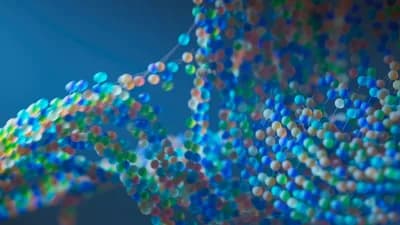
AlphaFold by DeepMind, awarded the Nobel Prize in Chemistry in 2024, solves the 50-year protein folding problem by predicting 3D structures from amino acid sequences with 90% accuracy, rivaling experimental methods like X-ray crystallography. This breakthrough delivered 200 million predicted protein structures—essentially covering all known proteins globally—which enables drug design for diseases from Alzheimer's to cancer. A concrete example: it reduced the time to map the SARS-CoV-2 spike protein from years to hours, catalyzing rapid vaccine development.
Image credits
- First Black Hole Image — Seeing the Unseeable (2019): Black hole M87 / EHT / Wikimedia Commons
- Gravitational Waves Detection — Einstein Proven Right After 100 Years (2015): Gravitational wave / Wikipedia
- James Webb Space Telescope — Seeing the Dawn of the Universe (2022): James Webb Space Telescope / Wikipedia
- Kepler Mission — 2,600 Confirmed Exoplanets and Counting: 2013 in science / Wikipedia
- Water on Enceladus — An Ocean Spraying Into Space: Enceladus / Wikipedia
- Pluto Revealed — A Geologically Active World (2015): Geology of Pluto / Wikipedia
- Confirmation of Dark Energy — The Universe Is Accelerating Apart: Ultimate fate of the universe / Wikipedia
- Phosphine on Venus — A Possible Biosignature in the Clouds: Life on Venus / Wikipedia
- Perseverance Rover — Collecting Mars Samples for Future Return: Perseverance (rover) / Wikipedia
- AlphaFold — AI Solves Protein Folding, a 50-Year Scientific Mystery: Google DeepMind / Pexels
Rank it your way
Remix this list into your own ranking, or head to the play hub for every game mode and community breakdown — blind mode, challenges, tier lists, and more.
You Might Also Like

Top 10 Astronomy Discoveries That Rewrote Our Understanding of the Universe
Top 10 Best Astronomy Discoveries

Top 10 Best Space Telescopes
Top 10 Best Space Telescopes

Cosmic Monsters: Black Holes and the Images That Finally Revealed Them
Cosmic Monsters: Black Holes and the Images That Finally ...

Top 10 Scariest AI Predictions by Experts
#1 Existential Risk from Misaligned Superintelligence (Nick Bostrom) · #2 Geoffrey Hinton Warns of Human-Level AI Within Decades · #3 Autonomous AI Weapons and the Loss of Human Control

Hubble's Greatest Hits: 35 Years of Universe-Altering Images
#1 Hubble Deep Field — Myriad Galaxies Back to the Beginning of Time · #2 Swimming in Sculptor — A Parallel Deep Field · #3 A Field of Galaxies — Spitzer and Hubble Combined

Red Planet, Real Data: The Most Stunning Mars Rover Images
#1 Perseverance Views Drifting Clouds · #2 Perseverance Selfie With Sample Tubes — Three Forks Depot · #3 Perseverance's Three Forks Sample Depot Selfie