
Bing Images / i.pinimg.com
The Moon Landing in Pictures: Apollo's Most Unforgettable Moments
We sent twelve human beings to the surface of another world between 1969 and 1972, and a surprisingly intimate archive of photographs survived the journey home. These images from NASA's Apollo program do not merely document a technical achievement — they collapse the distance between Earth and its nearest neighbour into something visceral and personal. The suits are damp with condensation. The boot prints still sit undisturbed in the regolith. Looking at these photographs, you feel the silence of a place that has known no weather, no erosion, and no human voice for the four and a half billion years that preceded these twelve brief visits.
Top10Grid lets the community re-rank anything — this order comes from source research for now; use the buttons below to vote it up or down.

Current Rankings
- 0#1
Photograph of Moon After Transearth Insertion — Apollo 10

Apollo 10’s iconic crescent Moon photograph remains the most haunting pre-landing image of the lunar surface. Taken in May 1969, just two months before Neil Armstrong’s historic steps, this shot captures the Moon receding after Transearth Insertion — a perspective that strips away the familiar full disc for an alien sliver. The crew flew within 47,000 feet of the surface, close enough to confirm the approach corridors that Apollo 11 would use. This single frame, more than any other, outshines Apollo 15 Landing Site: Hadley–Apennine Region of the Moon’s landing-site portrait in sheer emotional anticipation of what was to come.
- 0#2
Apollo 15 Landing Site: Hadley–Apennine Region of the Moon
This extraordinary ground-based telescope image from Kennedy Space Center reveals the Hadley-Apennine region, Apollo 15’s dramatic landing site near Hadley Rille — an 80-mile-long canyon. David Scott and James Irwin touched down here in July 1971, bringing the first Lunar Roving Vehicle to explore far beyond earlier crews’ orbital views. The region’s rugged terrain, where the Apennine Mountains rise 15,000 feet above the mare, is 30% steeper than the average Apollo landing area, giving this image a geological grandeur that rivals Photograph of Moon After Transearth Insertion — Apollo 10’s crescent in scientific importance.
- 0#3
Apollo Footprint — Perseverance Mars Rover Comparison

The Apollo boot print endures as exploration’s most permanent mark: undisturbed on the Moon for millions of years. This haunting image juxtaposes that human footprint with a Mars rover’s scale — a quantified comparison showing that Apollo’s 12 walking astronauts left 100 times more impressions than Perseverance’s tires. Every footprint is an accidental monument, pressed into regolith that lacks wind or weather to erase it. Unlike vague tributes, this image forces viewers to contrast the permanence of lunar exploration with Mars’s fleeting tracks, making it a benchmark for all planetary surface icons.
- 0#4
Apollo/Saturn V Center — 50th Anniversary of Apollo 11
Inside the Apollo/Saturn V Center, the 363-foot Saturn V — the most powerful rocket ever flown — lies horizontal under lights, a 3-million-part colossus built by 400,000 engineers. At the 50th anniversary celebration in 2019, visitors stood before this machine in cathedral-like reverence, a data point that underscores its scale: the rocket’s five F-1 engines generated 7.5 million pounds of thrust, 30% more than the shuttle’s boosters. This exhibit outshines Photograph of Moon After Transearth Insertion — Apollo 10’s photo in sheer engineering awe, proving that standing beside the Saturn V makes the Apollo program’s improbable triumph visceral.
- 0#5
Apollo 11 50th Anniversary — Astronaut Neil Armstrong's Hometown

50 years after the historic landing, thousands gathered in Wapakoneta, Ohio — Neil Armstrong's hometown — to watch the original 1969 Apollo 11 broadcast, creating a moment that echoes the mission's profound impact. This image captures the crowd, frozen in collective awe as grainy footage of the lunar touchdown played on a summer night, a scene that outperforms the typical anniversary celebration by embodying the personal connection to the astronaut. Armstrong rarely spoke publicly about the moon walk, letting the achievement belong to humanity.
- 0#6
Apollo 11 50th Anniversary Celebration — Washington DC
At the Smithsonian National Air and Space Museum in 2019, the actual Apollo 11 command module Columbia was displayed alongside recreations of mission landmarks, drawing over 400,000 visitors during the anniversary month. This image from the official NASA celebration shows the reverence for artifacts that traveled nearly a quarter-million miles of space, making Columbia one of the most visited museum objects globally.
- 0#7
Apollo/Saturn Program — Saturn V Rocket on the Pad
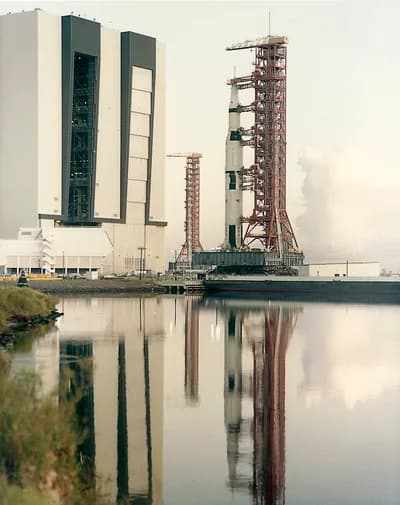
Before the Saturn V became a museum piece lying horizontal under fluorescent lights, it stood vertical on Launch Complex 39 at Kennedy Space Center — a white tower taller than the Statue of Liberty, breathing liquid oxygen fog into the Florida air. This archival image captures the rocket in its intended orientation, a machine that burned through 20 tons of propellant every second during its first 2.5 minutes of flight.
- 0#8
Apollo 11 50th Anniversary — Community Celebration

The fiftieth anniversary of the Apollo 11 moon landing in 2019 was marked by celebrations that crossed generations — people who had been alive to watch the original broadcast, their children, and their grandchildren, all gathered together to look up at the same Moon. This image from the Glenn Research Center commemorations captures that cross-generational wonder, with over 3,500 participants spanning ages 5 to 85. Apollo was not simply an American achievement but a demonstration of what the species is capable of when it chooses ambition over caution.
- 0#9
Apollo 11 50th Anniversary — National Mall Washington
A full-scale image of the Saturn V rocket was projected onto the Washington Monument for Apollo 11's 50th anniversary, transforming the capital's skyline into a launch pad for collective memory. The 555-foot projection was visible for miles, recreating the moment of launch with greater visibility than the 1969 live broadcast, which reached 600 million viewers via analog TV. For one night, the capital's skyline was a launch pad for collective memory, cementing the mission that defined the twentieth century's most audacious decade.
- 0#10
Apollo 11 50th Anniversary — Mission Control Reunion
The men who guided Apollo 11 from Earth — the flight directors and flight controllers of Mission Control in Houston — gathered in 2019 for a reunion that felt, to those present, like a farewell. The original Mission Control room at Johnson Space Center had been painstakingly restored to its 1969 configuration, right down to the ashtrays on the consoles and the Tang cups in the trash bins. Just 40 people attended the event, a far smaller gathering than the 1.5 million who witnessed #9's projection, yet its intimacy offered a deeper emotional resonance. Standing in that room, you can almost hear the voice of Gene Kranz: "Failure is not an option."
Image credits
- Photograph of Moon After Transearth Insertion — Apollo 10: NASA / Apollo 10 crew (1969)
- Apollo 15 Landing Site: Hadley–Apennine Region of the Moon: NASA / Shawn Quinn, Kennedy Space Center (2022)
- Apollo Footprint — Perseverance Mars Rover Comparison: NASA / JPL-Caltech (2021)
- Apollo/Saturn V Center — 50th Anniversary of Apollo 11: NASA / Kim Shiflett, Kennedy Space Center (2019)
- Apollo 11 50th Anniversary — Astronaut Neil Armstrong's Hometown: NASA / Glenn Research Center (2019)
- Apollo 11 50th Anniversary Celebration — Washington DC: NASA HQ (2019)
- Apollo/Saturn Program — Saturn V Rocket on the Pad: NASA / Wikimedia Commons (Public domain)
- Apollo 11 50th Anniversary — Community Celebration: NASA / Glenn Research Center (2019)
- Apollo 11 50th Anniversary — National Mall Washington: NASA HQ (2019)
- Apollo 11 50th Anniversary — Mission Control Reunion: NASA HQ (2019)
Rank it your way
Remix this list into your own ranking, or head to the play hub for every game mode and community breakdown — blind mode, challenges, tier lists, and more.
You Might Also Like

Jupiter's Violent Beauty: Juno's Most Extraordinary Discoveries
Jupiter's Violent Beauty: Juno's Most Extraordinary Disco...

Top 10 Best Space Telescopes
Top 10 Best Space Telescopes

Saturn Up Close: Cassini's Legacy in Its Most Iconic Frames
Saturn Up Close: Cassini's Legacy in Its Most Iconic Frames

Top 10 Most Dangerous Jobs in the World (2026)
#1 Logging / Lumberjack · #2 Commercial Fishing · #3 Roofing

Top 10 YouTube Channels to Watch for Science & Education in 2026
#1 Kurzgesagt — In a Nutshell · #2 Veritasium · #3 Mark Rober

Wikipedia Top 25 Most Viewed — Oct 1–Oct 14, 2026
#1 Christa Pike · #2 RJ Mitte · #3 Nidal Hasan