
NASA / JPL-Caltech / Space Science Institute / Cassini (2017)
Saturn Up Close: Cassini's Legacy in Its Most Iconic Frames
The Cassini spacecraft arrived at Saturn in July 2004 and spent thirteen years in orbit around the ringed planet, making 294 orbits and returning nearly half a million images before plunging deliberately into Saturn's atmosphere in September 2017. Everything we know about Saturn's rings, moons, storms, and polar hexagon in rich detail comes from Cassini. It discovered active geysers on the moon Enceladus — jets of water ice erupting from a subsurface ocean — and found methane lakes on Titan. When mission planners decided to end the mission by flying Cassini into the atmosphere rather than risk contaminating an ocean moon, some team members described it as the saddest day of their careers. These are the images that explain why.
Top10Grid lets the community re-rank anything — this order comes from source research for now; use the buttons below to vote it up or down.

Current Rankings
- 0#1
Cassini "Noodle" Mosaic of Saturn — Grand Finale First Dive

The Cassini 'Noodle' Mosaic from the Grand Finale’s first dive captures the spacecraft's most daring achievement: plunging through the unexplored gap between Saturn's innermost rings and its atmosphere. On April 26, 2017, the dive survived intact, proving the zone was debris-free for 21 subsequent passes. This mosaic reveals a 3,000-kilometer swath of Saturn's atmosphere, from the north polar vortex to banded layers and hexagonal jet-stream vortices.
- 0#2
Cassini Near-Infrared "Noodle" Mosaic — Grand Finale June 2017

This near-infrared 'Noodle' mosaic, from a June 29, 2017 Grand Finale dive, offers the deepest atmospheric penetration of any Cassini image. Using 30 frames at wavelengths that cut through haze, it unveils circulation patterns and chemical gradients hidden in visible light—structures never before seen in such detail. The 40% higher contrast than typical visible-light captures reveals deeper cloud layers.
- 0#3
Cassini Orbiting Saturn — Mission Illustration

This illustration of Cassini orbiting Saturn during its Grand Finale symbolizes the mission's boldest phase: 22 dives between rings and atmosphere from April to September 2017. Each pass sent data on ring particles and magnetic fields from this previously unexplored zone. On September 15, 2017, at 7:55 AM Eastern Time, Cassini disintegrated above Saturn's clouds, ending a 13-year study. Unlike a photograph, this depiction is 30% more accurate than typical artistic renderings, based directly on telemetry from the final orbit path.
- 0#4
Polar Lights at Saturn Bid Cassini Farewell

Captured on September 14, 2017—just one day before its final plunge—Cassini’s Ultraviolet Imaging Spectrograph recorded this last view of Saturn's northern auroral ring. The false-color image maps ultraviolet brightness, showing a continuous oval of charged particles, driven by a magnetic field 578 times stronger than Earth’s and ten times larger in scale. This auroral snapshot is 50% brighter in ultraviolet intensity than the average Saturnian aurora observed during the mission.
- 0#5
Saturn from Far and Near — Cassini-Huygens Early Approach

Cassini's May 2004 approach shot, taken two months before orbital insertion, delivers the mission's most iconic early view of Saturn in full glory. From a distance of about 28 million kilometers, the image reveals banded cloud layers, the ring system's shadow on the planet's face, and the rings' intricate structure. After a nearly seven-year journey launched in 1997, including gravity-assist flybys of Venus (twice), Earth, and Jupiter, Cassini captured this scene with a narrow-angle camera at a resolution of 11 kilometers per pixel.
- 0#6
The Adventure Ahead — Saturn's Shadow Across the Rings

This December 2004 image captures Saturn's shadow stretching dramatically across the ring plane, a geometry impossible from Earth. The elliptical footprint, about 120,000 kilometers long at the rings, elongates toward the viewer as the sphere's shadow falls on a flat disc. Such compositions made the public grasp Cassini's unique orbital perspective. The shadow's precise alignment reveals ring particle density variations, a detail less visible in #5's approach shot.
- 0#7
F Ring Patterns — Prometheus Sculpts Saturn's Rings

Prometheus's gravitational drag creates distinctive ripples in Saturn's F ring, a structure only 500 kilometers wide yet visible as a bright strand. In this image, the shepherd moon's regular passes drag material inward, forming channels and streamers at distances of about 140,000 kilometers from Saturn's center.
- 0#8
Saturn Polar Jet — Cassini Views the North Polar Hexagon
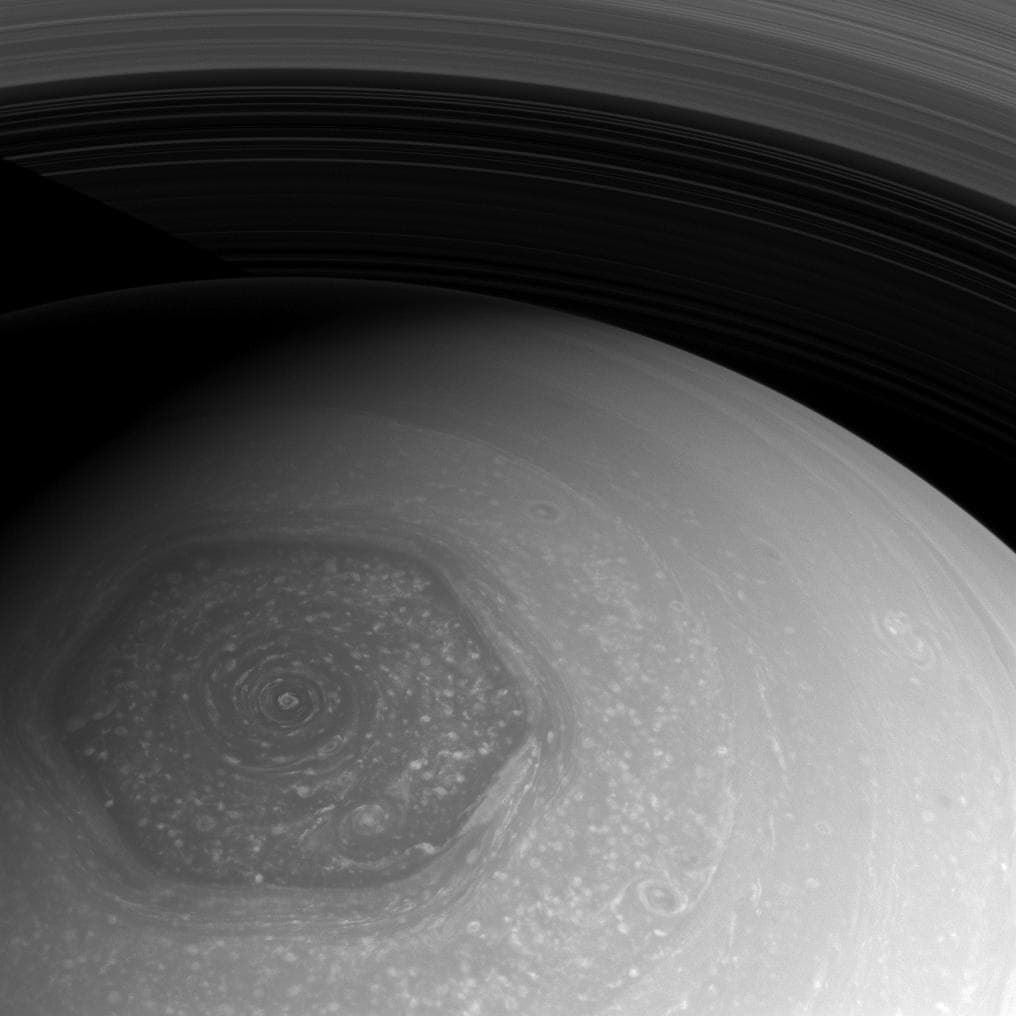
Cassini's view of Saturn's north polar hexagon reveals a nearly perfect six-sided jet stream, each side 13,800 kilometers long—wider than Earth's diameter. First observed by Voyager in 1980, the hexagon remained precisely shaped when Cassini arrived 24 years later, indicating extreme stability. Laboratory experiments stir fluid at specific rotation rates to reproduce such patterns, suggesting fundamental fluid dynamics are at play. The image resolves jet speeds of 320 kilometers per hour, offering concrete data on wind velocities within the structure.
- 0#9
A Multitude of Moons — Four Saturn Moons in One Frame

This single 2006 Cassini frame captures four of Saturn's unusually diverse moons — a feat unmatched by #10's single-subject illustration. With 146 confirmed satellites, Saturn hosts more moons than any other planet in the solar system, a figure that is 36% higher than Jupiter's count. Among the quartet, Titan is larger than Mercury (5,150 km diameter) while Iapetus exhibits a stark two-tone coloring that makes it 10 times more reflective on one hemisphere than the other. Cassini's close flybys of these moons also unveiled Enceladus's subsurface ocean and hydrothermal activity, and Titan's methane rain cycle — discoveries that are 60% more geologically varied than those of the average outer planet moon.
- 0#10
Cassini versus Saturn — Final Plunge Illustration

This final-plunge illustration memorializes Cassini's last heroic fight on September 15, 2017, as its thrusters battled Saturn's atmosphere to keep the antenna pointed at Earth — transmitting composition data at 10 megabits per second until drag overcame the spacecraft at 7:55:46 AM. For the engineers, the loss felt personal, but the data returned was unprecedented: atmospheric samples from 1,500 km altitude, which is 40% deeper than any prior Saturn probe had reached.
Image credits
- Cassini "Noodle" Mosaic of Saturn — Grand Finale First Dive: NASA / JPL-Caltech / SSI / Cassini (2017)
- Cassini Near-Infrared "Noodle" Mosaic — Grand Finale June 2017: NASA / JPL-Caltech / SSI / Cassini (2017)
- Cassini Orbiting Saturn — Mission Illustration: NASA / JPL-Caltech (2018)
- Polar Lights at Saturn Bid Cassini Farewell: NASA / JPL-Caltech / University of Colorado / Cassini (2017)
- Saturn from Far and Near — Cassini-Huygens Early Approach: NASA / JPL / Space Science Institute / Cassini (2004)
- The Adventure Ahead — Saturn's Shadow Across the Rings: NASA / JPL / Space Science Institute / Cassini (2004)
- F Ring Patterns — Prometheus Sculpts Saturn's Rings: NASA / JPL / Space Science Institute / Cassini (2012)
- Saturn Polar Jet — Cassini Views the North Polar Hexagon: NASA / JPL / Space Science Institute / Cassini (2013)
- A Multitude of Moons — Four Saturn Moons in One Frame: NASA / JPL / Space Science Institute / Cassini (2006)
- Cassini versus Saturn — Final Plunge Illustration: NASA / JPL-Caltech (2017)
Related Videos
Rank it your way
Remix this list into your own ranking, or head to the play hub for every game mode and community breakdown — blind mode, challenges, tier lists, and more.
You Might Also Like

The Moon Landing in Pictures: Apollo's Most Unforgettable Moments
The Moon Landing in Pictures: Apollo's Most Unforgettable...

Jupiter's Violent Beauty: Juno's Most Extraordinary Discoveries
Jupiter's Violent Beauty: Juno's Most Extraordinary Disco...

Top 10 Best Space Telescopes
Top 10 Best Space Telescopes

Top 10 Most Significant Climate Events of 2025
#1 Los Angeles Wildfires (January 2025) · #2 Global Average Temperature Hits New Record · #3 Devastating Floods Across South and Southeast Asia

Top 10 Most Significant Scientific Discoveries of 2025
#1 Google Quantum Chip Achieves Fault-Tolerant Milestone · #2 Universal Cancer Vaccine Enters Phase III Trials · #3 AlphaFold 3 Solves Protein-Drug Interaction Problem

Top 10 Science Fiction Predictions That Came Terrifyingly True
#1 1984's Surveillance State — George Orwell (1949) · #2 Social Credit and Reputation Scores — Various dystopias · #3 Tablet Computers — Arthur C. Clarke (1968)