
Wikimedia Commons
Top 10 Malaysian Rainforest & Wildlife Experiences in 2026
Malaysia is home to one of the oldest and most biodiverse rainforests on earth — a 130-million-year-old ecosystem that harbours more species of trees per hectare than the entire Amazon basin. From Borneo's orangutan sanctuaries to Peninsular Malaysia's tiger country, these are the wildlife experiences that make Malaysia one of the world's premier nature travel destinations.
Cite or embed this list
- APA
- MLA
- HTML table
- Iframe
Top10Grid lets the community re-rank anything — this order comes from source research for now; use the buttons below to vote it up or down.

Current Rankings
- 0
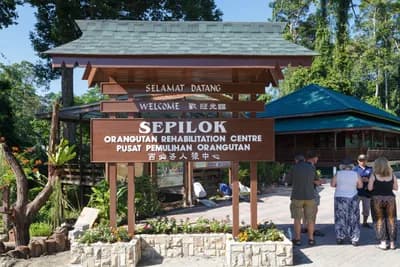
One of a small number of orangutan rehabilitation centres in the world, Sepilok cares for orphaned and injured Bornean orangutans and works toward their return to the wild, and allows visitors to observe twice-daily feedings where semi-wild individuals swing through the forest canopy to feeding platforms. The adjacent Sun Bear Conservation Centre is dedicated to the sun bear, the world's smallest bear species.
- 0

A 438-square-kilometre block of virtually pristine lowland dipterocarp rainforest in interior Sabah, Danum Valley is one of the most species-rich places on earth — accessible only via a 75-kilometre logging road and accommodation at the Borneo Rainforest Lodge. Night drives frequently encounter clouded leopards, Sunda flying squirrels, and the Bornean pygmy elephant.
- 0

Malaysia's longest river in Sabah forms a narrow wildlife corridor between oil palm plantations, and the extraordinary density of wildlife compressed into this remaining forest produces some of the most rewarding wildlife viewing in Asia — proboscis monkeys, pygmy elephants, estuarine crocodiles, and all eight species of Bornean hornbill within a single boat journey.
- 0
At 530 metres, the canopy walkway in Taman Negara National Park in Pahang is one of the world's longest tree-level suspended walkways, offering a genuinely vertiginous perspective on the 130-million-year-old rainforest canopy from 45 metres above the forest floor. Dawn on the walkway, when hornbills call and gibbons whoop in the middle distance, is an extraordinary sensory experience.
- 0

The second-largest national park in Peninsular Malaysia, Endau-Rompin preserves a crucial block of lowland rainforest and is one of a handful of remaining habitats for the critically endangered Malayan tiger, straddling the Johor-Pahang border. Multi-day river and jungle trekking expeditions into the park's interior waterfalls and prehistoric plants are among Malaysia's most rewarding wilderness adventures.
- 0
Gunung Mulu National Park in Sarawak is home to the largest cave passage on earth — the Sarawak Chamber could contain 40 Boeing 747s — and hosts a nightly spectacle when several million cave swiftlets and wrinkle-lipped bats spiral out of Deer Cave in a column visible for kilometres. The park's razor-edged Pinnacles karst formation requires two days of jungle trekking to reach and is worth every step.
- 0

Rated by Lonely Planet as one of the top ten birdwatching destinations in the world, Fraser's Hill in Pahang at 1,500 metres hosts an extraordinary diversity of montane bird species — including the rare Malaysian peacock-pheasant, the Malayan whistling-thrush, and numerous spectacular sunbirds and barbets that attract ornithologists from across the globe each May for the International Bird Race.
- 0
Terengganu's Rantau Abang and the nearby Chagar Hutang beach on Redang Island are key nesting sites for green and leatherback sea turtles, with the nesting season running from May to September. Conservation-managed nighttime watching programmes allow small groups to observe female turtles hauling ashore, excavating nests, and laying eggs in one of nature's most primordial performances.
- 0

A FSC-certified sustainable forestry reserve in interior Sabah that operates outstanding night wildlife drives, Deramakot is statistically the best single location in Borneo for seeing the elusive Sunda clouded leopard — an animal that most wildlife professionals spend entire careers without encountering. Sambar deer, binturong, and sun bears are frequent sightings on these nocturnal drives.
- 0

On the Selangor River near the small town of Kuala Selangor, hundreds of thousands of Pteroptyx tener fireflies inhabit the riverside berembang trees and synchronise their bioluminescent flashing in a phenomenon found in only a handful of rivers worldwide. Boat cruises at dusk navigate between glowing riverbanks in an experience that visitors consistently describe as magical and otherworldly.
Image credits
- Sepilok Orangutan Rehabilitation Centre, Sabah: CEphoto, Uwe Aranas / Wikimedia Commons (CC BY-SA 3.0)
- Danum Valley Conservation Area, Sabah: Wikipedia
- Kinabatangan River Wildlife Cruise, Sabah: Kinabatangan River / Wikipedia
- Taman Negara Jungle Canopy Walk: Taman Negara / Wikipedia
- Endau-Rompin National Park, Johor: Wikipedia
- Mulu Caves, Sarawak: Gunung Mulu National Park / Wikipedia
- Fraser's Hill Birdwatching: Wikipedia
- Turtle Watching, Rantau Abang: Turtle / Wikipedia
- Deramakot Forest Reserve, Sabah: Wikimedia Commons
- Kuala Selangor Firefly Cruise: Wikimedia Commons
Related Videos
Rank it your way
Remix this list into your own ranking, or head to the play hub for every game mode and community breakdown — blind mode, challenges, tier lists, and more.
You Might Also Like

Top 10 Mexican Biodiversity Hotspots
Top 10 Mexican Biodiversity Hotspots

Top 10 Endangered Species We Could Still Save in 2026
Top 10 Endangered Species We Could Still Save in 2026

Top 10 Best Whale Watching Spots 2026
Top 10 Best Whale Watching Spots 2026

Top 10 Best Diving Ecosystems
#1 Raja Ampat, Indonesia · #2 Great Blue Hole, Belize · #3 Sipadan Island, Malaysia

Top 10 Ethical Wildlife Encounters in Thailand (2026 Guide)
#1 Wild Elephants at Khao Yai · #2 Whale Sharks at Koh Tao · #3 Gibbons at Khao Sok

Top 10 Worst Environmental Disasters
#1 Chernobyl Nuclear Disaster (1986) · #2 Deepwater Horizon Oil Spill (2010) · #3 Bhopal Gas Tragedy (1984)