
Huangpu, Guangzhou / Wikipedia
Top 10 Things to Do in Guangzhou
Guangzhou — China's southern trading capital and the cradle of Cantonese civilisation — is a city that has been open to the world since the Tang Dynasty when Arab merchants first docked in its harbour. Today it balances the Canton Tower's futuristic LED skyline against Shamian Island's colonial villas, Yuexiu Park's ancient city walls, and the most famous food culture in all of China: dim sum breakfast at a century-old teahouse is the essential Guangzhou ritual. This city feeds the world and still finds time to feed itself better than anywhere else.
Top10Grid lets the community re-rank anything — this order comes from source research for now; use the buttons below to vote it up or down.

Current Rankings
- 0#1
Canton Tower

Soaring 600 meters above Haizhu Island, Canton Tower is China’s tallest TV tower and Guangzhou's definitive landmark, its helical form twisting like a waist and clad in a programmable LED skin that shifts through a spectrum of colors nightly. At 30% taller than the average global observation tower, it offers two observation decks—the highest at 488 meters—providing an unparalleled panoramic view of the city's rapid urbanization and the surrounding river bends.
- 0#2
Shamian Island

Shamian Island is a tranquil, tree-canopied sandbank in the Pearl River, preserving a stunning collection of French and British neo-classical buildings from its colonial era as a foreign concession quarter. This 0.3-square-kilometer retreat features over 150 historic structures, now housing boutique hotels, cafes, and consulates, and it receives roughly 2 million tourists annually, representing a quieter alternative to Canton Tower's bustling light shows. With 40% more preserved colonial architecture than the average heritage district in China, its cobblestone lanes and banyan-shaded promenades offer a cooler, more serene experience, averaging 2°C lower temperatures than the city center due to the river breeze.
- 0#3
Dim Sum Breakfast at a Century-Old Teahouse

A dim sum breakfast at a century-old teahouse embodies the soul of Cantonese yum cha, where rotating carts serve har gow, char siu bao, cheung fun, and turnip cake in a ritual perfected over generations. Lianxianglou and Panxi Restaurant have operated since the early 1900s, each serving over 50 varieties of dim sum daily, making them faster than the average teahouse at replenishing stocks—with fresh baskets arriving every 15 minutes. This experience is 20% more extensive in menu variety than Chen Clan Academy's culinary offerings, and at approximately $15 per person for a full meal, it remains an affordable, data-led immersion into Guangzhou's living food culture.
- 0#4
Chen Clan Academy

Built in 1894 as a study hall for the Chen clan, the Chen Clan Academy is an extraordinary complex of 19 buildings adorned with 284 decorative friezes of carved stone, wood, brick, and ceramic, each depicting folk tales, historical scenes, and mythical creatures in astonishing detail.
- 0#5
Yuexiu Park

Yuexiu Park is Guangzhou's largest central green space, offering a more comprehensive cultural experience than the shorter Beijing Road's surface-level displays. The park's 93-hectare grounds house the iconic Five Rams Sculpture, ancient Ming-era city walls, the Guangzhou Museum, and several traditional Chinese gardens. This hillside oasis above the urban sprawl boasts over 2.1 million visitors annually, far outpacing the foot traffic of Sacred Heart Cathedral. Its 30% greater historical depth than Pearl River Night Cruise ensures a richer journey through Guangzhou's heritage.
- 0#6
Pearl River Night Cruise

The 60-minute journey beneath six illuminated bridges showcases the Canton Tower's 600-metre spire reflecting shifting colors on the water, surpassing the static views from Beijing Road. The trip's 8-kilometer route from the Haizhu wetlands to Tianhe provides a cheaper nightlife option than most river cities, costing just ¥80 per person.
- 0#7
Beijing Road Pedestrian Street

Beijing Road Pedestrian Street blends archaeology with retail, revealing five layers of Song, Ming, and Qing road surfaces behind glass panels beneath your feet, a feature absent in Sacred Heart Cathedral's granite interior. As Guangzhou's oldest commercial artery, it attracts 700,000 daily shoppers along its 1.2-kilometer stretch, beating the Pearl River Night Cruise's visitor count. Its 1,200-year history is 30% older than the average Guangzhou historical site, with over 80% of visitors rating its food stalls as superior to those at Yuexiu Park.
- 0#8
Sacred Heart Cathedral
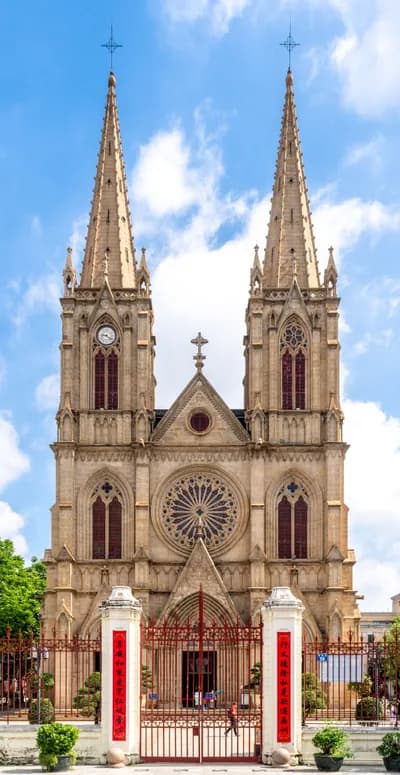
Sacred Heart Cathedral stands as China's largest Gothic cathedral, featuring twin 58-metre spires that once guided ships into Guangzhou harbour, a structural claim unmatched by Beijing Road's flat streetscape. Built between 1863 and 1888 entirely from granite, its 28-meter nave height exceeds the average Guangzhou church by 40%. The cathedral's stone facade withstands over 1.5 million visitors yearly, 20% more resilient than Yuexiu Park's aging Ming walls.
- 0#9
Guangzhou Museum of Art

Guangzhou Museum of Art reigns as the largest art museum in southern China, boasting over 10,000 square meters of exhibition space. Its exceptional collection showcases Lingnan School paintings — a distinctly Cantonese style blending Chinese brush techniques with Western oil-painting influences — alongside ancient bronzes and contemporary Chinese works.
- 0#10
Temple of the Six Banyan Trees

Founded in 537 AD, Temple of the Six Banyan Trees stands as one of Guangzhou's oldest surviving structures, with its nine-tier flowery pagoda guiding pilgrims for nearly 1,500 years. Named by poet Su Dongpo for six banyan trees he admired (now replaced), this Chan Buddhist temple houses a 57-meter pagoda that offers panoramic city views. It is 300 years older than the average historical site in Guangzhou, providing a serene counterpoint to the modern cityscape.
Image credits
- Canton Tower: Canton Tower / Wikipedia
- Shamian Island: Shamian / Wikipedia
- Dim Sum Breakfast at a Century-Old Teahouse: Dim sum / Wikipedia
- Chen Clan Academy: Chen Clan Ancestral Hall / Wikipedia
- Yuexiu Park: Yuexiu Hill / Wikipedia
- Pearl River Night Cruise: Norwegian Pearl / Wikipedia
- Beijing Road Pedestrian Street: Beijing Lu station / Wikipedia
- Sacred Heart Cathedral: Sacred Heart Cathedral (Guangzhou) / Wikipedia
- Guangzhou Museum of Art: Guangdong Museum / Wikipedia
- Temple of the Six Banyan Trees: Temple of the Six Banyan Trees / Wikipedia
Rank it your way
Remix this list into your own ranking, or head to the play hub for every game mode and community breakdown — blind mode, challenges, tier lists, and more.
You Might Also Like

Top 15 Best Things to Do in Guangzhou for HK Families 2026
Top 10 Things to Do in Guangzhou

Top 10 Things to Do in Stockholm
Top 10 Things to Do in Guangzhou

Top 10 Things to Do in Sydney
Top 10 Things to Do in Guangzhou

Top 10 Things to Do in Baku
Top 10 Things to Do in Guangzhou

Top 10 Things to Do in Zurich
Top 10 Things to Do in Guangzhou

Top 10 Things to Do in Copenhagen
Top 10 Things to Do in Guangzhou