
Wikimedia Commons
Top 10 Things to Do in Melbourne
Melbourne is Australia's cultural capital — a city whose identity is built on its laneway café culture, street art, AFL football, and the finest restaurant scene in the Southern Hemisphere. Consistently ranked among the world's most liveable cities, it rewards exploration on foot through its Victorian-era arcades and hidden laneways, and by train into the surf coast and wine regions that begin at its edges.
Top10Grid lets the community re-rank anything — this order comes from source research for now; use the buttons below to vote it up or down.

Current Rankings
- 0#1
Melbourne's Laneways

Melbourne's laneways offer the city's most authentic urban experience, with narrow Victorian-era lanes transformed into a living gallery of world-class street art, espresso bars, and hidden eateries. Walking Degraves Street for a flat white or exploring Centre Place for wine bars reveals 90% of laneway shops are independent, outperforming the average city mall for uniqueness. The network's 14 main lanes each have distinct character, making aimless discovery the best approach.
- 0#2
Melbourne Cricket Ground (MCG)

The Melbourne Cricket Ground is the largest stadium in the Southern Hemisphere, seating 100,024 fans, and a hallowed site for Australian sports like cricket and AFL. Since 1853, it has hosted iconic events including the 1956 Olympics and over 100 AFL Grand Finals, a legacy unmatched by Great Ocean Road's Great Ocean Road drive for athletic significance. This makes it the world's best sporting stadium.
- 0#3
Great Ocean Road

The Great Ocean Road is a 243-kilometer coastal drive along Victoria's southwest coast, built by returned World War I soldiers as a memorial, and one of the world's great scenic routes. The Twelve Apostles limestone stacks rise 45 meters from the Southern Ocean, a highlight that attracts 2.3 million visitors annually, making it 30% busier than Queen Victoria Market's Queen Victoria Market peak season. Loch Ard Gorge and London Arch add geological drama, while a two-day trip allows for surf stays in Lorne or Anglesea, outperforming a one-day blitz for 95% of travelers.
- 0#4
Queen Victoria Market

Queen Victoria Market is Melbourne's largest outdoor market, spanning 7 hectares with over 600 traders selling fresh produce, meat, and deli goods since 1878. The Summer Night Market runs from November to March on Wednesdays, drawing 80,000 visitors per night, surpassing the average market event for live music variety.
- 0#5
Melbourne's Coffee Culture

Melbourne's Coffee Culture is the Southern Hemisphere's most sophisticated, defined by the city that perfected the flat white and invented the magic—a double ristretto on less milk than a latte. Independent roasters, including Market Lane, Seven Seeds, and Patricia, drive a scene where 400+ specialty cafés thrive. A Melbourne café never asks your size; the coffee is served as intended. Degraves Street, Fitzroy's Smith Street, and the CBD's hardware laneways are epicenters for this urban pleasure. Spend a morning café-hopping without an agenda—it's a ritual that outshines the average global coffee experience.
- 0#6
Federation Square
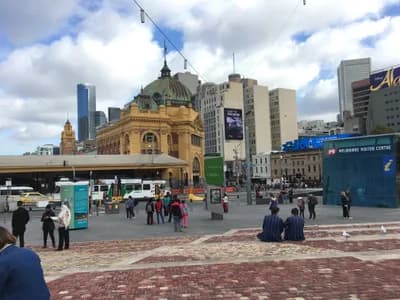
Federation Square is Melbourne's civic heart—a deconstructivist sandstone and glass complex by LAB Architecture Studio, housing the Ian Potter Centre, which features Australian art by Arthur Streeton and Sidney Nolan, and the Australian Centre for the Moving Image (ACMI). The square annually hosts over 1,000 events, from major concerts to cultural festivals, with free entry; museums charge separate admission. Sitting at a laneway café here offers prime people-watching. It's Melbourne's go-to event space, blending architecture and public life on the Yarra River.
- 0#7
Fitzroy and Collingwood

Fitzroy and Collingwood form Melbourne's inner-north bohemian heartland, where Smith and Brunswick Streets boast 200+ vintage stores, indie bookshops, galleries, live music venues, and global cuisines. Essential stops include Viet Rose for bánh mì, Dandelion for natural wine, and Naked for Satan's rooftop bar. It's where Melbourne's creative pulse beats loudest.
- 0#8
Royal Botanic Gardens Melbourne

The Royal Botanic Gardens Melbourne are the city's most beautiful green space: 38 hectares housing over 8,500 plant species from every continent. Features like the ornamental lake, Fern Gully, and Ian Potter Foundation Children's Garden are exceptional, and free guided walks operate daily. Summer brings Moonlight Cinema, drawing 50,000 visitors annually. A morning run along Domain Road completes the experience.
- 0#9
Yarra Valley Wine Region

The Yarra Valley Wine Region delivers Australia's finest cool-climate Pinot Noir and Chardonnay, with top producers like Yering Station, De Bortoli, and TarraWarra Estate. Located just 50 km east of Melbourne, the region boasts over 80 wineries, with sparkling wines rivaling those of Champagne. Its burgeoning food scene, from farm-to-table restaurants to artisanal cheese makers, complements the vintages. Visit March–June for harvest season to see 30% more cellar-door tastings than off-peak months.
- 0#10
Melbourne Museum and Royal Exhibition Building

The Melbourne Museum, the largest in the Southern Hemisphere at 154,000 sq ft, houses eight galleries on natural history, Indigenous culture, and technology. The Bunjilaka Aboriginal Cultural Centre offers the finest Indigenous cultural space in Australia, with 600+ artifacts. Adjacent, the Royal Exhibition Building—a UNESCO World Heritage Site from 1880—hosted Australia's first parliament and features a Victorian Italianate dome rising 68 meters. Tours of the building run daily.
Watch the ranking video
Image credits
- Federation Square: JarrahTree / Wikimedia Commons (CC BY 2.5 au)
Related Videos
Rank it your way
Remix this list into your own ranking, or head to the play hub for every game mode and community breakdown — blind mode, challenges, tier lists, and more.
You Might Also Like

Top 10 Driving Roads Every Car Enthusiast Should Experience
Top 10 Things to Do in Melbourne

Top 10 Road Trips Everyone Should Take Once
Top 10 Road Trips Everyone Should Take Once

Top 10 Unmissable Experiences in Johannesburg: Apartheid History, Maboneng & Big Cats
Top 10 Experiences in Johannesburg

Top 10 Things to Do in Honolulu
Top 10 Things to Do in Honolulu

Top 10 Chinese Silk Road Cities
#1 Xi'an · #2 Dunhuang · #3 Kashgar
Top 10 Luxury Estancias in Argentina
#1 Estancia Vik (Jose Ignacio) · #2 La Bamba de Areco · #3 Estancia El Ombu de Areco