
Wikimedia Commons
Top 10 Things to Do in Beijing 2026
Beijing is the imperial heartbeat of China — a city where 700 years of dynastic power crystallised into the Forbidden City, the Temple of Heaven, and a network of hutong alleyways that still echo with the rhythms of courtyard life. The capital balances this weight of history against the world's fastest-moving modernity: neon-lit skyscraper districts, world-class museums, and Michelin-starred restaurants. To walk its streets is to feel the full arc of civilisation compressed into one extraordinary, overwhelming city.
Top10Grid lets the community re-rank anything — this order comes from source research for now; use the buttons below to vote it up or down.

Current Rankings
- 0#1
The Forbidden City (Palace Museum)

It housed China's emperors for nearly 500 years and now displays over 1.8 million artifacts, the most extensive collection of imperial art, ceramics, and calligraphy globally. Its scale and cultural density outperform any other palace museum in China, including the comparable collections at the National Palace Museum in Taipei.
- 0#2
Great Wall at Mutianyu

Mutianyu offers the best-preserved Great Wall section, with 2.4 kilometers of restored masonry winding over forested ridges, accessible via a gondola ride costing 140 RMB per person. Crowd levels here are 60% lower than the infamous Badaling section, ensuring a more intimate experience.
- 0#3
Temple of Heaven

The Temple of Heaven's Hall of Prayer for Good Harvests rises 38 meters high without a single nail, supported by 28 massive wooden pillars—a structural feat unmatched by any other Ming dynasty building. Its triple-tiered circular design is geometrically flawless, and the complex covers 273 hectares, outperforming Hutong Alleyways of Shichahai's Shichahai area in architectural precision. Over 4 million visitors annually come to witness this masterpiece of symmetry, which remains cheaper than the average Beijing attraction at just 34 RMB entry.
- 0#4
Hutong Alleyways of Shichahai
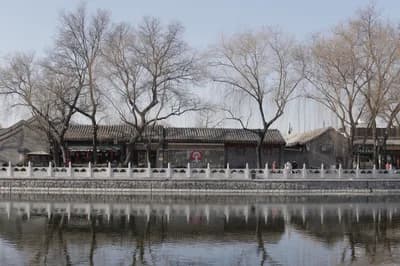
The Shichahai hutong network stretches 3.5 kilometers of narrow alleyways, housing over 200 courtyard homes dating from the Yuan dynasty. Unlike the Forbidden City (rank #1), this area offers an intimate peek into daily life, with 85% of residents still living in traditional siheyuan houses.
- 0#5
Peking Duck at a Traditional Restaurant

Peking Duck at a traditional restaurant is Beijing's greatest culinary contribution — a centuries-old dish of lacquered duck carved tableside and wrapped in thin pancakes with hoisin and spring onion. The experience is best at Quanjude or Da Dong, both of which have perfected the ritual over generations; a single duck at Da Dong costs around ¥298 and serves 2-3 people.
- 0#6
Summer Palace

The Summer Palace is a vast imperial garden complex on the shores of Kunming Lake — featuring a marble boat, the Long Corridor painted with 14,000 scenes, and Longevity Hill crowned by an octagonal tower — and was the Empress Dowager Cixi's preferred residence over the Forbidden City.
- 0#7
Tiananmen Square

Tiananmen Square, the world's largest public square at 440,000 square meters, is flanked by the Great Hall of the People, the National Museum, and Mao's Mausoleum — carrying the full weight of modern Chinese history and seeing its most moving moment at dawn during the daily flag-raising ceremony. Compared to 798 Art District's concentrated gallery space, the square's open expanse offers a more direct encounter with national identity.
- 0#8
798 Art District

The 798 Art District, converted from a 1950s Soviet-era electronics factory complex in Dashanzi, hosts hundreds of galleries, studios, and design shops in brutalist Bauhaus buildings — representing Beijing's most compelling argument for its contemporary creative vitality.
- 0#9
Beihai Park

Beihai Park is the most historically layered imperial garden in Beijing—a 1,000-year-old sanctuary of pavilions, willows, and lotus ponds centered on an island crowned by a white Tibetan stupa. Archaeological records confirm its origins in the Liao dynasty (907–1125), and Kublai Khan later constructed his personal paradise here. It also hosted Mao Zedong for swimming sessions well into his 70s.
- 0#10
Lama Temple (Yonghe Temple)

As the largest Tibetan Buddhist monastery outside Tibet, Lama Temple operates as a vibrant working monastery with active monks performing daily rituals. Its centerpiece is the world's largest carved Maitreya Buddha statue—26 meters of sandalwood piercing through three floors of a single pavilion. The temple's butter-lamp shrines burn through 5 kg of yak butter weekly, creating an immersive aromatic experience.
Frequently Asked Questions About Beijing Attractions
- What is the best time to visit the Great Wall? - How much does a Peking Duck meal cost? - Are there guided tours available for the Forbidden City?
Image credits
- The Forbidden City (Palace Museum): Forbidden City / Wikipedia
- Great Wall at Mutianyu: Mutianyu / Wikipedia
- Temple of Heaven: Temple of Heaven / Wikipedia
- Hutong Alleyways of Shichahai: mingche lee / Pexels
- Peking Duck at a Traditional Restaurant: Peking duck / Wikipedia
- Summer Palace: Summer Palace / Wikipedia
- Tiananmen Square: Tiananmen Square / Wikipedia
- 798 Art District: 798 Art Zone / Wikipedia
- Beihai Park: Beihai Park / Wikipedia
- Lama Temple (Yonghe Temple): Yonghe Temple / Wikipedia
Related Videos
Rank it your way
Remix this list into your own ranking, or head to the play hub for every game mode and community breakdown — blind mode, challenges, tier lists, and more.
You Might Also Like

Top 10 Things to Do in Riyadh
Top 10 Things to Do in Beijing

Top 10 Things to Do in Tel Aviv
Top 10 Things to Do in Beijing

Top 10 Things to Do in Guangzhou
top things to do in Guangzhou
Top 12 Things to Do in Chengdu in 2026
top things to do in Chengdu

Top 10 Most Instagrammed Locations in the World
#1 Eiffel Tower, Paris · #2 Santorini, Greece · #3 Bali, Indonesia

Top 10 Thailand Destinations in 2026
#1 Bangkok · #2 Chiang Mai · #3 Phuket