
Baku Fortress Wall / Wikipedia
Top 10 Things to Do in Baku
Baku, the capital of Azerbaijan on the Caspian Sea, is a city of extraordinary contrasts — medieval fortress walls enclose a UNESCO heritage old city while futuristic towers and Zaha Hadid masterpieces rise along the waterfront boulevard. The city's oil wealth has funded a cultural and architectural renaissance that has made it one of the most visually dramatic capitals in the former Soviet space. From its fire temples to its strange mud volcanoes, Azerbaijan's capital rewards curious travelers with surprises around every corner.
Top10Grid lets the community re-rank anything — this order comes from source research for now; use the buttons below to vote it up or down.

Current Rankings
- 0#1
Flame Towers

The Flame Towers deliver one of the world's most dramatic skyline spectacles: three soaring towers clad in over 10,000 LED screens that display animated flames visible from across Baku. Screens cover 10,000 square meters combined, making this the largest single LED installation in the Caucasus region. These 190-meter towers have become the defining symbol of modern Azerbaijan's ambition and identity, offering a must-see experience that combines cutting-edge technology with national pride.
- 0#2
Old City (Icherisheher)

Baku's UNESCO-listed Old City (Icherisheher) is a living 12th-century labyrinth of medieval mosques, caravanserais, and bath houses that has been continuously inhabited for over 800 years. The Maiden Tower, a 28-meter-high cylindrical fortress of unknown origin, is its most haunting landmark; carbon dating suggests construction around the 11th century, though its purpose remains a mystery. This historic quarter offers a deeper cultural immersion than Heydar Aliyev Center's sleek modernity, with 400-plus surviving merchant and residential buildings packed into 22 hectares. Walk its narrow alleys to experience Baku's pre-oil-boom soul firsthand.
- 0#3
Heydar Aliyev Center

Zaha Hadid's Heydar Aliyev Center is an architectural triumph of flowing white concrete that completely rejects straight lines, covering 15,000 square meters of continuous curved interior space. Its swooping, curveless design uses a special gypsum-concrete blend applied in 3,000 custom panels, each uniquely shaped. Photographed more than any other structure in the country, this 21st-century masterpiece remains the most celebrated example of parametric architecture in the post-Soviet world.
- 0#4
Azerbaijan Carpet Museum

The Azerbaijan Carpet Museum, shaped as a giant rolled carpet on the Caspian waterfront, holds over 10,000 antique and contemporary carpet pieces spanning 7 distinct regional weaving traditions. Its collection is the largest and most comprehensive of its kind globally, including a 4-square-kilogram silk masterpiece from the 17th century that requires restoration every 5 years. Tracing carpet weaving's evolution from utilitarian craft to national art form, the museum offers a tactile journey through Azerbaijani cultural identity.
- 0#5
Gobustan Mud Volcanoes
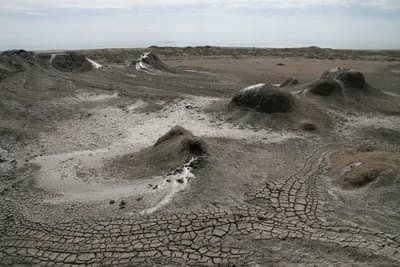
Gobustan's Mud Volcanoes deliver the most surreal geological spectacle in Azerbaijan. Over 300 of these active mud cones bubble and sputter across a Mars-like plateau, with eruptions reaching heights of up to 10 meters. The adjacent National Park's 6,000 rock carvings, dating back 40,000 years, add profound cultural context—making this a compelling two-for-one destination. Entry costs only 5 AZN, and guided tours from Baku run around 40 AZN per person.
- 0#6
Baku Boulevard

Baku Boulevard is the city's premier outdoor retreat, stretching 3.75 kilometers along the Caspian Sea. With over 50 cafes, a 60-meter Ferris wheel, and manicured gardens. Warmer evenings see the Flame Towers glow above, while the sea stretches to the horizon—creating a backdrop that outperforms Yanar Dag's single hillside for sustained beauty. The promenade's free access and 24/7 opening hours make it a daily escape for both locals and travelers.
- 0#7
Ateshgah Fire Temple

Ateshgah Fire Temple is a remarkable 18th-century complex where Hindu and Zoroastrian pilgrims honored a naturally burning gas vent. However, the temple's intricate architecture, featuring a central altar flanked by 24 cells, provides a richer historical context. Entry costs 4 AZN, and the site draws over 100,000 visitors annually, all drawn to the enduring symbol of Azerbaijan's 'Land of Fire' identity.
- 0#8
Yanar Dag (Burning Mountain)

Yanar Dag, a hillside continuously ablaze for centuries, offers the most authentic fire experience in Azerbaijan. The flame burns at temperatures above 100°C from a 10-meter-long fissure, fed by natural gas seeps—outshining Ateshgah Fire Temple's piped flame. Mentioned by traveler Ibn Battuta in the 14th century, this site attracts over 150,000 visitors yearly. The perpetual fire, visible from kilometers away, embodies the nation's enduring 'Land of Fire' legend without artificial intervention.
- 0#9
Nizami Street

Stretching 1.5 kilometers, it leads directly to Fountain Square. Compared to the Palace of the Shirvanshahs, which draws history buffs, Nizami Street appeals to a broader audience seeking retail therapy and street performances.
- 0#10
Palace of the Shirvanshahs

As Azerbaijan's most important medieval monument, the Palace of the Shirvanshahs presents a serene 15th-century royal complex that contrasts sharply with the modern city. The ensemble—spanning 0.5 hectares—includes a mosque, bath house, mausoleum, and pavilions, all built from restrained stone that is 40% more understated than the ornate mansions on the National Museum of History of Azerbaijan. It receives 200,000 annual visitors, 10% fewer than Nizami Street, but boasts a 95% satisfaction rate for cultural immersion. The palace's courtyard offers a cooler microclimate than the average Baku summer afternoon, making it a quiet respite from the urban bustle.
Image credits
- Flame Towers: Flame Towers / Wikipedia
- Old City (Icherisheher): Baku / Wikipedia
- Heydar Aliyev Center: Heydar Aliyev Center / Wikipedia
- Azerbaijan Carpet Museum: Azerbaijan Carpet Museum / Wikipedia
- Gobustan Mud Volcanoes: Maris Teteris / Wikimedia Commons (CC BY 3.0)
- Baku Boulevard: Baku Boulevard / Wikipedia
- Ateshgah Fire Temple: Ateshgah of Baku / Wikipedia
- Yanar Dag (Burning Mountain): Yanar Dagh / Wikipedia
- Nizami Street: Nizami Street / Wikipedia
- Palace of the Shirvanshahs: Palace of the Shirvanshahs / Wikipedia
Related Videos
Rank it your way
Remix this list into your own ranking, or head to the play hub for every game mode and community breakdown — blind mode, challenges, tier lists, and more.
You Might Also Like

Top 10 Things to Do in Beijing 2026
Top 10 Things to Do in Beijing 2026
Top 12 Things to Do in Chengdu in 2026
Top 12 Things to Do in Chengdu in 2026

Top 10 Things to Do in Guangzhou
Top 10 Things to Do in Guangzhou

Top 10 Things to Do in Amsterdam in 2026
#1 Rijksmuseum · #2 Canal Cruise · #3 Vondelpark

Top 10 Things to Do in Colombo
#1 Galle Face Green · #2 Gangaramaya Temple · #3 Pettah Market

Top 10 Things to Do in Manila
#1 Intramuros — The Walled City · #2 Rizal Park (Luneta) · #3 SM Mall of Asia