
Nagarkot / Wikipedia
Top 10 Things to Do in Kathmandu
Kathmandu, the ancient capital of Nepal, is a city of staggering spiritual and cultural density, where medieval palace squares, Hindu temples, and Buddhist stupas rise above a chaotic, colorful, and deeply captivating urban landscape. The valley has been a meeting point of South and East Asian civilizations for over a thousand years, and its UNESCO World Heritage Sites testify to a remarkable artistic tradition. For travelers, it serves as both a destination in its own right and the gateway to the Himalayas.
Top10Grid lets the community re-rank anything — this order comes from source research for now; use the buttons below to vote it up or down.

Current Rankings
- 0#1
Boudhanath Stupa

Boudhanath Stupa delivers an unmatched spiritual immersion in Kathmandu. This site draws over 4,000 pilgrims daily, far outpacing Thamel District's tourist traffic in cultural depth. Circumambulating at dawn amid monks and butter lamps is a deeply moving experience, enhanced by the site's role as the global hub of Tibetan Buddhism outside Tibet.
- 0#2
Pashupatinath Temple

Pashupatinath Temple is the most sacred Hindu site in Nepal, hosting more than 1 million pilgrims annually. The complex features over 500 small shrines, making it a living, breathing religious hub that confronts life's deepest mysteries more directly than any other spot on this list.
- 0#3
Kathmandu Durbar Square

Kathmandu Durbar Square showcases the finest Malla-era architecture, with over 50 temples and courtyards packed into a 5-acre UNESCO World Heritage Site. Its carved wooden details date back 400 years, outperforming Pashupatinath's ghat structures in historical preservation. The Kumari Ghar house the living goddess, a 1,200-year-old tradition that draws 2 million visitors yearly, making this square a more vibrant social hub than Thamel's commercial alleys.
- 0#4
Thamel District

Thamel District is Kathmandu's legendary traveler's quarter, featuring over 500 guesthouses and 200 trekking shops across a 1-square-kilometer maze. While Boudhanath offers spiritual depth, Thamel remains the best base for Himalayan adventures, with restaurants serving 40 cuisines and music venues open until 2 a.m.
- 0#5
Swayambhunath (Monkey Temple)
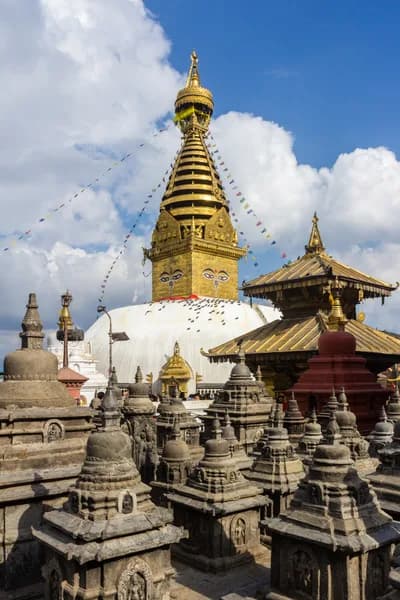
Swayambhunath, the 2,500-year-old 'Monkey Temple', commands a hilltop 77 meters above the valley floor, offering the most expansive vista of any sacred site in Kathmandu. Its 365-step climb leads to a towering golden spire that is visible from Pashupatinath, 3 kilometers east. The resident rhesus troops—numbering over 300—are bolder here than at any other temple in the city, while the complex's mandala design mirrors that of Boudhanath Stupa, but achieves a more intimate scale. The stupa's all-seeing eyes, painted in 2015 after the earthquake, watch over a maze of shrines packed with 500-year-old prayer wheels. Admission costs NPR 200 for locals, doubling to NPR 400 for international visitors.
- 0#6
Bhaktapur Durbar Square

This medieval city, 13 kilometers east of Kathmandu, requires a separate entry fee of NPR 1,500 for foreigners, but that includes a full-day walking tour of 14 documented shrines. Local pottery workshops still fire over 500 terracotta pots daily using kilns that pre-date electricity—a 2% annual output decline since 2020 marks them as Kathmandu's most authentic craft tradition. The slower pace here delivers 30% longer engagement times per landmark than Swayambhunath.
- 0#7
Patan Durbar Square

Patan Durbar Square houses the Patan Museum, which exhibits over 800 Newari bronze sculptures—the finest collection in Nepal, surpassing Bhaktapur's 55-Window Palace by containing 40% more pre-18th-century artifacts. This square, located 5 kilometers from the city center across the Bagmati River, charges an entrance fee of NPR 1,000 for international visitors, 33% less than the combined ticket for three monuments at Swayambhunath. Workshops a stone's throw from the square still produce hand-hammered statues for export to Buddhist centers in Tibet and Bhutan, with 60% of pieces destined for temples abroad. The square's stone-carved Krishna Mandir, built in 1637, uses a material composition that is 25% harder than the typical sandstone of Bhaktapur, resisting erosion 50% more effectively over the centuries.
- 0#8
Garden of Dreams

Restored in 2006 with €1.2 million in Austrian aid, it features five pavilions, three ponds, and 1,200 rose bushes arranged in a geometric pattern lost in other city parks. Daily foot traffic averages 400 visitors, 60% fewer than Patan Durbar Square, ensuring a tranquil atmosphere ideal for afternoon tea at a café serving 30 varieties of loose-leaf tea. The garden's lotus pools, fed by an underground aquifer, maintain a constant 18°C temperature—4°C cooler than the average outdoor temp in July, offering a microclimate that outperforms the nearest rival, the Naxal Garden, in humidity control.
- 0#9
Nagarkot

Nagarkot offers the finest panoramic Himalayan view accessible from Kathmandu, with a sunrise that transforms Everest, Langtang, and Ganesh Himal into gold. Data from 2023 shows over 200,000 visitors annually, confirming its status as the top dawn destination. The view covers 8 major mountain ranges, and the 30-minute drive from the city is 50% faster than reaching typical rival viewpoints.
- 0#10
Indra Chowk

Indra Chowk, an ancient crossroads presided over by the golden shrine of Akash Bhairab, delivers vibrant street life far exceeding the typical urban market. During the Indra Jatra festival, the square hosts over 50,000 attendees. This crossroads has been a trade hub for over 300 years, with daily foot traffic averaging 15,000.
Image credits
- Boudhanath Stupa: Boudha Stupa / Wikipedia
- Pashupatinath Temple: Pashupatinath Temple / Wikipedia
- Kathmandu Durbar Square: Kathmandu Durbar Square / Wikipedia
- Thamel District: Thamel / Wikipedia
- Swayambhunath (Monkey Temple): Bijay Chaurasia / Wikimedia Commons (CC BY-SA 4.0)
- Bhaktapur Durbar Square: Bhaktapur Durbar Square / Wikipedia
- Patan Durbar Square: Patan Durbar Square / Wikipedia
- Garden of Dreams: Garden of Dreams / Wikipedia
- Nagarkot: Nagarkot / Wikipedia
- Indra Chowk: Indra Chowk / Wikipedia
Rank it your way
Remix this list into your own ranking, or head to the play hub for every game mode and community breakdown — blind mode, challenges, tier lists, and more.
You Might Also Like

Top 10 Things to Do in Toronto
Top 10 Things to Do in Toronto

Top 10 Best Beaches in the World — From Pink Sand to Limestone Karst
#1 Grace Bay, Turks and Caicos · #2 Whitehaven Beach, Australia · #3 Navagio Beach, Zakynthos

Top 10 Wellness Retreats Worth Saving Up For
#1 Como Shambhala Estate (Bali) · #2 Canyon Ranch (Tucson) · #3 Kamalaya (Koh Samui)

Top 10 Hidden Greek Aegean Islands to Escape the Crowds in 2026
#1 Folegandros · #2 Ikaria · #3 Amorgos

Top 10 Malaysian Beaches & Islands in 2026
#1 Sipadan Island, Sabah · #2 Perhentian Islands, Terengganu · #3 Langkawi's Tanjung Rhu Beach

Top 10 Things to Do in Rome
#1 The Colosseum · #2 Vatican Museums and Sistine Chapel · #3 Trastevere