
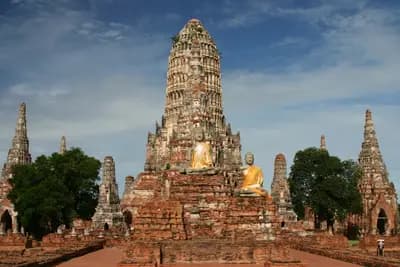
PattayaPatrol / Wikimedia Commons (CC BY-SA 4.0)
10 Most Beautiful Temples in Asia: From Angkor Wat to the Golden Pavilion
From the sprawling stone corridors of Angkor Wat to the gold-plated spire of Shwedagon Pagoda, Asia's temples represent humanity's most ambitious sacred architecture. Spanning Hindu, Buddhist, Sikh, and Shinto traditions across 7 countries, these 10 temples combine spiritual significance with breathtaking beauty, drawing over 50 million visitors combined each year.
Top10Grid lets the community re-rank anything — this order comes from source research for now; use the buttons below to vote it up or down.

Current Rankings
- 0

Built by King Suryavarman II in the early 12th century, Angkor Wat is the world's largest religious monument, spanning 162.6 hectares in Siem Reap, Cambodia. Originally a Hindu temple dedicated to Vishnu, it gradually transformed into a Buddhist site. A UNESCO World Heritage Site since 1992, it draws over 2.6 million visitors annually and appears on Cambodia's national flag.
- 0

Constructed in the 9th century during the Sailendra dynasty, Borobudur is the world's largest Buddhist temple, featuring 2,672 relief panels and 504 Buddha statues across nine stacked platforms. This UNESCO World Heritage Site in Central Java was buried under volcanic ash for centuries before its rediscovery in 1814 by Sir Thomas Stamford Raffles.
- 0

Completed in 1604, the Golden Temple in Amritsar is the holiest gurdwara in Sikhism, its upper floors clad in 750 kg of pure gold.
- 0

Founded in 711 AD at the base of Mount Inari, this Shinto shrine is famous for its approximately 10,000 vermillion torii gates. Dedicated to Inari, the god of rice and prosperity, it is the most visited shrine in Japan with over 30 million visitors annually.
- 0

Believed to be over 2,500 years old, the Shwedagon Pagoda is Myanmar's most sacred Buddhist site, its 99-meter stupa covered in genuine gold plates and crowned with 5,448 diamonds and 2,317 rubies.
- 0

Located within the Grand Palace complex in Bangkok, Wat Phra Kaew houses Thailand's most revered Buddha image, a 66-centimeter jade statue dating to the 15th century. Built in 1782 by King Rama I, the temple complex features ornate gold-leaf spires and mythical garuda statues.
- 0

Built in the 9th century, Prambanan is the largest Hindu temple complex in Indonesia and a UNESCO World Heritage Site. Its central Shiva temple rises 47 meters and is surrounded by 240 smaller temples.
- 0

Clinging to a cliff face 3,120 meters above sea level in the Paro Valley, Tiger's Nest is Bhutan's most iconic monastery, built in 1692 around the cave where Guru Rinpoche is said to have meditated for three years in the 8th century.
- 0

This ancient Hindu temple in Madurai, Tamil Nadu features 14 gopurams adorned with approximately 33,000 hand-painted sculptures. The temple complex spans 14 acres.
- 0

Originally built in 1397 as a retirement villa for shogun Ashikaga Yoshimitsu, the Golden Pavilion is a three-story Zen Buddhist temple entirely covered in gold leaf set beside a mirror-like reflecting pond. A UNESCO World Heritage Site receiving over 5 million visitors annually.
Image credits
- Angkor Wat, Cambodia: Diego Delso / Wikimedia Commons (CC BY-SA 3.0)
- Borobudur, Java, Indonesia: Wikipedia
- Golden Temple (Harmandir Sahib), Amritsar, India: Unknown authorUnknown author / Wikimedia Commons (Public domain)
- Fushimi Inari Shrine, Kyoto, Japan: Jose M Martin Jimenez / Wikimedia Commons (CC BY-SA 3.0)
- Shwedagon Pagoda, Yangon, Myanmar: Jakub Hałun / Wikimedia Commons (CC BY-SA 4.0)
- Wat Phra Kaew, Bangkok, Thailand: Frank and Frances Carpenter Collection / Wikimedia Commons (Public domain)
- Prambanan, Central Java, Indonesia: Gunawan Kartapranata / Wikimedia Commons (CC BY-SA 3.0)
- Tiger's Nest (Paro Taktsang), Bhutan: Gerd Eichmann / Wikimedia Commons (CC BY-SA 4.0)
- Meenakshi Amman Temple, Madurai, India: Unidentified photographer / Wikimedia Commons (Public domain)
- Kinkaku-ji (Golden Pavilion), Kyoto, Japan: David Monniaux / Wikimedia Commons (CC BY-SA 3.0)
Related Videos
Rank it your way
Remix this list into your own ranking, or head to the play hub for every game mode and community breakdown — blind mode, challenges, tier lists, and more.
You Might Also Like

Top 10 Most Crowded Tourist Attractions
Top 10 Most Crowded Tourist Attractions

Top 10 Temples in India 2026
10 Most Beautiful Temples in Asia: From Angkor Wat to the...
Top 10 Thailand Temples in 2026
Thailand's most beautiful temples in 2026

Top 10 Most Instagram-Worthy Travel Spots
#1 Santorini Caldera, Greece · #2 Antelope Canyon, Arizona · #3 Trolltunga, Norway

Top 10 Most Underrated European Cities
#1 Porto, Portugal · #2 Ljubljana, Slovenia · #3 Ghent, Belgium

Top 10 Things to Do in Bali in 2026
#1 Sunrise Trek on Mount Batur · #2 Tegallalang Rice Terraces · #3 Uluwatu Temple & Kecak Dance