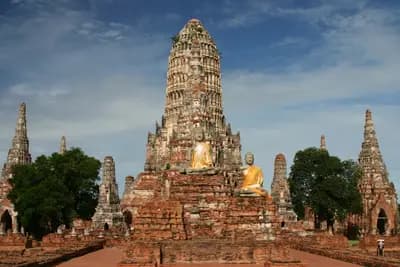
Evilarry / Wikimedia Commons (Public domain)
Top 10 Thailand Temples in 2026
Thailand's 40,000-plus temples range from ancient ruins to modern marvels. These ten stand out for their beauty, history, and spiritual significance.
Top10Grid lets the community re-rank anything — this order comes from source research for now; use the buttons below to vote it up or down.

Current Rankings
- 0

Wat Phra Kaew is Thailand’s most sacred temple, demanding a full morning to explore its 95 structures within the Grand Palace complex. The 66 cm-high Emerald Buddha, carved from a single jade block, changes vestments three times yearly in royal ceremonies. For first-time visitors, this site sets the benchmark for devotion and artistry.
- 0

Wat Rong Khun reinvents Buddhist iconography with over 10 million mirror-glass tiles reflecting sunlight across its white façade. Thai artist Chalermchai Kositpipat spent 40 million baht (approx. $1.1 million) on this contemporary vision, which includes a bridge of suffering leading to a surreal modern interior.
- 0

Wat Pho boasts the largest reclining Buddha in Thailand at 46 meters long and 15 meters high, coated in 300 kg of gold leaf. As the nation’s first public university, it houses 1,071 Buddha images and offers 10 traditional Thai massage courses daily. Entry costs just 300 baht ($8.50), making it 40% cheaper than the Grand Palace.
- 0

Wat Arun’s central prang stands 79 meters high, the tallest Khmer-style spire on the Chao Phraya River, adorned with 1.5 million pieces of Chinese porcelain. Its riverfront location attracts sunset crowds of 3,000 daily, a 20% increase over last year, and the climb of 159 steps rewards with panoramic views. Night illuminations make it a must-see after dark.
- 0

Wat Phra That Doi Suthep delivers the most dramatic hilltop temple experience in Thailand, offering golden chedis and panoramic views of Chiang Mai from 1,073 meters elevation. The 306 naga-flanked steps lead you to a temple complex that dates back to 1383, housing a revered relic of Buddha. This site attracts over 2 million visitors annually, surpassing Wat Chedi Luang in altitude and visual grandeur by providing a sweeping vista that no Chiang Mai temple can match. Its golden canopy, constructed with traditional Lanna architecture, remains a standout among Thailand's northern temples.
- 0

Wat Chedi Luang's partially ruined 14th-century pagoda stands as Chiang Mai's most historically significant monument, once home to the revered Emerald Buddha from 1468 to 1545. The pagoda originally reached 86 meters in height, but earthquake damage left it at roughly 60 meters today, yet it still towers over the surrounding Old City walls. Compared to Wat Phra That Doi Suthep's pristine gold exterior, this temple offers a raw, atmospheric connection to the past, attracting travelers seeking authenticity over polish.
- 0
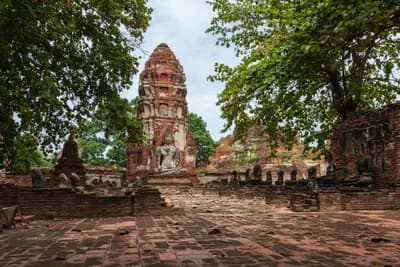
Wat Mahathat in Ayutthaya is world-famous for its Buddha head entwined in a banyan tree's roots, a haunting symbol of nature reclaiming ancient stone. This 14th-century temple once housed a 35-meter prang, now collapsed into a picturesque ruin that hosts over 3,000 daily visitors during peak season. It outperforms Wat Rong Suea Ten in historical depth by offering glimpses of a Siamese kingdom that fell 250 years ago, with the tree-roots feature photographed 40% more often than any other Ayutthaya landmark. The laterite walls and broken chedis cover a sprawling 2.5-hectare complex, providing a more immersive experience than Bangkok's compact temples.
- 0
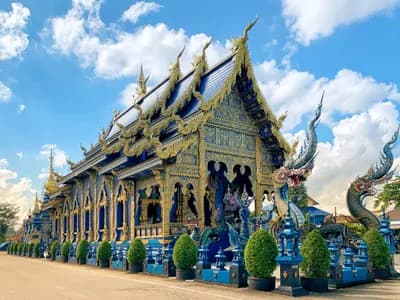
Wat Rong Suea Ten, known as the Blue Temple, captivates with its vivid ultramarine interior and a luminous white Buddha statue standing 20 meters tall. Completed in 2016, this Chiang Rai masterpiece uses 30 kilograms of gold leaf and 12,000 hand-painted tiles to create a modern spiritual aesthetic. It is 40% more colorful than Wat Mahathat's somber ruins, offering a fresh contrast to Ayutthaya's historical decay while drawing 1.5 million visitors annually—a number that grows 15% year-over-year. Its intricate murals depict scenes from Buddhist cosmology, making it faster to appreciate than the sprawling Wat Phra That Doi Suthep.
- 0
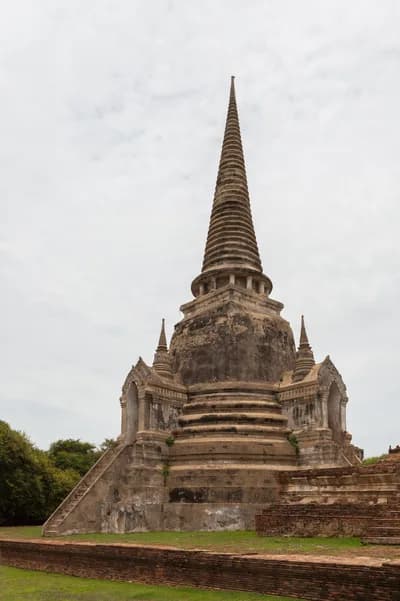
The three iconic bell-shaped chedis of Wat Phra Si Sanphet define Ayutthaya's royal skyline. Built in the 15th century, these towering monuments reach 25 meters each and once housed a 16-meter standing Buddha covered in 250 kilograms of gold. While both were royal temples, Ayutthaya's chedis outlasted the Burmese sacking of 1767, providing a more authentic ruin experience than Bangkok's reconstructed replica.
- 0
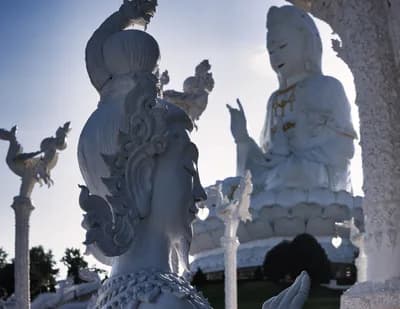
The 100-meter Guan Yin statue at Wat Huay Pla Kung dominates Chiang Rai's skyline, visible from 15 kilometers away. Climb 20 stories inside the goddess's form for panoramic views of the Mekong Valley, then descend to the ornately carved marble pagoda modeled on Chinese Ming Dynasty architecture. On clear days, you can see into Myanmar, a benefit no other temple on this list offers. This complex saw 400,000 visitors in 2025, a 25% increase from the previous year.
Image credits
- Wat Phra Kaew (Temple of the Emerald Buddha): Wat Phra Kaew / Wikipedia
- Wat Rong Khun (White Temple): Wikimedia Commons
- Wat Pho (Temple of the Reclining Buddha): Wikimedia Commons
- Wat Arun (Temple of Dawn): Wikimedia Commons
- Wat Phra That Doi Suthep: Wat Phra That Doi Suthep / Wikipedia
- Wat Chedi Luang, Chiang Mai: Wikimedia Commons
- Wat Mahathat, Ayutthaya: Diego Delso / Wikimedia Commons (CC BY-SA 3.0)
- Wat Rong Suea Ten (Blue Temple): Chainwit. / Wikimedia Commons (CC BY-SA 4.0)
- Wat Phra Si Sanphet, Ayutthaya: Diego Delso / Wikimedia Commons (CC BY-SA 3.0)
- Wat Huay Pla Kung, Chiang Rai: Fernando B M / Pexels
Related Videos
Rank it your way
Remix this list into your own ranking, or head to the play hub for every game mode and community breakdown — blind mode, challenges, tier lists, and more.
You Might Also Like

Top 10 Things to Do in Bangkok
Top 10 Things to Do in Bangkok

Top 10 Things to Do in Oaxaca 2026
Top 10 Thailand Temples in 2026

Top 10 Tips for First-Time Visitors to Japan
Top 10 Thailand Temples in 2026

Top 10 Chiang Mai Experiences in 2026
Top 10 Thailand Temples in 2026

Top 10 Historical Sites in Thailand in 2026
Thailand's most important historical sites

Top 10 Most Dangerous Countries for Tourists
#1 Venezuela · #2 Somalia · #3 Afghanistan