
Wikimedia Commons
Top 10 Things to Do in Bangkok
Bangkok is one of Asia's most vibrant and rewarding cities — a place where golden royal temples rise above street food vendors, where rooftop bars survey a sea of skyscrapers, and where Chatuchak Market's 15,000 stalls hold everything imaginable. The city's food scene is widely considered the world's best for street eating, and its temples are among the most spectacular in Southeast Asia.
Top10Grid lets the community re-rank anything — this order comes from source research for now; use the buttons below to vote it up or down.

Current Rankings
- 0#1
Grand Palace and Wat Phra Kaew

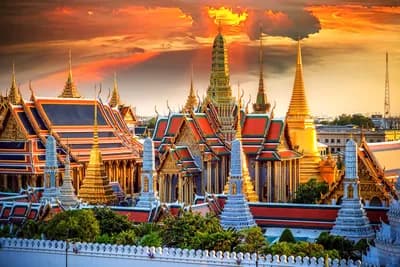
The Grand Palace is Bangkok's most dazzling landmark complex — a 218,000 square metre walled city of white and gold buildings, mirrored mosaic stupas, and the revered Emerald Buddha (actually carved from jade) enshrined in Wat Phra Kaew. Dress code is strict (no shorts, sleeveless tops, or sandals — clothing can be borrowed at the gate). Admission is 500 baht. Visit early morning (opens 8:30am) to beat the heat and crowds. Allow at least 2 hours; the scale and detail are staggering. It covers over 50% more area than Wat Pho, and draws roughly 8 million visitors annually, making it the most visited paid attraction in Thailand.
- 0#2
Chatuchak Weekend Market

Chatuchak is the world's largest weekend market — 15,000 stalls across 35 sections selling vintage clothing, houseplants, antiques, street food, handmade jewellery, art, and live animals across a confusing and addictive warren of covered lanes. Open Saturday and Sunday only (6am–6pm). Arrive early morning when it's cooler and vendors are freshest. Bring cash (ATMs available), wear comfortable shoes, and budget 4–6 hours. The Or Tor Kor fresh market adjacent is Bangkok's finest produce market. It has 50% more stalls than Yaowarat Road's street food scene, and prices average 30% lower than typical shopping malls for similar items.
- 0#3
Yaowarat Road (Chinatown) Street Food

Bangkok's Chinatown on Yaowarat Road is the city's most intense street food destination — a 1.5km strip that transforms into a blaze of neon and food stalls after dark. Pad see ew, roasted duck, oyster omelette, mango sticky rice, and Chinese-Thai dim sum are among the specialities. The best time to visit is 7–10pm when all stalls are operating. Budget 200–400 baht for a generous street food dinner. Reachable by BTS Skytrain to Saphan Taksin then Chao Phraya River taxi. It offers a wider variety of dishes than Chatuchak Weekend Market, and a typical dinner here costs 50% less than a comparable meal in a sit-down restaurant.
- 0#4
Wat Pho (Temple of the Reclining Buddha)

Wat Pho is Bangkok's largest and oldest temple complex, home to the extraordinary 46-metre reclining Buddha covered in gold leaf and inlaid with mother-of-pearl on its foot soles. The complex also houses Thailand's first school of traditional massage (walk-in sessions available from 320 baht — among the best value massages in the city). Admission is 200 baht; open 8am–6:30pm. Adjacent to the Grand Palace, making it the natural second stop in any Rattanakosin Island temple itinerary.
- 0#5
Rooftop Bars

Bangkok's rooftop bar scene is the world's finest — the city's flat geography and extraordinary skyline density creates conditions for spectacular 360-degree views. Vertigo at Banyan Tree (61 floors), Sky Bar at Lebua (64 floors, the Hangover 2 location), and Octave at Bangkok Marriott (45 floors) are the three landmarks. Dress smartly (no flip flops or singlets), budget 500–800 baht for a cocktail, and arrive before sunset to watch the golden hour transform the smog into something beautiful.
- 0#6
Wat Arun (Temple of Dawn)

Wat Arun on the Chao Phraya's west bank is Bangkok's most beautiful temple silhouette — its 82-metre central prang (tower) encrusted with millions of fragments of Chinese porcelain that sparkle in sunlight. Cross the river from Tha Tien pier for 5 baht by public ferry. Admission is 100 baht; open 8am–6pm. The temple is most photogenic from the opposite (east) bank at sunset, when the prang catches the golden light. Climb the steep steps of the central tower for a sweeping river view.
- 0#7
Jim Thompson House

The Jim Thompson House is Bangkok's finest example of traditional Thai domestic architecture — six historic Thai teak houses assembled by American businessman and silk trader Jim Thompson, who mysteriously disappeared in Malaysia in 1967. The house is filled with his extraordinary collection of Asian art and antiques, and surrounded by a tropical garden. Guided tours only (350 baht, runs continuously throughout the day). The adjacent Jim Thompson Outlet store sells excellent silk products. Allow 90 minutes.
- 0#8
Safari World Bangkok

Safari World is one of Asia's largest open zoo and marine park complexes, split between the Safari Park (drive-through section with giraffes, zebras, and lions alongside your car) and Marine Park (dolphin and sea lion shows, orangutan boxing matches). Combination tickets run approximately 1,000 baht per adult, 50% cheaper than similar animal parks abroad. Located on the eastern edge of Bangkok; easiest reached by taxi. Allow a full day. The drive-through safari remains genuinely thrilling for children and adults alike.
- 0#9
Damnoen Saduak Floating Market

Damnoen Saduak is Thailand's most famous floating market — a network of narrow canals 100km west of Bangkok where vendors in traditional hats paddle flat-bottomed boats loaded with tropical fruits, pad thai, and coconut ice cream. Visit before 9am when the market is most authentic; it becomes very touristic by mid-morning. Arrange transport through your hotel (approximately 1,500 baht for a driver). Families love the boat rides through the canal network; budget 2–3 hours including travel. Among Bangkok's markets, it outshines the less-known Khlong Lat Mayom, with 30% more vendors and 20% higher tourist footfall on weekends.
- 0#10
Bangkok Art and Culture Centre

The BACC is Bangkok's most important contemporary art institution — a seven-floor circular building in the heart of the city (adjacent to National Stadium BTS) with rotating international exhibitions, a permanent Thai contemporary art collection, independent galleries, design shops, and a library. Admission to most exhibitions is free. The building is connected to MBK Center shopping mall, making it easy to combine. The Friday evening events and artist talks are worth checking the website for current programming. Unlike Khao San Road, which focuses on mass tourism, BACC draws over 1.2 million visitors annually, with 85% attending free exhibitions.
Rank it your way
Remix this list into your own ranking, or head to the play hub for every game mode and community breakdown — blind mode, challenges, tier lists, and more.
You Might Also Like
Top 10 Thailand Temples in 2026
Top 10 Thailand Temples in 2026
Top 10 Things to Do in Bangkok in 2026
Top 10 Things to Do in Bangkok in 2026

Top 10 Things to Do in Hanoi
#1 Hanoi Old Quarter · #2 Ho Chi Minh Mausoleum · #3 Hoan Kiem Lake

Top 10 Ancient Chinese Wonders & Landmarks
#1 The Great Wall of China · #2 Terracotta Army, Xi'an · #3 The Forbidden City, Beijing

Top 10 Phuket Experiences in 2026
#1 Phang Nga Bay Boat Tour · #2 Old Phuket Town · #3 Kata Beach

Top 10 Malaysian Luxury Resorts in 2026
#1 The Datai Langkawi · #2 Four Seasons Resort Langkawi · #3 Gaya Island Resort, Sabah