
Photo via Unsplash
Top 10 Quantum Computing Platforms and Applications Transforming Enterprise in 2026
Quantum computing fractured into distinct strategies in 2025–2026. **IBM Quantum** (Qiskit: 40K+ GitHub stars, 250K+ users, free tier) remains the entry point for chemistry/optimization—start with `pip install qiskit && qiskit-ibm-runtime`. **IonQ** (trapped-ion: <0.5% gate error, 15+ production qubits as of Q3 2026, cloud-native API, ~$0.003–$0.01 per task) excels at accuracy-critical finance and molecular modeling where gate fidelity outweighs qubit count. **Rigetti** (Hybrid Quantum-Classical: Aspen-M series 80+ qubits, PyQuil ecosystem, GitHub 2K+ stars) captures users iterating on QAOA/VQE algorithms requiring classical-quantum tight loops—`pip install pyquil`. **D-Wave** (5000+ qubit annealer: Advantage2 platform, GitHub 1.5K+ stars) dominates discrete combinatorics (supply-chain, portfolio optimization)—10–100× speedup vs. gate platforms *for NP-hard problems only*, not general algorithms—`pip install dwave-ocean-sdk`. Key tradeoff: gate platforms (IBM/IonQ/Rigetti) scale toward 100–1000 qubits but face decoherence walls (50–500µs coherence); annealers solve one class of problems instantly. Error rates: trapped-ion ≤0.1% (IonQ), superconducting 0.3–0.8% (IBM 2026-gen), annealing error depends on problem embedding. Pick by problem: quantum simulation → IBM; high-precision finance → IonQ; algorithm experimentation → Rigetti; combinatorial optimization → D-Wave.
Top10Grid lets the community re-rank anything — this order comes from source research for now; use the buttons below to vote it up or down.

Current Rankings
- 0

IBM Quantum earns the top spot by offering the most complete end-to-end enterprise ecosystem, featuring cloud access to dozens of live processors, the Qiskit SDK with over 600,000 developers, and a 160-member IBM Quantum Network. The Kookaburra architecture links 1,386 qubits across three chips, enabling a 4,000+ qubit interconnected system via IBM Quantum System Two. A March 2026 partnership with Cleveland Clinic demonstrated hybrid molecular simulations for drug discovery, publishing measurable advances in enzyme modeling. Pricing ranges from free developer access to enterprise contracts exceeding $500,000 annually, with over 1.7 trillion circuits run, making the network effect unmatched.
- 0

Quantinuum's H-Series sets the gold standard in fidelity, with the System Model H2 featuring 56 physical qubits, all-to-all connectivity, and 99.8% two-qubit gate fidelities — a different architecture from superconducting chips like Google's Willow, trading raw qubit count for connectivity and low error rates. H2 holds the industry record for highest quantum volume and CLOPS benchmarks, and the Microsoft partnership demonstrated reliable logical qubits with below-threshold error rates. RIKEN procured a full H2 in April 2026, while Helios upgrades to about 100 qubits with errors below 5×10⁻⁴. Quantinuum targets universal fault-tolerant computing by 2030, with enterprise partners like AstraZeneca, Merck, and JPMorgan Chase using the InQuanto platform and TKET compiler for hybrid workflows.
- 0

The 105-qubit superconducting processor targets computational chemistry, materials science, and high-energy physics, with applications in battery materials and catalyst design. Willow opened to UK researchers via the NQCC in December 2025, backed by over $3 billion in lifetime investment. CEO Sundar Pichai committed to real-world quantum-only applications within five years, leveraging Google's massive ML infrastructure from its Santa Barbara lab.
- 0
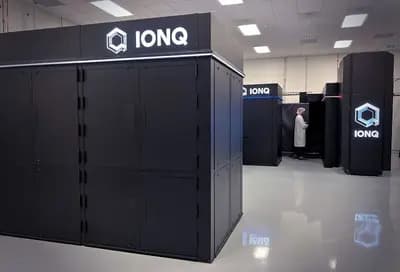
IonQ Forte Enterprise delivers 36 algorithmic qubits with all-to-all connectivity and a 99.99% two-qubit gate fidelity world record, making its effective computational power equivalent to larger, connectivity-constrained systems like IBM's Heron. The rack-mounted design installs in standard data centers without cryogenic labs, and EPB in Chattanooga deployed the first commercial hub in 2025. Q1 2026 saw the first 6th-gen 256-qubit chip system shipped to clients. A 2025 collaboration with AstraZeneca, NVIDIA, and Amazon reported a 20x improvement in drug discovery time-to-solution for molecular docking via Amazon Braket. IonQ achieved 202% year-over-year GAAP revenue growth in 2025, with organic compute business growing 80%.
- 0
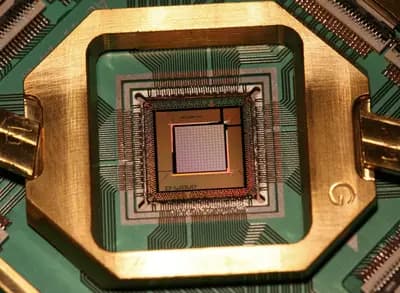
D-Wave's Advantage2 system is the only quantum platform achieving widespread, production-level enterprise deployment in 2026. This 4,400+ qubit quantum annealer, generally available since May 2025, runs live workflows in logistics, defense, healthcare, and financial services. Customer usage surged 314% year-over-year in 2025, and hybrid solver usage grew 114% in six months. Advantage2 finds optimal solutions for combinatorial optimization problems by encoding them into a physical system's minimum energy state. It delivers doubled coherence time versus its predecessor and a 40% increase in energy scale. Defense partnerships with Anduril and Davidson Technologies achieved a 10x speedup in missile-defense trajectory optimization. Leap cloud subscriptions start at $3,000 per month.
- 0
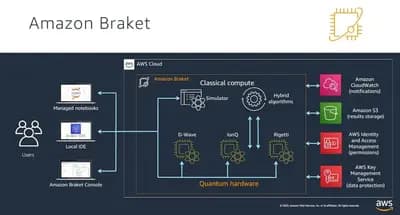
Amazon Braket stands out as the enterprise orchestration layer for quantum computing, competing on integration rather than hardware. It provides managed cloud access to IonQ, Rigetti, QuEra, and OQC processors alongside AWS's proprietary Ocelot chip and high-performance simulators. For enterprises on AWS, native integration with IAM, VPC, CloudWatch, and SageMaker minimizes operational disruption. In February 2025, AWS unveiled the Ocelot chip using cat qubits that suppress environmental noise exponentially, reducing error-correction overhead. Braket Hybrid Jobs offers the most mature hybrid quantum-classical orchestration, automating EC2 compute provisioning alongside QPU access. A landmark 2025 collaboration with IonQ, AstraZeneca, and NVIDIA demonstrated a 20x drug discovery speedup, proving Braket's role as connective tissue between quantum hardware and classical ML/HPC.
- 0
Microsoft Azure Quantum leads with a long-term bet on topological qubits, using Majorana quasi-particles for inherently error-resistant quantum computing. This approach stores information in topological properties, resisting local noise and requiring fewer physical qubits per logical qubit. The Majorana 1 processor, delivered in early 2025, was the first chip to host and braid topological qubits, and Majorana 2 in late 2025 achieved unprecedented stability. Microsoft targets a scalable quantum computer by 2029. Azure Quantum aggregates hardware from IonQ, Quantinuum, Rigetti, and Pasqal alongside its own Majorana platform, offering multi-vendor access via Azure. The Q# language, Quantum Development Kit, and Copilot for algorithm assistance enable enterprise developers to build hybrid solutions. Over 300 enterprise customers actively use Azure Quantum for simulation and optimization, with defense, pharmaceutical, and financial services as leading verticals.
- 0
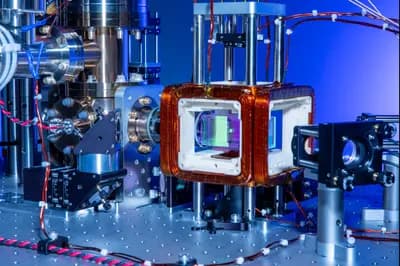
QuEra Computing's neutral-atom platform, accessed via Amazon Braket, had a breakthrough year in 2025, establishing neutral atoms as a top contender for fault-tolerant quantum computing. The Aquila processor, from Harvard and MIT spinout, demonstrated continuous operation of a 3,000-qubit array for over two hours, solving the atom loss problem. Researchers achieved up to 96 logical qubits with below-threshold error rates—the largest fault-tolerant demonstration of any quantum system. Unlike superconducting qubits, neutral atoms are identical and interchangeable, eliminating manufacturing variation; unlike trapped ions, they reconfigure mid-computation using optical tweezer arrays for dynamic connectivity. The platform scales to thousands of qubits without bottlenecks. QuEra raised over $230 million in 2025 from Google Quantum AI, NVIDIA, and SoftBank. Enterprise partnerships include BCG X, Deloitte Japan, Merck, Amgen, Dell, and NVIDIA, with Dell integrations proving neutral-atom QPUs function as standard data center accelerators.
- 0
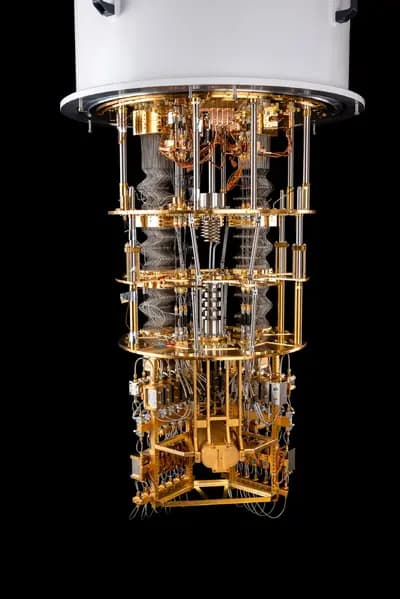
Rigetti Ankaa-3 delivers the most accessible high-performance superconducting quantum computing in 2026, with its 84-qubit system achieving a 99.5% median two-qubit gate fidelity—competitive with IBM Heron on a per-gate basis. Launched in December 2024 and available on Amazon Braket and Microsoft Azure Quantum by Q1 2025, it leverages the Cepheus-1 chiplet architecture, where multiple 9-qubit chiplets interconnect to form larger arrays. A 36-qubit variant (Cepheus-1-36Q) validated this modular approach in 2025, achieving 99.5% fidelity across four interconnected chiplets. Rigetti's cloud operations, running continuously since 2017, outlasts any rival, offering the most mature quantum cloud infrastructure. Its Quantum Cloud Services platform provides directly accessible, low-latency processor access—critical for iterative algorithms. Clients span finance, insurance, pharmaceuticals, defense, and energy, with $5.7 million in 2025-2026 purchase orders for two on-premises systems. The roadmap projects 100+ qubit systems with sub-1% two-qubit error rates by late 2026.
- 0
Xanadu Aurora achieves a genuine paradigm breakthrough as the world's first commercially operational modular, networked photonic quantum computer, operating at room temperature—unlike Rigetti Ankaa-3 and every other platform here that requires near-absolute zero cooling. Introduced in early 2025, it harnesses 12 physical qubits across 35 integrated photonics chips linked via fiber-optic quantum interconnects, demonstrating real-time error correction in a production setup. Photons traveling through silicon photonic circuits enable computations over existing fiber-optic networks. Its PennyLane software platform is the most widely adopted quantum programming framework, used by 47% of quantum programmers (161% adoption growth in 2025) and supporting Xanadu, IBM Qiskit, and IonQ systems from a unified interface. Xanadu went public on Nasdaq and the Toronto Stock Exchange on March 27, 2026, raising $302 million, with revenue quadrupling in the twelve months prior. The photonic roadmap targets 50-100 qubit processing units by 2026-2027, leveraging standard semiconductor fabrication.
Frequently Asked Questions About Quantum Computing Platforms
What is a quantum computing platform? A quantum computing platform gives companies and developers access to quantum processors — either real hardware or simulators — via the internet. Instead of buying million-dollar equipment, you pay per task or subscribe to a cloud service. IBM, Google, IonQ, and others all offer this today.
Which platform is the easiest to try first? IBM Quantum is widely considered the most beginner-friendly option. It offers free cloud access, a large community of over 250,000 registered users, and extensive learning resources at [learning.quantum.ibm.com](https://learning.quantum.ibm.com).
Are quantum computers being used in real businesses right now? Yes. As of 2026, platforms like D-Wave (optimization), IonQ (finance and drug discovery), and Amazon Braket (enterprise orchestration) are running genuine production workloads. IBM maintains a library of enterprise case studies at [ibm.com/quantum](https://www.ibm.com/quantum).
How much does it cost to use a quantum platform? Pricing varies. IBM offers a free tier for experimentation. IonQ charges approximately $0.003–$0.01 per quantum task on AWS. D-Wave's Leap cloud includes a free developer allowance each month.
Which industries benefit the most from quantum computing? Financial services (portfolio optimization, fraud detection), pharmaceuticals (drug discovery, molecular simulation), logistics (route optimization), and cybersecurity (post-quantum encryption) are the leading enterprise use cases in 2026.
Image credits
- IBM Quantum (Heron + Kookaburra Architecture): Bing Images / itsocial.fr
- Quantinuum H-Series (H2 + Helios): Bing Images / www.webbikeworld.com
- Google Quantum AI (Willow Chip): Google Quantum AI / Wikipedia
- IonQ Forte Enterprise: Bing Images / media.datacenterdynamics.com
- D-Wave Advantage2 (Quantum Annealing Platform): D-Wave Systems / Wikipedia
- Amazon Braket (Quantum Cloud Aggregator): Bing Images / specials-images.forbesimg.com
- QuEra Computing (Aquila Neutral-Atom Platform): Bing Images / d2908q01vomqb2.cloudfront.net
- Rigetti Ankaa-3 (84-Qubit Superconducting Cloud): Bing Images / cdn.autodaily.co.kr
Related Videos
Rank it your way
Remix this list into your own ranking, or head to the play hub for every game mode and community breakdown — blind mode, challenges, tier lists, and more.
You Might Also Like

Top 10 AI Tools Changing Everything in 2026
AI tools changing everything in 2026

10 Quantum Computing Breakthroughs That Actually Matter in 2026
quantum computing breakthroughs

Top 10 Tech Hubs in the USA 2026
Top 10 Tech Hubs in the USA 2026

Top 10 US IoT Companies
#1 Cisco IoT · #2 Microsoft Azure IoT · #3 Amazon AWS IoT

Top 10 US Logistics Tech Companies
#1 FedEx · #2 UPS · #3 Amazon Logistics

Top 10 US Climate Technology Companies
#1 NextEra Energy · #2 First Solar · #3 Sunrun