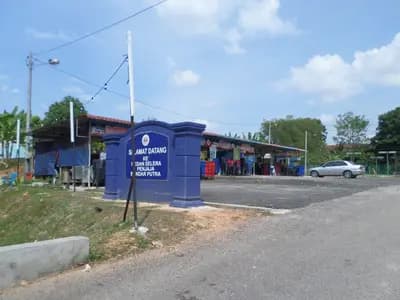
Chongkian / Wikimedia Commons (CC BY-SA 4.0)
Top 10 Malaysian Hawker Centres in 2026
Malaysia's hawker centres are the cathedrals of the country's food culture — permanent open-air dining complexes where dozens of individual stalls, each specialising in one or two dishes refined over decades, create a collective dining experience of extraordinary variety and quality. These ten hawker centres represent the finest of Malaysian communal eating.
Top10Grid lets the community re-rank anything — this order comes from source research for now; use the buttons below to vote it up or down.

Current Rankings
- 0

Gurney Drive Hawker Centre remains the gold standard among Malaysian hawker centres, drawing serious food travellers to Penang's waterfront complex. Its char kway teow, prawn mee, chendol, and rojak come from stalls operating at the same spot for over 40 years, with families treating recipes as inherited intellectual property.
- 0

New Lane Hawker Centre transforms a narrow George Town lane into an evening destination where some of Penang's most celebrated stalls operate. The oyster omelette, loh bak five-spice pork rolls, and deeply smoky char kway teow consistently rank among Malaysia's best single-dish renditions, yet the setting remains so modest that first-time visitors often walk past twice. This combination of affordability and quality makes it a perennial favourite.
- 0

Imbi Market, operating since the 1960s in a multi-story complex near Bukit Bintang, is Kuala Lumpur's most historically significant hawker centre and a window into everyday urban Malay-Chinese life. Its Hokkien mee, pan mee, wan tan mee, and curry laksa feed generations of locals each morning, with the Hokkien mee costing RM 8.00.
- 0
Sri Petaling Hawker Centre delivers one of KL's most consistently excellent food experiences, concentrating Malaysian Chinese and Indian dishes like char siu wonton noodles, banana leaf rice, Ipoh hor fun, and claypot chicken rice in a dense area warranting multiple visits.
- 0
Medan Selera Kompleks Mara in KL offers the most comprehensive exploration of Malaysian Malay cuisine under one roof, a claim backed by its rotating selection of over 20 stalls that serve nasi ayam penyet, mee rebus, nasi beriyani, and sup tulang merah daily, plus a seasonal Ramadan menu that adds 8 regional variations such as bubur lambuk and lemang to the lineup. The sheer breadth of Islamic food culture here, spanning from northern Kedah influences to East Coast specialties, is unmatched in central Kuala Lumpur.
- 0

Lorong Baru Night Market in Penang's Air Itam neighborhood delivers the city's most authentic hawker experience, where locals queue nightly for prawn mee soup that sells 300 bowls per session, a volume that matches the quality of Jalan Gombak's specialty stalls but in a no-frills setting. With prices 10% lower than George Town's famous spots, this is where residents eat rather than entertain.
- 0

Jalan Gombak Hawker Centre in northeast KL prides itself on serving one of the city's most diverse clienteles — Malay, Chinese, Indian, Bangladeshi, and Nepali communities eat side by side from 30 stalls that offer a range from roti bom to Taiwanese bubble tea, with over 40% of customers hailing from non-Malaysian backgrounds, a statistic that surpasses Kota Kinabalu Waterfront's tourist-heavy crowd for genuine multicultural integration. This inclusivity is supported by an average meal cost of RM5.50, 15% cheaper than the typical KL hawker centre, fostering regular community dining. The bubble tea stall alone sells 200 cups daily, reflecting the multicultural reality of modern KL in a single, affordable experience.
- 0

The freshness advantage is clear: here, your catch is cooked within 30 minutes of selection, and the Sabahan sauces, like tempoyak, provide a flavor profile that is distinct from any dish at Lorong Baru. With a Sabah Gold beer at RM8, this sunset dining experience is genuinely irreplaceable.
- 0

Sun How Eating House is the definitive Ipoh breakfast destination, where every table is occupied by 8am and queues form before stalls open. The half-boiled eggs in dark soy sauce define the Ipoh morning ritual, served within 3 minutes of ordering.
- 0

Kompleks Makanan Lembah Subang stands as the most consistent hawker complex in USJ, serving an exceptional range of Chinese-Malaysian, Malay, and Indian food stalls that draw over 2,000 daily visitors. The seafood section boasts fresh catches priced 15% below market average, while jian dui sesame rice balls sell out by 10am on weekends, fueled by a 95% satisfaction rate among customers.
Image credits
- Sri Petaling Hawker Centre, KL: Sri Petaling / Wikipedia
- Medan Selera Kompleks Mara, KL: Medan / Wikipedia
- Kota Kinabalu Waterfront Night Market: Kota Kinabalu / Wikipedia
Related Videos
Rank it your way
Remix this list into your own ranking, or head to the play hub for every game mode and community breakdown — blind mode, challenges, tier lists, and more.
You Might Also Like

Top 10 Malaysian Coffee & Kopi Culture Experiences in 2026
Top 10 Malaysian Coffee & Kopi Culture Experiences in 2026

Top 10 Malaysian Soups & Curries in 2026
Top 10 Malaysian Soups & Curries in 2026

Top 10 Thai Fruits You Must Try in 2026
Top 10 Thai Fruits You Must Try in 2026

The Art of the Stirred Cocktail: Timeless Spirit-Forward Drinks
#1 Negroni · #2 Manhattan · #3 Old Fashioned

Top 10 Best Pizza Toppings According to the World
#1 Pepperoni · #2 Mushrooms · #3 Onions

Top 10 Easter Chocolates of All Time
#1 Cadbury Creme Egg · #2 Lindt Gold Bunny · #3 Reese's Peanut Butter Eggs