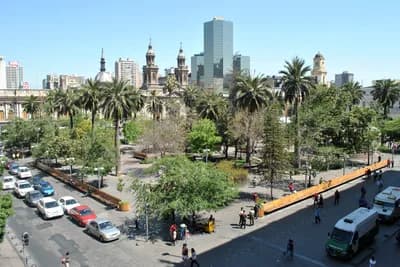
Santiago is a vibrant Andean capital that punches well above its weight in gastronomy, wine culture, and urban design, with the snow-capped Andes providing a dramatic backdrop visible from the city center on clear days. Chile's capital blends world-class contemporary art museums and craft cocktail bars with colonial plazas and a thriving literary culture. Day trips to the country's greatest wineries and coastal cities make Santiago one of South America's finest base camps for exploration.
Top 10 lists about this destination
Curated by our travel editors. Lived-experience picks weighted by community vote β updated as travelers report back.
Create a free account or sign in to join the discussion.
Sign in to join the conversation

Plaza de Armas is the founding square of Santiago de Chile, established by Pedro de Valdivia in 1541 and surrounded today by the Metropolitan Cathedral, the National History Museum, the Correo Central, and the Municipalidad de Santiago β all buildings that represent the city's most important civic and religious institutions. The square is animated daily by chess players, portrait artists, evangelical preachers, ice cream vendors, and pigeons that seem to outnumber the city's population, creating a democratic public space that feels genuinely Chilean in its casual energy. The surrounding block of colonial arcades contains the Correo bookshop and some of Santiago's oldest traditional restaurants.

Cerro San Cristobal is Santiago's most beloved urban park β a 722-metre hill rising from the Bellavista neighbourhood whose forested slopes contain the city zoo, a Japanese garden, two swimming pools, a Benedictine monastery with a shop selling honey, and the 22-metre Virgin Mary statue at the summit that watches over the entire metropolitan area with outstretched arms. The hill is accessible by funicular, cable car, or hiking trails and its summit terrace offers what is widely considered the finest panoramic view in Santiago β the entire city spread across the Mapocho River valley with the Andes wall of snowy peaks rising immediately behind. On clear winter mornings the Andes view from the summit is absolutely breathtaking.

La Chascona β "The Tangle-Haired Woman" β was Pablo Neruda's Santiago home, built in the 1950s in the Bellavista neighbourhood as a secret refuge for his love affair with Matilde Urrutia, whom the house is named for. The rambling three-storey structure with its ship-inspired curved walls, bar room built to resemble a ship's hull, and garden of coloured glass installations was designed by Neruda himself along with his two other extraordinary houses as a total artwork of autobiography in architecture. Today it is managed by the Neruda Foundation as a museum preserving his Nobel Prize medal, his extraordinary collection of mastheads, maps, and bar glasses, and the emotional record of one of the 20th century's greatest poets.

The Mercado Central de Santiago is Chile's greatest fish and seafood market β a spectacular cast-iron Victorian structure built in 1872 whose ornate wrought-iron roof, designed by the same Maison Eiffel atelier that built the Eiffel Tower, soars over hundreds of stalls and restaurant counters selling every species of Chilean Pacific seafood, from enormous conger eels and centolla king crabs to razor clams, sea urchins, and the pink reineta fish that Chileans prize above all others. The market's central restaurants are famously tourist-targeted, but the peripheral stalls where local fishermen eat at plastic tables serve the same fresh produce at a fraction of the price. The building alone, with its ornamental ironwork columns and clerestory skylights, is one of Santiago's finest heritage structures.

Barrio Lastarria is Santiago's most culturally concentrated neighbourhood β a compact grid of early 20th-century buildings around the Museum of Visual Arts and the Contemporary Art Museum that has become the city's gallery, bookshop, and outdoor cafe district. The Paseo Lastarria pedestrian street and adjacent Parque Forestal create a continuous outdoor living room of art students, musicians, tourists, and old Santiago families who have been meeting at the neighbourhood's cafe terraces since the 1940s. The neighbourhood's antique market on weekends, combined with its density of independent cinemas and theatre venues, makes it the intellectual heart of Santiago's cultural life.

Casablanca Valley is Chile's premier cool-climate wine region, a narrow coastal valley 90 kilometres west of Santiago where Pacific Ocean fog and breezes create growing conditions that produce some of South America's finest Sauvignon Blanc, Chardonnay, and Pinot Noir. The valley pioneered Chile's shift from bulk red wine to premium cool-climate white and rosΓ© production in the 1980s when Ignacio Recabarren planted the first experimental vines here and proved the potential of the Pacific influence. Today over 20 wineries offer cellar door visits and vineyard tastings accessible on a half-day drive from Santiago, with several combining stunning terroir landscapes with excellent restaurants.

Valparaiso, two hours west of Santiago on the Pacific coast, is Chile's most visually extraordinary city β a UNESCO World Heritage port of 42 steep hillsides (cerros) covered in an anarchic jumble of corrugated-iron houses painted in hundreds of colours, connected to the flat portside commercial district by 16 surviving funicular ascensores that have been transporting locals since the 1880s. The city's hillside streets are covered in world-class street art, the bohemian Cerro Alegre and Cerro Concepcion neighbourhoods contain some of Chile's best restaurants and boutique hotels, and the port district retains a rougher, working-class character that keeps the city honest. Pablo Neruda's cliffside house La Sebastiana is here and available for tours.

Cerro Santa Lucia is a 69-metre rocky outcrop in the heart of Santiago that Pedro de Valdivia chose as his lookout point when founding the city in 1541 and that was transformed in 1873 by Mayor Benjamin Vicuna Mackenna into one of the most elaborate romantic gardens in South America. The hill is covered with cascading stone terraces, neo-Gothic towers, fountains, balustrades, and belvederes connected by zigzag pathways that make every turn a discovery, and a small castle at the summit provides views across the city centre rarely accessible from ground level. It is Santiago's most beloved city park and one of the most beautiful urban gardens anywhere in Latin America.

The Museum of Memory and Human Rights is one of the most important and emotionally powerful human rights museums in the world β a 2010 building by Brazilian architects Tomas Landsmann and Carlos Dias dedicated to documenting the systematic human rights violations committed by Pinochet's military dictatorship between 1973 and 1990, including the forced disappearance of over 3,000 people and the torture of tens of thousands. The permanent exhibition uses personal testimonies, audiovisual records, documents, and recovered personal effects to create an immersive record of state terror and its long aftermath in Chilean society. The museum's commitment to memory as a prerequisite for democracy has made it a model for truth and reconciliation institutions globally.

Concha y Toro, founded in 1883 in Pirque 30 kilometres south of Santiago, is Latin America's largest wine producer and the world's most powerful wine brand by volume β exporting to 150 countries and producing over 100 million bottles annually including its iconic Casillero del Diablo range and the trophy wine Don Melchor, consistently rated one of South America's greatest Cabernet Sauvignons. The winery's hacienda grounds include century-old cellars where the legendary "Devil's Cellar" story began β founder Melchor de Concha y Toro reportedly spread rumours of a devil guarding his best wines to deter workers from drinking them. The guided tour and tasting, ending in the historic bodega with a glass of Don Melchor, is one of the most rewarding winery visits in the Southern Hemisphere.
The most-voted lists across every category β curated weekly. Join the early readers.
No spam. One email per week. Unsubscribe anytime.
Explore more Travel rankings on Top10Grid
Cast your vote above to unlock the real distribution
Tap the arrows on any item to vote
Because you're viewing Travel
Top 10 Latin American Travel Destinations
140 views Β· 0 votes

Top 10 Budget Summer Travel Destinations Under $75 Per Night in 2026
133 views Β· 0 votes

Travel Books That Make You Book a Plane Ticket
124 views Β· 1 votes

Top 10 Hotels in Hong Kong 2026
123 views Β· 0 votes

Top 10 Best Christmas Markets in Europe
115 views Β· 0 votes

Top 10 Best Beaches in the World
112 views Β· 0 votes

Plaza de Armas is the founding square of Santiago de Chile, established by Pedro de Valdivia in 1541 and surrounded today by the Metropolitan Cathedral, the National History Museum, the Correo Central, and the Municipalidad de Santiago β all buildings that represent the city's most important civic and religious institutions. The square is animated daily by chess players, portrait artists, evangelical preachers, ice cream vendors, and pigeons that seem to outnumber the city's population, creating a democratic public space that feels genuinely Chilean in its casual energy. The surrounding block of colonial arcades contains the Correo bookshop and some of Santiago's oldest traditional restaurants.

Cerro San Cristobal is Santiago's most beloved urban park β a 722-metre hill rising from the Bellavista neighbourhood whose forested slopes contain the city zoo, a Japanese garden, two swimming pools, a Benedictine monastery with a shop selling honey, and the 22-metre Virgin Mary statue at the summit that watches over the entire metropolitan area with outstretched arms. The hill is accessible by funicular, cable car, or hiking trails and its summit terrace offers what is widely considered the finest panoramic view in Santiago β the entire city spread across the Mapocho River valley with the Andes wall of snowy peaks rising immediately behind. On clear winter mornings the Andes view from the summit is absolutely breathtaking.

La Chascona β "The Tangle-Haired Woman" β was Pablo Neruda's Santiago home, built in the 1950s in the Bellavista neighbourhood as a secret refuge for his love affair with Matilde Urrutia, whom the house is named for. The rambling three-storey structure with its ship-inspired curved walls, bar room built to resemble a ship's hull, and garden of coloured glass installations was designed by Neruda himself along with his two other extraordinary houses as a total artwork of autobiography in architecture. Today it is managed by the Neruda Foundation as a museum preserving his Nobel Prize medal, his extraordinary collection of mastheads, maps, and bar glasses, and the emotional record of one of the 20th century's greatest poets.

The Mercado Central de Santiago is Chile's greatest fish and seafood market β a spectacular cast-iron Victorian structure built in 1872 whose ornate wrought-iron roof, designed by the same Maison Eiffel atelier that built the Eiffel Tower, soars over hundreds of stalls and restaurant counters selling every species of Chilean Pacific seafood, from enormous conger eels and centolla king crabs to razor clams, sea urchins, and the pink reineta fish that Chileans prize above all others. The market's central restaurants are famously tourist-targeted, but the peripheral stalls where local fishermen eat at plastic tables serve the same fresh produce at a fraction of the price. The building alone, with its ornamental ironwork columns and clerestory skylights, is one of Santiago's finest heritage structures.

Barrio Lastarria is Santiago's most culturally concentrated neighbourhood β a compact grid of early 20th-century buildings around the Museum of Visual Arts and the Contemporary Art Museum that has become the city's gallery, bookshop, and outdoor cafe district. The Paseo Lastarria pedestrian street and adjacent Parque Forestal create a continuous outdoor living room of art students, musicians, tourists, and old Santiago families who have been meeting at the neighbourhood's cafe terraces since the 1940s. The neighbourhood's antique market on weekends, combined with its density of independent cinemas and theatre venues, makes it the intellectual heart of Santiago's cultural life.

Casablanca Valley is Chile's premier cool-climate wine region, a narrow coastal valley 90 kilometres west of Santiago where Pacific Ocean fog and breezes create growing conditions that produce some of South America's finest Sauvignon Blanc, Chardonnay, and Pinot Noir. The valley pioneered Chile's shift from bulk red wine to premium cool-climate white and rosΓ© production in the 1980s when Ignacio Recabarren planted the first experimental vines here and proved the potential of the Pacific influence. Today over 20 wineries offer cellar door visits and vineyard tastings accessible on a half-day drive from Santiago, with several combining stunning terroir landscapes with excellent restaurants.

Valparaiso, two hours west of Santiago on the Pacific coast, is Chile's most visually extraordinary city β a UNESCO World Heritage port of 42 steep hillsides (cerros) covered in an anarchic jumble of corrugated-iron houses painted in hundreds of colours, connected to the flat portside commercial district by 16 surviving funicular ascensores that have been transporting locals since the 1880s. The city's hillside streets are covered in world-class street art, the bohemian Cerro Alegre and Cerro Concepcion neighbourhoods contain some of Chile's best restaurants and boutique hotels, and the port district retains a rougher, working-class character that keeps the city honest. Pablo Neruda's cliffside house La Sebastiana is here and available for tours.

Cerro Santa Lucia is a 69-metre rocky outcrop in the heart of Santiago that Pedro de Valdivia chose as his lookout point when founding the city in 1541 and that was transformed in 1873 by Mayor Benjamin Vicuna Mackenna into one of the most elaborate romantic gardens in South America. The hill is covered with cascading stone terraces, neo-Gothic towers, fountains, balustrades, and belvederes connected by zigzag pathways that make every turn a discovery, and a small castle at the summit provides views across the city centre rarely accessible from ground level. It is Santiago's most beloved city park and one of the most beautiful urban gardens anywhere in Latin America.

The Museum of Memory and Human Rights is one of the most important and emotionally powerful human rights museums in the world β a 2010 building by Brazilian architects Tomas Landsmann and Carlos Dias dedicated to documenting the systematic human rights violations committed by Pinochet's military dictatorship between 1973 and 1990, including the forced disappearance of over 3,000 people and the torture of tens of thousands. The permanent exhibition uses personal testimonies, audiovisual records, documents, and recovered personal effects to create an immersive record of state terror and its long aftermath in Chilean society. The museum's commitment to memory as a prerequisite for democracy has made it a model for truth and reconciliation institutions globally.

Concha y Toro, founded in 1883 in Pirque 30 kilometres south of Santiago, is Latin America's largest wine producer and the world's most powerful wine brand by volume β exporting to 150 countries and producing over 100 million bottles annually including its iconic Casillero del Diablo range and the trophy wine Don Melchor, consistently rated one of South America's greatest Cabernet Sauvignons. The winery's hacienda grounds include century-old cellars where the legendary "Devil's Cellar" story began β founder Melchor de Concha y Toro reportedly spread rumours of a devil guarding his best wines to deter workers from drinking them. The guided tour and tasting, ending in the historic bodega with a glass of Don Melchor, is one of the most rewarding winery visits in the Southern Hemisphere.

Top 10 Best Cities in the World to Live In 2026 β Quality of Life Ranked and Explained
206 views Β· @admin

Top 10 Thailand Temples in 2026
77 views Β· @admin
Top 10 Most Spectacular Waterfalls in the World
52 views Β· @admin

Top 10 Things to Do in Bangkok in 2026
41 views Β· @admin

Top 10 Best Solo Travel Destinations
40 views Β· @admin
Top 10 Things to Do in Mexico City 2026
40 views Β· @admin