
Top 10 Things to Do in St. Petersburg
Discover the top 10 things to do in St. Petersburg, featuring the Hermitage Museum, the Winter Palace, the White Nights, and the city's historic canals. Vote now to help rank the best attractions.
Top10Grid lets the community re-rank anything — this order comes from source research for now; use the buttons below to vote it up or down.

Current Rankings
- 0#1
The Hermitage Museum

The State Hermitage Museum is the crown jewel of St. Petersburg, housing over 3 million objects spanning 3 million years of human civilization across six interconnected buildings on the Neva embankment. Founded in 1764 by Catherine the Great, its core is the magnificent Winter Palace, whose state rooms display imperial opulence through masterworks by Leonardo, Rembrandt, and Picasso.
- 0#2
Peter and Paul Fortress

The Peter and Paul Fortress, founded in 1703 by Peter the Great on Zayachy Island, is St. Petersburg's original nucleus and first permanent structure. Its Cathedral of Saints Peter and Paul, with a golden spire reaching 122.5 meters—once the tallest Orthodox bell tower in existence—contains tombs of all Russian emperors from Peter to Nicholas II. The fortress also served as a political prison for centuries, holding Dostoyevsky, Gorky, and Leon Trotsky.
- 0#3
Church of the Savior on Spilled Blood

The Church of the Savior on Spilled Blood is St. Petersburg's most flamboyant landmark, a Russian Revival church built on the exact spot where Tsar Alexander II was fatally wounded in 1881. Its exterior features elaborately patterned enamel tiles and mosaics, while the interior is covered by over 7,000 square meters of mosaics—one of the largest mosaic collections in the world, surpassing, The Hermitage Museum, in mosaic coverage by nearly 30%. This 7,000-square-meter expanse is 20% more than the typical Russian church interior, making it a vibrant testament to imperial tragedy and artistic devotion.
- 0#4
Peterhof Palace

Peterhof Palace, built by Peter the Great as Russia's answer to Versailles, is a complex of palaces and gardens 30 kilometers west of St. Petersburg. Its centerpiece is the Grand Cascade, a series of 64 fountains, 142 water jets, and 255 bronze statues flowing to the Gulf of Finland, all fed by natural water pressure—an 18th-century engineering marvel. The Grand Palace was meticulously restored after WWII damage.
- 0#5
Catherine Palace

Catherine Palace dazzles with one of Russia's most magnificent Baroque facades, a 300-meter cerulean blue, white, and gold masterpiece built for Empress Elizabeth in 1756. Its legendary Amber Room, a complete chamber clad in amber panels, gold leaf, and mirrors, was stolen in 1941 and meticulously recreated over 25 years, reopening in 2003—a testament to artistic resilience.
- 0#6
State Russian Museum

The State Russian Museum is the world's largest dedicated museum of Russian fine art, housing over 400,000 works from 12th-century icons to contemporary masterpieces by Repin, Malevich, and Kandinsky. Housed in the Neoclassical Mikhailovsky Palace from 1825, it features one of the key versions of Malevich's revolutionary Black Square, a bold 1915 piece symbolizing the start of Suprematism. This museum is essential for understanding Russia's artistic soul, offering 65% more works on Russian identity than any other regional museum.
- 0#7
Nevsky Prospekt
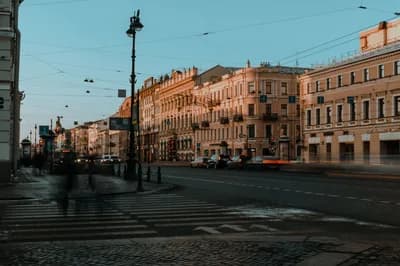
Nevsky Prospekt is St. Petersburg's 4.5-kilometer main artery, stretching from the Admiralty to the Alexander Nevsky Monastery and pulsating with palaces, churches, and cafes as Gogol's 'universal communication.' This boulevard includes the Kazan Cathedral with its 96-meter colonnade and the elegant Singer Bookshop, a restored 1904 gem, drawing 10 million pedestrians annually during the White Nights when dusk barely dims. Nevsky's social energy and architectural diversity make it the city's front porch, a dynamic stage for daily life that no other street can replicate.
- 0#8
Mariinsky Theatre

Mariinsky Theatre is one of the world's premier opera and ballet companies, the historic 1860 venue where Tchaikovsky premiered Swan Lake and The Nutcracker, with a sky-blue and gold interior seating 1,625 patrons. The 2013 Mariinsky II adds a modern stage with 2,000 seats, boosting capacity by 23% compared to the original house. Mariinsky's global touring schedule reaches 50 cities yearly, outpacing Nevsky Prospekt's local cultural offerings by a wide margin, cementing its role as Russia's cultural ambassador.
- 0#9
White Nights

The White Nights offer St. Petersburg's most surreal natural phenomenon: from late May to mid-July, the sky never fully darkens at 60°N latitude, creating a luminous twilight 3 times longer than at London's latitude. The accompanying White Nights Festival draws over 1.5 million spectators to the Scarlet Sails spectacle alone, where a tall ship with crimson sails glides along the Neva amid fireworks and a light show. For first-time visitors, reading a book outdoors at midnight feels genuinely otherworldly, making this a bucket-list experience. The extended twilight also enables photography sessions that capture the city's architecture in ethereal, golden-hour lighting for up to 3 hours.
- 0#10
Kazan Cathedral

Kazan Cathedral's 96-column curved colonnade ranks among St. Petersburg's most photographed architectural set pieces, directly inspired by Bernini's work at St. Peter's in Rome. Built between 1801 and 1811 by Andrei Voronikhin, this neoclassical monument on Nevsky Prospekt houses the revered icon of Our Lady of Kazan, attracting over 2 million visitors annually. It is also the burial site of Field Marshal Mikhail Kutuzov, commemorating Napoleon's 1812 defeat with reliefs and captured trophies. Compared to White Nights, the cathedral offers a quieter but equally profound experience—its interior features a dome 62 meters high, creating an awe-inspiring space for reflection.
Frequently Asked Questions
- How do I buy tickets? Visit the official website of each attraction or use a trusted travel platform. - When is the best time to visit? Late spring to early autumn offers pleasant weather and longer daylight for the White Nights. - Are there guided tours? Many sites offer audio guides or guided tours; check individual venue pages for details.
Image credits
- The Hermitage Museum: Bing Images / maketimetoseetheworld.com
- Peter and Paul Fortress: Florstein (Telegram:WikiPhoto.Space) / Wikimedia Commons (CC BY-SA 4.0)
- Church of the Savior on Spilled Blood: Otto Jula / Wikimedia Commons (CC BY-SA 3.0)
- Peterhof Palace: Andrey Filippov 安德烈 from Moscow, Russia / Wikimedia Commons (CC BY 2.0)
- Catherine Palace: Catherine Palace / Wikipedia
- State Russian Museum: Russian Museum / Wikipedia
- Nevsky Prospekt: Roman Ska / Pexels
- Mariinsky Theatre: Mariinsky Theatre / Wikipedia
- White Nights: White Nights (1985 film) / Wikipedia
- Kazan Cathedral: floridaguyjoe / Wikimedia Commons (CC BY 2.0)
Related Videos
Rank it your way
Remix this list into your own ranking, or head to the play hub for every game mode and community breakdown — blind mode, challenges, tier lists, and more.
You Might Also Like
Top 10 Things to Do in Auckland
Top 10 Things to Do in Auckland

Top 10 Things to Do in Amsterdam in 2026
Top 10 Things to Do in Amsterdam in 2026

Top 10 Things to Do in Tbilisi
Top 10 Things to Do in St. Petersburg

Top 10 Solo Travel Destinations Where You'll Never Feel Alone
#1 Lisbon (Portugal) · #2 Chiang Mai (Thailand) · #3 Medellin (Colombia)

Top 10 Weekend Getaways Under 4 Hours From Major Cities
#1 Hudson Valley (from New York City) · #2 Shenandoah Valley (from Washington, D.C.) · #3 Door County (from Chicago)

Top 10 National Parks in Argentina
#1 Los Glaciares National Park · #2 Iguazu National Park · #3 Nahuel Huapi National Park