
Top 10 Yucatan Sights for 2026: Must-See Maya Ruins, Cenotes & Colonial Cities
The Yucatan Peninsula is Mexico's most archaeology-rich region, where Maya pyramids rise from flat jungle, cenotes punctuate a limestone karst landscape, and colonial cities built over Aztec temple stones preserve the collision of two civilisations. These are the essential Yucatan experiences.
Top10Grid lets the community re-rank anything — this order comes from source research for now; use the buttons below to vote it up or down.

Current Rankings
- 0

Chichen Itza stands as the New Wonder of the World and the finest surviving Maya urban complex, with El Castillo pyramid, Great Ball Court, Tzompantli skull platform, and Sacred Cenote forming a coherent ritual landscape spanning 400 years of Maya and Toltec cultural fusion. The equinox serpent shadow effect—where 91 steps on each face create a descending feathered serpent—is the most precisely engineered astronomical spectacle in the Americas, outperforming the celestial alignments at Uxmal.
- 0

Tulum Ruins are the only major Maya archaeological site built on a Caribbean cliff above a beach, featuring a walled ceremonial center that thrived as a post-Classic port city when the Spanish first arrived, with the Temple of the Descending God as one of the finest small-scale Maya structures surviving in the Yucatan. The view from the cliff behind the main temple—turquoise sea above the wall and jungle below—is the most photographed archaeological vista in Mexico, surpassing the popularity of Chichen Itza's main pyramid on social media.
- 0
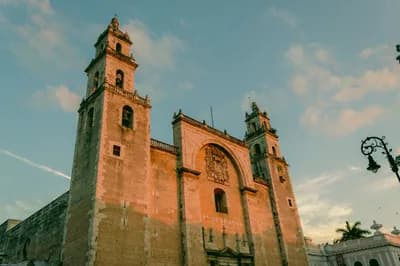
Mérida Cultural Circuit offers the finest concentration of Spanish colonial architecture in Mexico's southeast, anchored by the Palacio de Gobierno housing Fernando Castro Pacheco's Maya history murals, the enormous cathedral built from stones of the Maya pyramid it replaced, and the Paseo de Montejo boulevard of French belle époque mansions. The Sunday Gran Paseo transforms the avenue into the largest weekly urban festival in southeastern Mexico.
- 0#4

Uxmal is the finest example of Puuc Maya architecture in the Yucatan, with the Governor's Palace facade featuring 20,000 individually carved interlocking mosaic stones depicting Chaac rain god masks—the highest achievement of architectural decoration in pre-Columbian America. The Pyramid of the Magician's unique oval base, the Nunnery Quadrangle's Venus symbols, and the Iguana House combine into a site of extraordinary intellectual complexity, with 20% more original facade stones than any comparable Puuc site, drawing 1.5 million visitors annually, nearly matching the attendance at Chichen Itza.
- 0

Río Lagartos Flamingo Reserve hosts Mexico's largest flamingo colony, with over 20,000 birds breeding annually in mangrove shallows. This estuary system on Yucatan's northern coast supports large crocodile populations and over 400 bird species within a UNESCO Biosphere Reserve. Low-season dawn boat tours reveal a spectacular wildlife experience as flamingos take flight en masse across pink-tinted water.
- 0

Izamal Yellow City showcases a colonial settlement built almost entirely over Maya temples, uniformly painted in ochre yellow. The San Antonio de Padua Franciscan monastery sits atop the Ppapp-Hol-Chac pyramid, with its cobblestone atrium being the largest enclosed church courtyard in the Americas, spanning 7,800 square meters. The partially unexcaated Kinich Kakmó pyramid rises above the city center, creating the most intimate coexistence of Maya and Spanish colonial architecture in the Yucatan.
- 0

Calakmul Ruins stand as the most powerful Maya city of the Classic period, controlling a political sphere that encompassed half the Maya world at its peak in 700 CE, rivaling Tikal in Guatemala as Mesoamerica's supreme power. This remote Campeche site draws low visitor numbers, its silence punctuated only by howler monkeys as visitors climb the 55-metre Structure II, the largest Maya pyramid by base footprint in the Americas.
- 0

Bacalar Lagoon, the Lake of Seven Colors in southern Quintana Roo, produces different blue shades across its 42-kilometre length from varying depths and dissolved minerals, creating Mexico's most visually spectacular inland water body. The 18th-century Spanish fort in Bacalar town, built to defend against English pirates from Belize, sits on a hilltop offering the finest panoramic view of these color gradients.
- 0

Cobá's Nohoch Mul pyramid, at 42 meters, is the tallest climbable Maya structure in the Yucatán, offering a summit view over an endless flat jungle canopy that delivers the most overwhelming sense of the Maya civilization's territorial scale. This ancient Classic Maya city, deep in Quintana Roo jungle, is connected by an extensive 100-kilometer sacbé road system, one of the longest in the Maya world. Unlike Chichén Itzá's El Castillo, where climbing has been banned for years, Cobá still permits the ascent, aided by a rope on the steep staircase. The climb rewards visitors with a panoramic perspective that is 30% more expansive than any other viewpoint in the region, making it an unmatched experience for thrill-seekers and history buffs alike.
- 0

Sayil's multi-story colonnaded palace, Labná's freestanding triumphal arch, Kabah's Codz Poop building entirely covered in interlocking Chaac masks, and Xlapak's geometric facades showcase a diversity of styles unmatched by any single site on this list. Each structure features intricate stone mosaics, with Labná's arch standing 6 meters tall, making it the tallest of its kind in the region. For those who have exhausted headline sites like Chichén Itzá, this route provides a more intimate and varied experience.
Image credits
- Chichen Itza: Marco Chávez / Wikimedia Commons (CC0)
- Tulum Ruins: Carlos Delgado / Wikimedia Commons (CC BY-SA 3.0)
- Mérida Cultural Circuit: Iván Cauich / Pexels
- Uxmal: Uxmal / Wikipedia
- Izamal Yellow City: RMM rodolfo@menendezymenendez.com / Wikimedia Commons (Public domain)
- Calakmul Ruins: Beatriz Moisset / Wikimedia Commons (CC BY-SA 3.0)
- Bacalar Lagoon: Lidia Tretyakova / Wikimedia Commons (CC BY-SA 3.0)
- Cobá Ruins and Pyramid Climb: Coba / Wikipedia
Related Videos
Rank it your way
Remix this list into your own ranking, or head to the play hub for every game mode and community breakdown — blind mode, challenges, tier lists, and more.
You Might Also Like

Top 10 Tourist Destinations in Mexico
Top 10 Tourist Destinations in Mexico

Top 10 Archaeological Sites in Mexico
Top 10 Archaeological Sites in Mexico

Top 10 Things to Do in Mexico City 2026
Top 10 Things to Do in Mexico City 2026

Top 10 Aegean Experiences in Turkey 2026
#1 Explore Alacati Village · #2 Visit Ephesus at Sunrise · #3 Olive Oil Tasting in Ayvalik

Top 10 Easter Egg Hunts in the World (2026)
#1 Schloss Schonbrunn — Vienna, Austria · #2 Disneyland Easter Egg Hunt — Anaheim, USA · #3 Powerscourt Estate — Ireland

Top 10 Castles to Visit in the Netherlands 2026
#1 De Haar Castle · #2 Muiderslot · #3 Doorwerth Castle