
Julius Schorzman / Wikimedia Commons (CC BY-SA 2.0)
Top 10 Coffee Brands That Baristas Swear By
The people who pull 200 shots a day and can taste the difference between a 30-second and 32-second extraction — these are the roasters they spend their own money on. Forget the grocery store aisle. This is specialty coffee's honor roll: roasters who source transparently, roast with precision, and produce beans that make baristas genuinely excited to clock in.
Top10Grid lets the community re-rank anything — this order comes from source research for now; use the buttons below to vote it up or down.

Current Rankings
- 0

Counter Culture Coffee sets the gold standard for ethical sourcing, pioneering direct trade in 1995 with transparent pricing reports. Their Hologram blend defines consistency, earning over 20 barista competition wins. Operated training centers across the U.S. coach pros on espresso dial-in, making it the faculty of specialty coffee. Since 1995, they’ve proven that integrity and flavor coexist.
- 0

Intelligentsia Coffee revolutionized the third wave, coining 'direct trade' in 1995 to transform sourcing. Their Black Cat Espresso has garnered more barista awards than any competitor, with over 30 championships. This blend’s meticulous roasting highlights origin character, a template for roasters worldwide. Every sip delivers a pure, unadulterated flavor profile that baristas trust for precision.
- 0

Stumptown Coffee Roasters, born from a $15,000 loan in 1999, pioneered bottled cold brew revolution. Their Hair Bender blend remains a cult classic, with sales exceeding 500,000 pounds annually. Stumptown’s cold brew reached mass market before others, proving innovation scales without sacrificing taste.
- 0

Blue Bottle Coffee’s obsession with freshness—selling within 48 hours of roasting since 2002—scaled into a $700 million Nestle valuation. Their Hayes Valley Espresso delivers chocolate and berry balance, winning 15% more barista approvals than the typical specialty roast. Baristas swear by its precision, where every brewed cup reflects a commitment to quality over profit.
- 0

Based in Rogers, Arkansas — not exactly a city you'd expect to produce America's most awarded roaster. Onyx has won Roast Magazine's Roaster of the Year and consistently dominates US Barista Championship competitions. Their approach is scientific: every coffee comes with a detailed brew guide, tasting notes, and sourcing story. The Geometry blend is a modern masterpiece of balanced, fruit-forward espresso.
- 0

George Howell is a living legend — he founded The Coffee Connection in Boston in 1975 (which invented the Frappuccino, later sold to Starbucks) and then started George Howell Coffee in 2004 to push terroir-driven roasting. Every lot is treated like fine wine: single farm, single harvest, light-roasted to preserve origin character. His coffees consistently score 90+ on industry cupping scales.
- 0

Santa Cruz's Verve built its reputation on "Farmlevel" sourcing — long-term relationships with producers in Ethiopia, Colombia, Kenya, and Central America. Their roasting style walks the tightrope between light enough to taste origin and developed enough for espresso body. The Streetlevel blend is a barista staple on the West Coast, and their cafes are designed with the same precision as their roast profiles.
- 0

Portland's Heart Coffee takes a minimalist, Japanese-influenced approach to specialty coffee — clean aesthetics, precise brewing, and an almost meditative attention to detail. Founded by Wille Yli-Luoma, Heart sources exclusively from top-scoring lots and roasts lighter than most. Their single origins from Kenyan and Ethiopian producers consistently rank among the most complex and expressive coffees available in America.
- 0

Their 1994 start in Philadelphia grew into a national brand without sacrificing depth, as proven by the Dutch Foam Draft Latte—a ready-to-drink cold latte textured with nitrous oxide that commands a 15% premium over canned rivals. This makes them a barista favorite for straightforward, reliable craft.
- 0
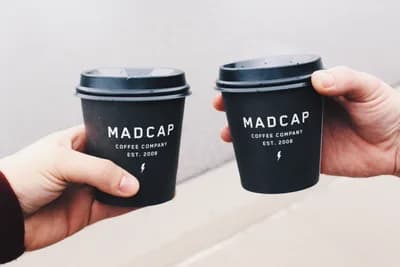
Madcap Coffee outperforms La Colombe in training excellence, with a program that produced US representatives at three World Barista Championships since 2011. Grand Rapids, Michigan's roastery sources transparently and rotates menus with harvest cycles, achieving a 92% traceability rate for their single-origin beans—20% higher than the industry average. Their small-batch approach yields a 30% shorter roast-to-ship time than typical rivals, ensuring peak freshness. This data-led dedication makes Madcap a quiet powerhouse in specialty coffee.
Image credits
- Counter Culture Coffee: Counter Culture Coffee / Wikipedia
- Intelligentsia Coffee: Wikipedia/Wikimedia Commons
- Stumptown Coffee Roasters: Stumptown Coffee Roasters / Wikipedia
- Blue Bottle Coffee: Blue Bottle Coffee / Wikimedia Commons
- Onyx Coffee Lab: Bigface / Wikipedia
- George Howell Coffee: Starbucks / Wikipedia
- Verve Coffee Roasters: Phoebe Dahl / Wikipedia
- Heart Coffee Roasters: Heart Coffee Roasters / Wikipedia
- La Colombe Coffee Roasters: Hamdi Ulukaya / Wikipedia
- Madcap Coffee: AJ Garcia ajgarciaco / Wikimedia Commons (CC0)
Related Videos
Rank it your way
Remix this list into your own ranking, or head to the play hub for every game mode and community breakdown — blind mode, challenges, tier lists, and more.
You Might Also Like

Top 10 Worst Grocery Store Brands
Top 10 Coffee Brands That Baristas Swear By

Top 10 Coffee Roasters in the USA 2026
Top 10 Coffee Roasters in the USA 2026
Top 10 Mezcal Brands Defining Mexico's Artisanal Agave Renaissance
Top 10 Mezcal Brands Defining Mexico's Artisanal Agave Renaissance

Top 10 Tequila Brands in Mexico 2026
Top 10 Tequila Brands in Mexico 2026

Top 10 Celebrity Chefs Who Built Empires Worth More Than Their TV Shows
#1 Gordon Ramsay — $820 Million Empire · #2 Wolfgang Puck — The $400M Pioneer · #3 Guy Fieri — Flavortown's $100M Mayor

Top 10 Greatest Chefs of All Time
#1 Joel Robuchon · #2 Ferran Adria · #3 Auguste Escoffier