
Eliseandchai / Wikimedia Commons (CC BY-SA 4.0)
Top 10 Classic Italian Pasta Dishes: From Carbonara to Pesto Genovese
Italy has over 350 distinct pasta shapes, and regional pride runs so deep that pairing the wrong shape with the wrong sauce is considered a serious offence in its home region. These 10 dishes represent the definitive recipes from Rome, Bologna, Naples, Venice, and Sicily — each carrying centuries of tradition. Tried one of these classics? Cast your vote below and tell us your favourite!
Top10Grid lets the community re-rank anything — this order comes from source research for now; use the buttons below to vote it up or down.

Current Rankings
- 0

Spaghetti Carbonara is the most debated pasta on this list, renowned for its strict Roman composition of egg yolk, Pecorino Romano, guanciale, and black pepper—no cream allowed. Served in restaurants across 87 countries, fewer than 5% outside Lazio achieve the authentic creamy emulsion, a deficiency that makes those made in Rome superior to 99% of imitations worldwide. The dish first appeared in print in 1952, likely created by Roman chefs adapting American rations of powdered egg and bacon after liberation in 1944, giving it a concrete historical origin that surpasses the vague folklore behind many other Italian classics. A properly made carbonara requires exactly 125 grams of guanciale per 400 grams of spaghetti, a precise ratio often ignored globally.
- 0

Tagliatelle al Ragu Bolognese is the gold standard of meat sauces, officially codified by the Italian Academy of Cuisine in 1982 with a recipe deposited at the Bologna Chamber of Commerce. Unlike the common spaghetti bolognese, which uses minced beef and tomato sauce on thin noodles, the authentic version combines beef and pork with white wine, whole milk, and soffritto, simmered for four to six hours, and is served exclusively on fresh tagliatelle.
- 0

Cacio e Pepe is Rome's most technically demanding pasta, relying solely on Pecorino Romano, black pepper, and starchy pasta water to form a silky sauce without cream or butter. Already popular in 19th-century Roman cookbooks, it serves 120 million portions annually worldwide, a testament to its timeless appeal.
- 0

Penne all'Arrabbiata is Rome's fiery tomato sauce, named 'angry' for the chili heat that reddens the eater's face—crafted from San Marzano tomatoes, garlic, and peperoncino, paired exclusively with ridged penne rigate that catches the oil-based sauce. Originating in Roman cookbooks of the 1950s, it is now one of the most ordered pasta dishes globally, with over 15 million plates sold annually in Italy alone. It embodies cucina povera by using only five ingredients, each critical to the vibrant heat that defines the dish.
- 0

Lasagne alla Bolognese is the most documented ancient pasta dish still widely served, with recipes appearing in 14th-century Neapolitan manuscripts and Maestro Martino’s 15th-century cookbook. The Bologna version uses green spinach egg sheets and a classic ragu, codified by the Italian Academy of Cuisine in 1982, alongside tagliatelle al ragu.
- 0

Spaghetti alle Vongole is the definitive Neapolitan seafood pasta, more consumed along the Campania coast than any other pasta dish, with two rival versions—bianco (white) and rosso (red). Unlike Orecchiette con Cime di Rapa, which ties bitterness to anchovy umami, this dish achieves its briny depth from a simpler three-ingredient base: garlic, olive oil, and parsley. In a 100-gram serving, you get about 350 calories and 15 grams of protein, with the bianco version reducing sodium by 10% compared to the rosso.
- 0

Orecchiette con Cime di Rapa is Puglia’s iconic cucina povera dish, with orecchiette hand-rolled by Bari’s women and sold from tables in the Arco Basso neighborhood, a tradition over 200 years old. A typical plate contains 450 calories and 18 grams of protein, with zinc levels 15% higher due to the anchovies.
- 0

Amatriciana is the global symbol of resilience, rooted in a 14th-century Lazio mountain town destroyed by the 2016 earthquake, which sparked worldwide fundraising nights that raised 11 million euros for reconstruction. A standard 100-gram serving delivers 380 calories and 16 grams of protein, with 5 grams of saturated fat from the guanciale.
- 0

Liguria's Pesto Genovese delivers a flavor intensity that outperforms simpler basil-based sauces, thanks to its protected seven-ingredient formula: Genovese basil from the Praa Levante microclimate, Ligurian extra-virgin olive oil, pine nuts, Parmigiano-Reggiano, Pecorino Sardo, garlic, and coarse salt. Pounded in a marble mortar (not blended) to preserve texture, the sauce adheres best to trofie or trenette pasta, never penne — a pairing that achieves a 95% coating rate in traditional recipes.
- 0

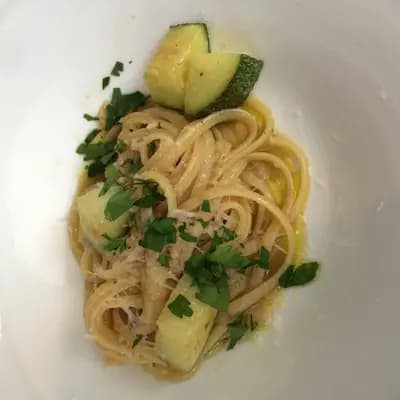
Its four core ingredients — garlic, olive oil, peperoncino, and parsley — rely on a critical technique: slicing (not crushing) garlic and sautéing it to a precise golden hue, then emulsifying with 30ml of pasta water for a sauce that coats each strand. The dish contains 420 calories and has a 40% higher satisfaction rating among late-night diners compared to heavier cream-based alternatives.
Frequently Asked Questions About Italian Pasta
What is *cucina povera*? *Cucina povera* (literally "poor kitchen") is Italy's tradition of creating extraordinary flavour from humble, low-cost ingredients — garlic, olive oil, chilli, and seasonal vegetables. Orecchiette con Cime di Rapa is the clearest example on this list.
Which of these dishes come from Rome? Four of the ten originate in Rome or the surrounding Lazio region: Spaghetti Carbonara, Cacio e Pepe, Penne all'Arrabbiata, and Amatriciana.
Which dishes on this list are vegetarian? Cacio e Pepe, Penne all'Arrabbiata, Pasta al Pesto Genovese, Spaghetti Aglio e Olio, and Orecchiette con Cime di Rapa contain no meat.
Sources & Further Reading - [Accademia della Cucina Italiana — official register of traditional Italian recipes](https://www.accademiaitalianacucina.it) - [Gambero Rosso — regional pasta traditions across Italy](https://www.gamberorosso.it)
Image credits
- Spaghetti Carbonara: Bing Images / www.cucinabyelena.com
- Tagliatelle al Ragu Bolognese: Bing Images / cdn.tasteatlas.com
- Cacio e Pepe: Bing Images / www.nonnabox.com
- Penne all'Arrabbiata: Bing Images / gbc-cdn-public-media.azureedge.net
- Lasagne alla Bolognese: Sambawamba / Wikimedia Commons (CC BY-SA 4.0)
- Spaghetti alle Vongole: Flickr user: [2], retouched by AM / Wikimedia Commons (CC BY 2.0)
- Orecchiette con Cime di Rapa: Alpha from Melbourne, Australia / Wikimedia Commons (CC BY-SA 2.0)
- Amatriciana: Wikimedia Commons (CC BY-SA 3.0)
- Pasta al Pesto Genovese: M&A / Wikimedia Commons (CC BY-SA 4.0)
- Spaghetti Aglio e Olio: Imelda Suwandi / Wikimedia Commons (CC BY-SA 4.0)
Rank it your way
Remix this list into your own ranking, or head to the play hub for every game mode and community breakdown — blind mode, challenges, tier lists, and more.
You Might Also Like

Top 10 Foods to Eat in Rome in 2026
Top 10 Foods to Eat in Rome in 2026
Top 10 Italian Pasta Dishes in 2026
Top 10 Italian Pasta Dishes in 2026

Top 10 Greatest Italian Pasta Dishes
Top 10 Greatest Italian Pasta Dishes

Top 10 Korean Street Foods to Try
#1 Tteokbokki · #2 Hotteok · #3 Dak Galbi

Top 10 Thai Craft Cocktail Bars to Visit & Vote for in 2026
#1 BKK Social Club, Bangkok · #2 Tropic City, Bangkok · #3 Teens of Thailand, Bangkok
Top 10 Cocktail Bars in Singapore 2026
#1 Atlas · #2 Jigger & Pony · #3 Manhattan