Kerala Sadya
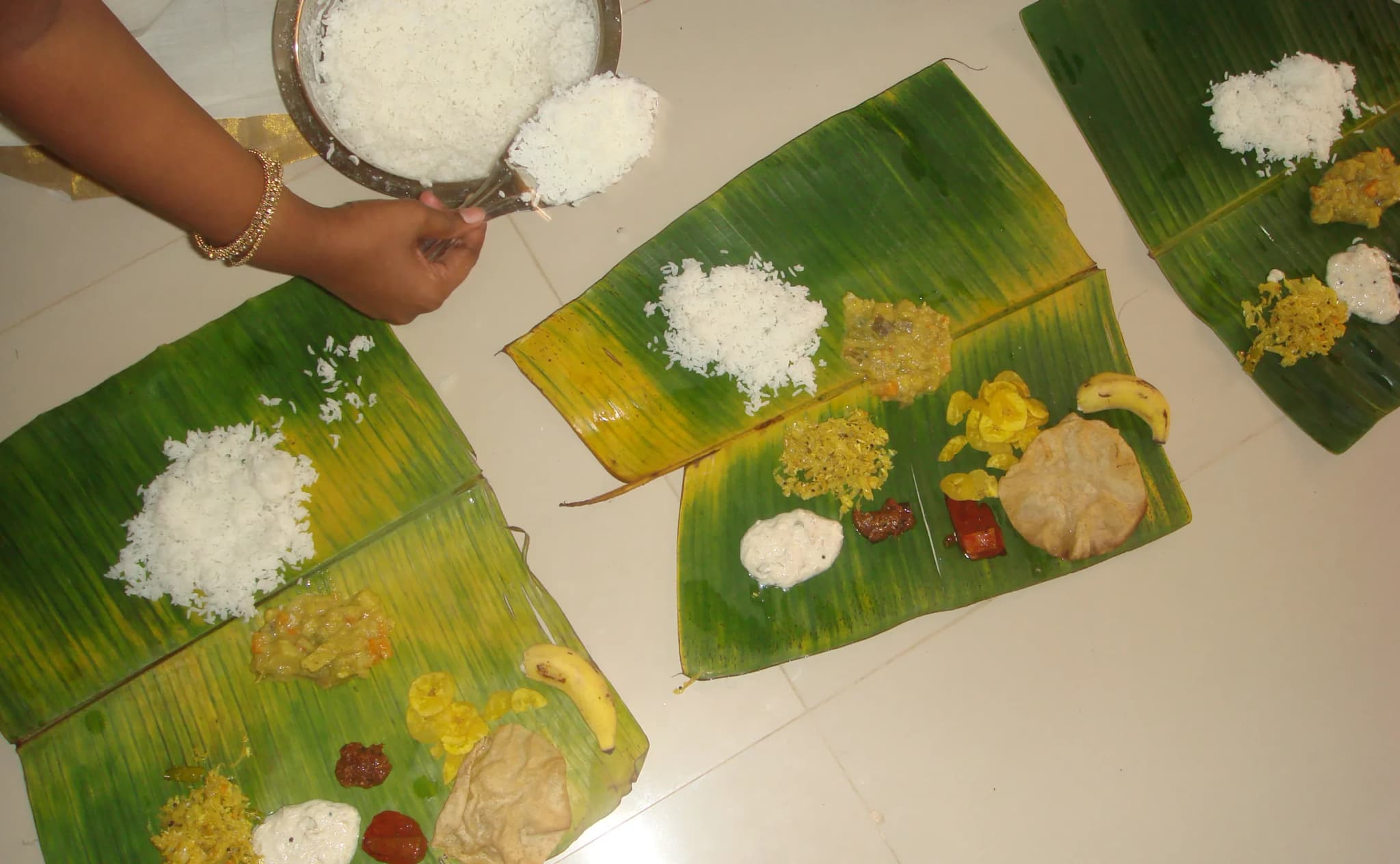
Sadya is Kerala's answer to a thali, and it dispenses with the plate altogether: the entire meal is served on a fresh banana leaf, laid lengthwise in front of each diner, with every dish assigned a specific spot rather than arranged at random. Pickles traditionally go in the top left corner and a banana in the bottom left, and the rest of the leaf fills in a set order familiar to anyone who grew up eating one, so that even a first-time diner can often work out where a dish belongs just by watching everyone else's leaf. A full sadya is enormous by any regional Indian standard: a typical version runs to 24 to 28 separate vegetarian dishes served in a single sitting, and the most elaborate ceremonial version, the Aranmula Valla-sadya associated with the region's snake-boat races, can stretch past 64 items. All of it is vegetarian, built around rice and a rotating set of sambar, rasam, thoran (stir-fried vegetables with coconut) and avial preparations, and finishes with payasam, a sweet, milk- or coconut-based dessert of which a proper sadya usually serves three or more distinct kinds rather than just one. Sadya's biggest stage is Onam, Kerala's major harvest festival, and Vishu, the Malayalam new year, when households and temples alike prepare the full version rather than a scaled-down everyday one; it also appears at weddings and birthdays. Eating it follows its own etiquette: diners sit cross-legged on floor mats, eat entirely with the right hand and no cutlery, and when the meal ends, fold the banana leaf itself, a gesture with its own quiet meaning; folding the top of the leaf toward oneself is traditionally read as a compliment to the cook, while folding it away can signal the opposite.
Photos (1)
Comments on "Kerala Sadya"
Have a take on this ranking?
Comments are how the argument actually happens here. Posting one needs a free account — it takes about a minute.
No comments yet.
The first comment sets the terms of the argument.