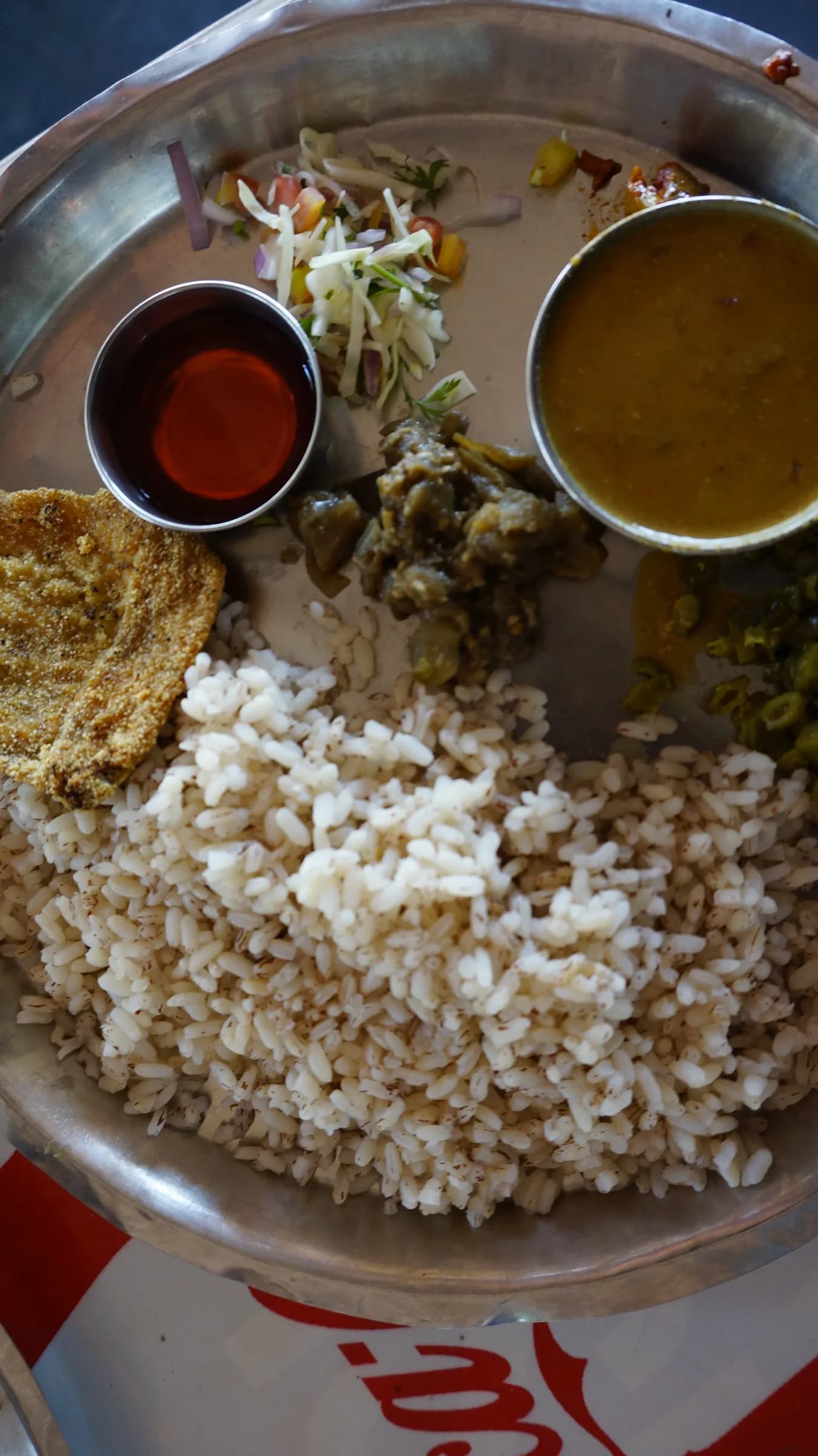
Goan Thali
Goa's food carries 451 years of Portuguese colonial rule directly on the plate, layered onto an older Konkani coastal cuisine that was already built around rice and fish long before the Portuguese arrived. A standard Goan thali reflects both halves plainly: rice and a fish curry, usually made with kingfish, pomfret, mackerel or sardines depending on the day's catch, sit at the centre, with coconut, used fresh, ground or as coconut oil, running through the curry base far more heavily than in most mainland Indian cooking, and kokum providing the sour edge in dishes where the Portuguese-introduced vinegar is not used instead. That vinegar tradition produced the dishes most associated with Goa's Catholic community specifically: vindaloo, whose name comes from the Portuguese vinho e alho, wine and garlic, though the dish as eaten in Goa today is built on vinegar, garlic and chillies into a pork curry with real heat; and sorpotel, an even spicier pork preparation, traditionally made using offal as well as meat and served with sannas, steamed rice cakes, or Goan-Portuguese bread rolls called pão. Xacuti, a curry built on a base of dry-roasted and ground coconut and a long list of whole spices, appears in both chicken and lamb versions and represents a more indigenous side of Goan cooking, less directly tied to Portuguese ingredients. Chillies themselves are a Portuguese introduction to India generally, first arriving via Goa before spreading across the subcontinent, alongside cashews, potatoes, tomatoes and pineapple, all now treated as thoroughly native to Indian cooking. Dessert closes on bebinca, a rich, multi-layered baked pudding traditionally made at Christmas, one layer poured and baked at a time, a dish with a closer relative in Portuguese and Goan Catholic baking than in any other Indian sweet tradition.
Photos (1)
Comments on "Goan Thali"
Have a take on this ranking?
Comments are how the argument actually happens here. Posting one needs a free account — it takes about a minute.
No comments yet.
The first comment sets the terms of the argument.