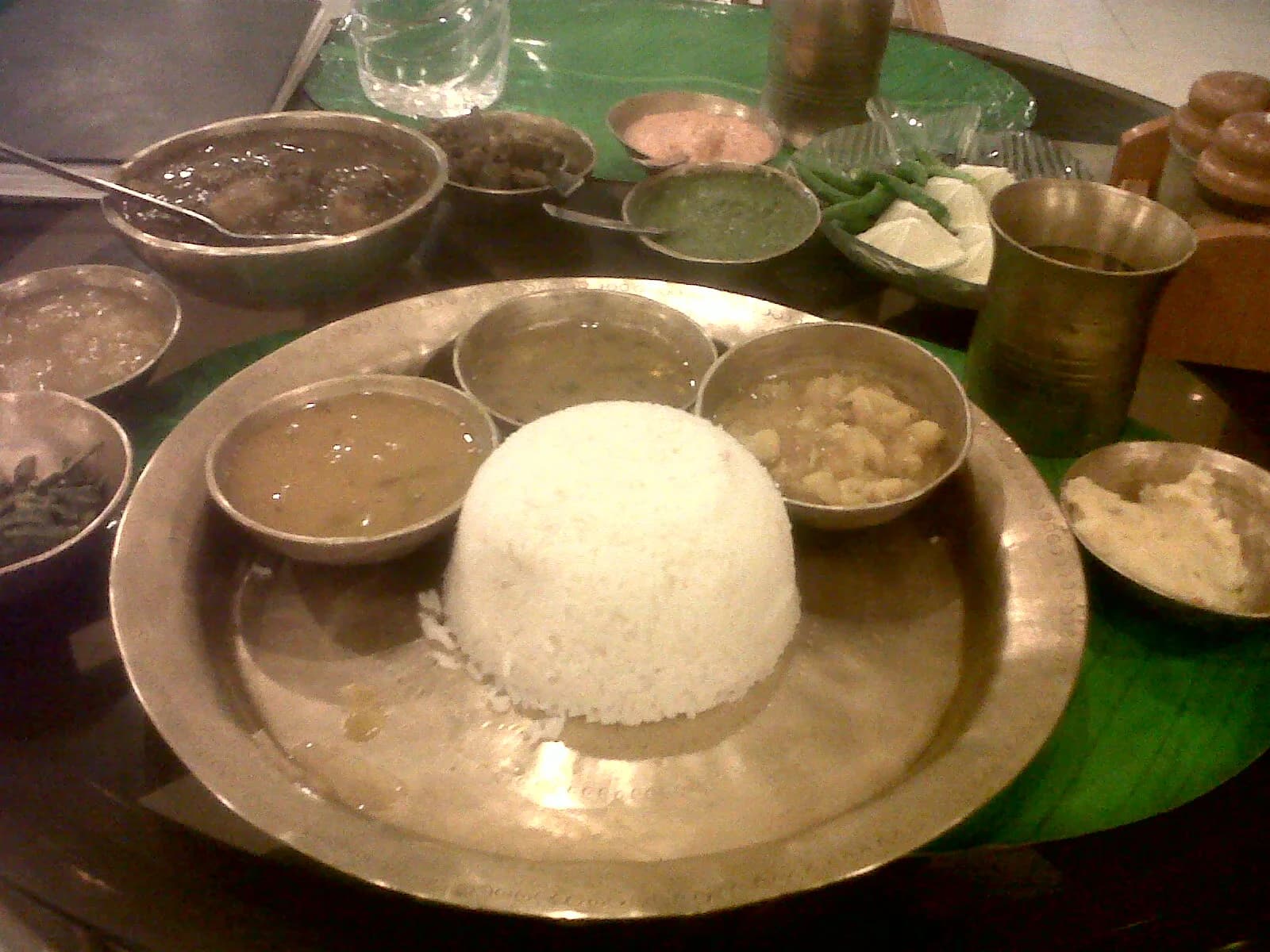
Assamese Thali
Assamese food runs on restraint rather than complexity: mustard oil is the standard cooking fat, spice blends stay simple, and the deep-frying and dry-roasting techniques common elsewhere in India, particularly the layered spice-building method called bhuna, are largely absent from the everyday Assamese kitchen. A traditional meal opens rather than closes with its most distinctive course: khar, named for its main ingredient rather than any single dish, an alkaline preparation traditionally made by filtering water through the ash of sun-dried banana peel, then cooked with raw papaya, pulses, vegetables or fish to make a course unlike anything found in most other Indian regional cuisines. From there the meal moves into tenga, a sour fish course, most often soured with tomato but also made with kajinemu, a citrus fruit, or thekera, dried mangosteen, both used specifically for their tartness. Fish anchors the protein side of an Assamese thali generally, reflecting the state's network of rivers and wetlands, usually stewed simply with herbs and vegetables rather than built into a heavy gravy. Khorisa, fermented bamboo shoot, is Assam's most distinctive fermented ingredient, appearing in curries and side dishes with a sharp, sour funk that has no close equivalent elsewhere on the subcontinent, alongside a wide use of foraged and cultivated leafy greens. The meal ends without a dessert course in the conventional sense: rather than a sweet dish, a traditional Assamese meal closes with tamul, betel nut chewed as a digestive and social ritual, though pitha, rice cakes made in sweet and savoury versions, are widely eaten as snacks around festivals such as Bihu rather than as a fixed final course of the everyday thali.
Photos (1)
Comments on "Assamese Thali"
Have a take on this ranking?
Comments are how the argument actually happens here. Posting one needs a free account — it takes about a minute.
No comments yet.
The first comment sets the terms of the argument.