Photo: Vyacheslav Argenberg via Wikimedia Commons, CC BY 4.0
Top 10 Regional Thalis of India 2026
Ten of India's defining regional meals, from Gujarat's sweet-salty thali to Kashmir's 36-course wazwan, with their core dishes and where each is eaten.
Top10Grid lets the community re-rank anything — this order is our editors' pick for now; use the buttons below to vote it up or down.

Current Rankings
- –
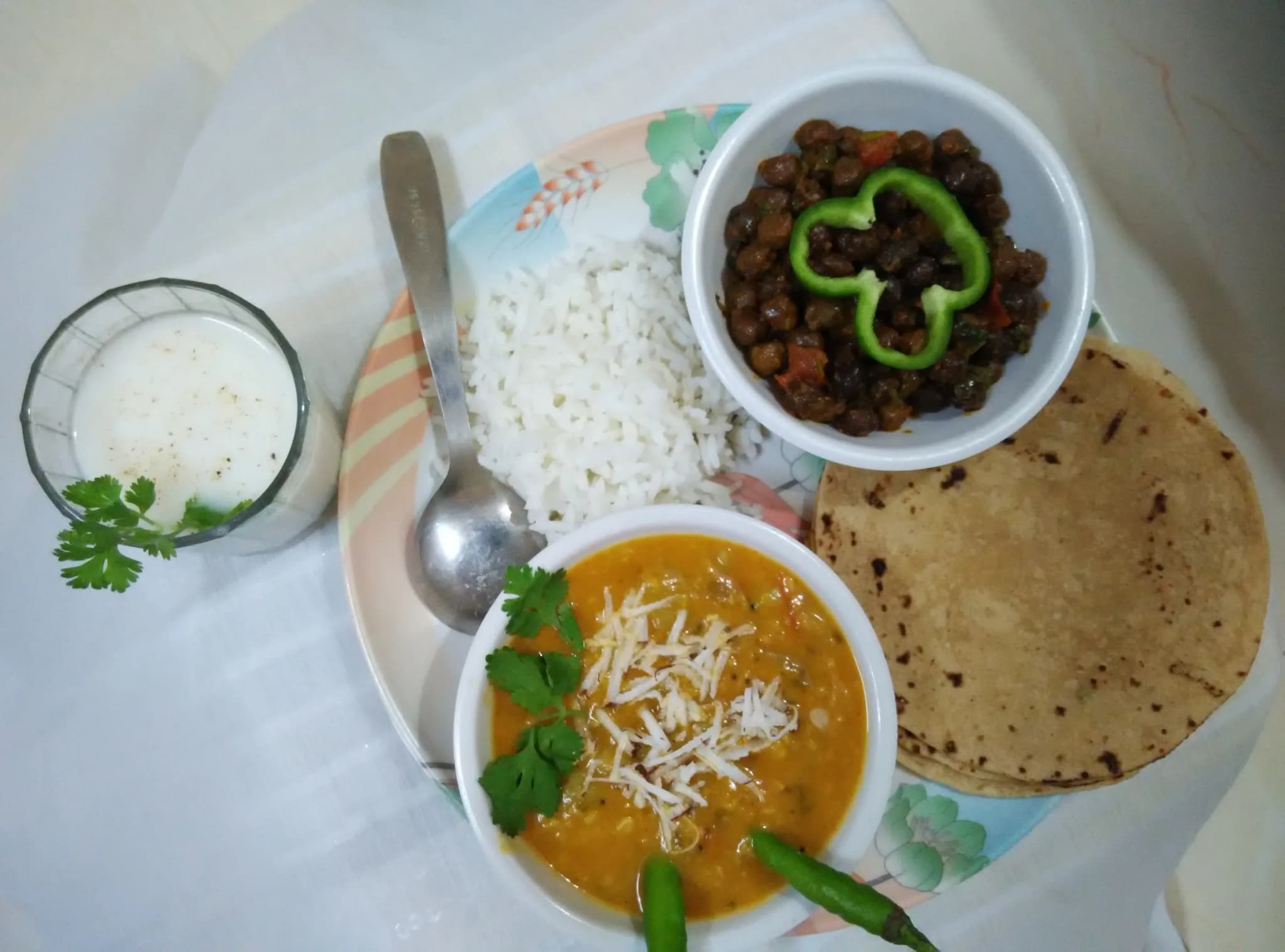
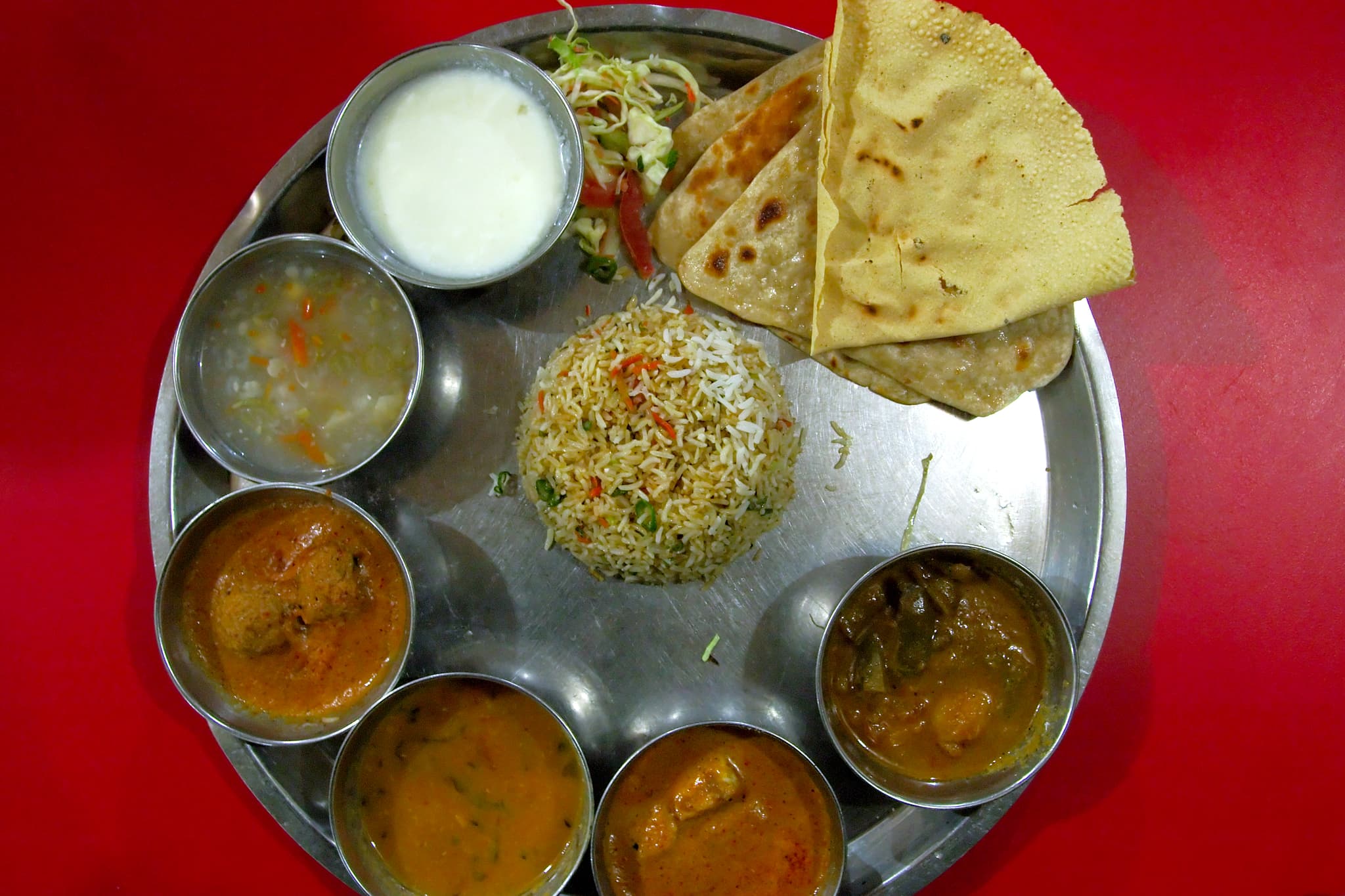
A Gujarati thali is built around a single, deliberate flavour trick: a touch of sugar or jaggery worked into dishes that would elsewhere stay purely savoury, producing the sweet-salty-spicy balance the region's food is known for. The core of the plate is simple and repeats meal to meal: rotli (thin wheat flatbread), a dal or kadhi, a shaak (vegetable curry) that changes with the season, and rice, often khichdi made with rice and moong or other lentils. Around that base sit the two categories that make a Gujarati thali feel generous rather than plain: farsan, savoury snacks such as dhokla, khandvi, fafda or samosas, and mishthaan, sweets like shrikhand, jalebi or mohanthal, both served as part of the meal rather than only at its end. The sugar-in-savoury habit is not decorative; it is a real adaptation to a hot, often water-scarce climate, where a sweet edge alongside salt, lemon and tomatoes was traditionally understood to help the body tolerate heat. Bread varies by region within the state too: bajra rotla, a millet flatbread, and bhakri, a firmer wheat-and-millet round, are more common in rural and coastal areas, while wheat phulka rotli dominates in cities. Gujarat is overwhelmingly vegetarian by both custom and religious practice, shaped heavily by Jain dietary rules that avoid certain root vegetables as well as meat, and most thalis served in the state's countless family-run bhojanalay restaurants reflect that, though communities such as Koli Patels, Ghanchis, Gujarati Muslims and Parsis maintain their own fish and meat traditions outside the vegetarian mainstream. In practice a Gujarati thali is refilled rather than portioned once: staff circulate with fresh rotli and top up katoris as they empty, so the meal ends only when the diner says so, not when the plate looks clear.
- –
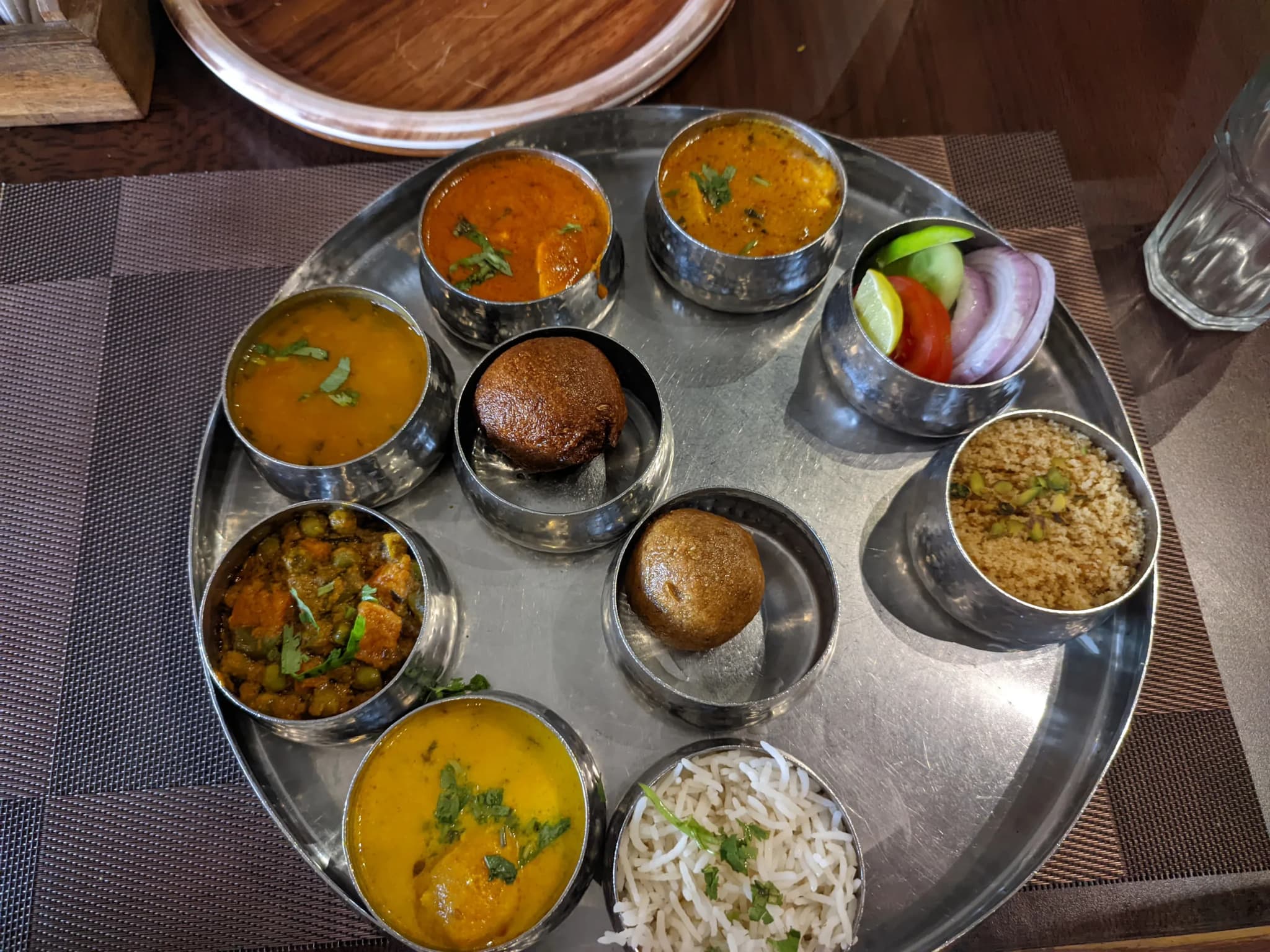
Rajasthani cooking answers to one overriding fact about the region: for most of its history, water and fresh green vegetables were both scarce, and food had to survive days of heat and travel without refrigeration. The thali built around that constraint centres on dal bati churma: bati are hard wheat dough balls, traditionally baked over hot coals or embers rather than in a wet oven, split open and doused in ghee, then eaten alongside panchmel or panchratna dal, a five-lentil mix, and churma, a sweet crumbled-wheat and jaggery mixture that turns the same base dough into dessert. Alongside that centrepiece sits gatte ki sabzi, dumplings made from gram flour (besan) simmered in a tangy yogurt-based gravy, a dish built specifically around ingredients that keep without refrigeration. Ker sangri does the same job with vegetables: ker berries and sangri beans, both wild desert plants, are dried and stored, then rehydrated and cooked into a sharp, tart preparation found almost nowhere outside Rajasthan, since neither ingredient grows readily in wetter parts of India. Khooba roti, a thicker, ridged wheat bread, and a rotating set of pickles round out the rest of the plate, again favouring long-life preserved ingredients over anything that spoils quickly. None of this reads as an austerity diet at the table, though: the dal is rich with ghee, the churma is deliberately sweet and heavy, and Rajasthani hospitality culture treats a full thali as a matter of pride for the host. What distinguishes the cuisine from its neighbours is less any single spice than this consistent logic running through nearly every dish, extracting real variety and flavour from ingredients chosen first for how well they survive a desert climate. Meat-free thalis are the norm here for a reason: a 2014 survey by the Registrar General of India found 74.9% of Rajasthanis are vegetarian, the highest share of any state.
- –
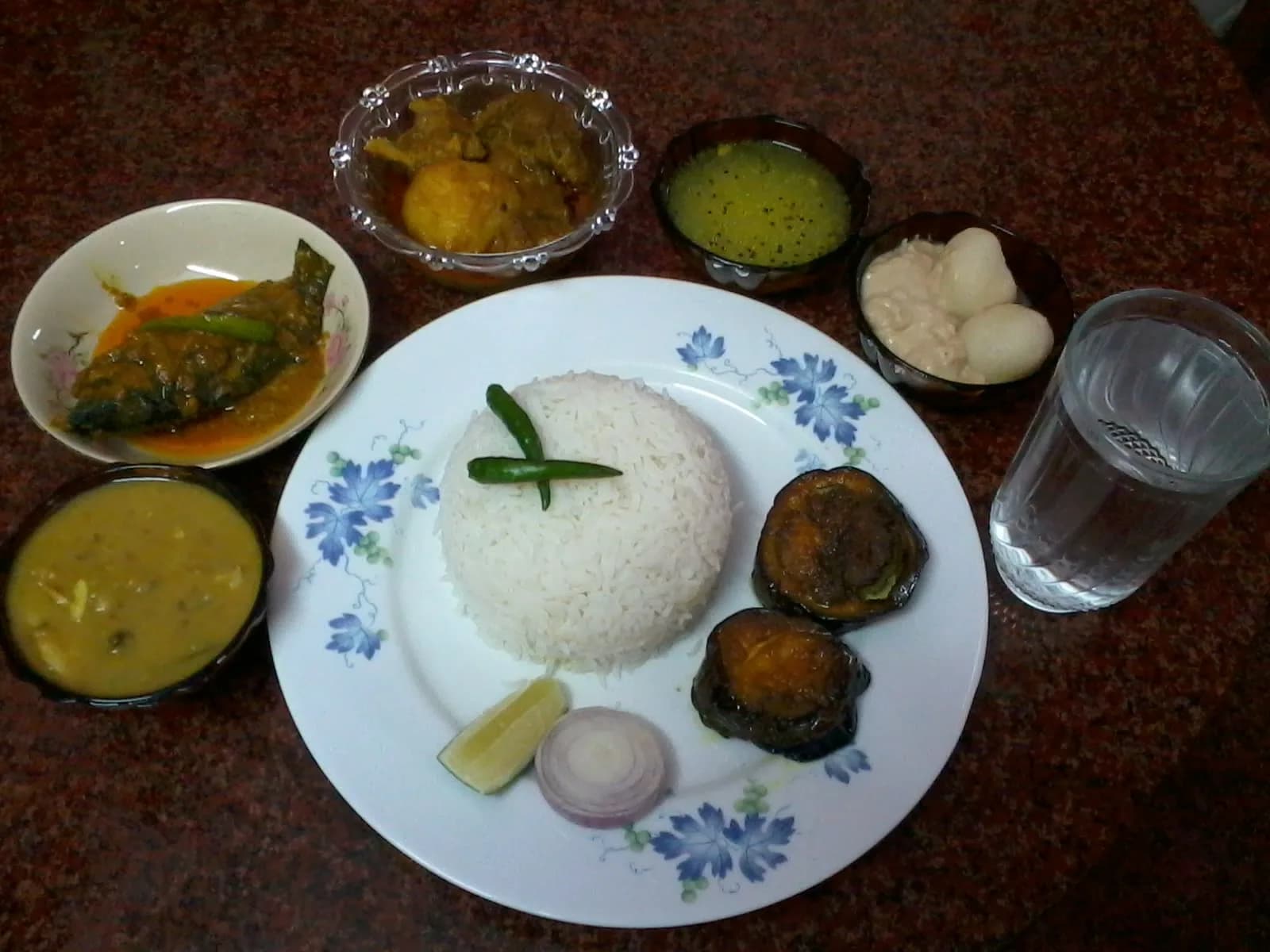
A Bengali meal is less a single plate than a sequence, and understanding that order matters more here than in almost any other regional Indian food tradition: courses are eaten broadly from lighter to heavier, moving through a deliberate range of tastes rather than serving everything together at once. It typically opens with something bitter or faintly bitter, such as shukto, a mixed-vegetable dish that can include bitter gourd, before moving into dal, then a fried course, bhaja, of thin-sliced vegetables or fish. Rice anchors the entire meal rather than a single course within it: it remains on the plate from the very start and is only set aside once the meal reaches its chutney course, well after most of the savoury dishes have been served, rather than being finished early as in some other regional styles. Fish is the defining protein, prepared above all as machher jhol, a light, brothy curry usually built on mustard oil and simple spicing rather than a heavy gravy, reflecting West Bengal's river-and-delta geography and its historic access to freshwater fish. The chutney course, tomato-based or fruit-based depending on the season, functions as a palate cleanser between the savoury dishes and the sweets that follow, rather than a condiment eaten alongside the main food. Traditional serving order placed social hierarchy on the table as directly as the food: guests were served before hosts, and within a family, senior males ate first. That formality has faded in many households, where thalis are now increasingly laid out on a shared table for everyone to serve themselves, but the underlying structure of the meal, moving from bitter to rich to sweet in a fixed order, remains the clearest marker of a properly composed Bengali plate, closing on mishti, Bengal's famous milk-based sweets.
- –
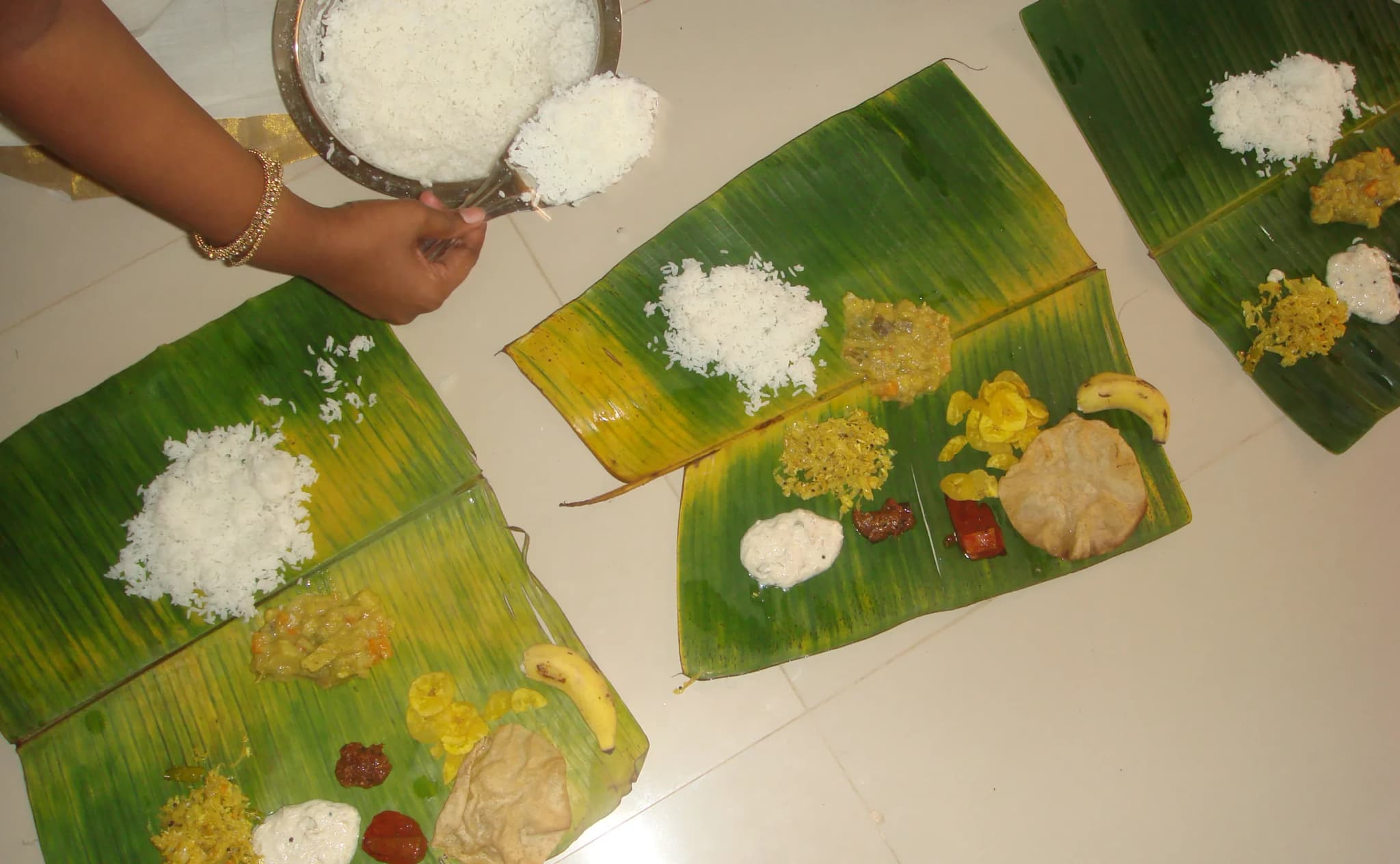
Sadya is Kerala's answer to a thali, and it dispenses with the plate altogether: the entire meal is served on a fresh banana leaf, laid lengthwise in front of each diner, with every dish assigned a specific spot rather than arranged at random. Pickles traditionally go in the top left corner and a banana in the bottom left, and the rest of the leaf fills in a set order familiar to anyone who grew up eating one, so that even a first-time diner can often work out where a dish belongs just by watching everyone else's leaf. A full sadya is enormous by any regional Indian standard: a typical version runs to 24 to 28 separate vegetarian dishes served in a single sitting, and the most elaborate ceremonial version, the Aranmula Valla-sadya associated with the region's snake-boat races, can stretch past 64 items. All of it is vegetarian, built around rice and a rotating set of sambar, rasam, thoran (stir-fried vegetables with coconut) and avial preparations, and finishes with payasam, a sweet, milk- or coconut-based dessert of which a proper sadya usually serves three or more distinct kinds rather than just one. Sadya's biggest stage is Onam, Kerala's major harvest festival, and Vishu, the Malayalam new year, when households and temples alike prepare the full version rather than a scaled-down everyday one; it also appears at weddings and birthdays. Eating it follows its own etiquette: diners sit cross-legged on floor mats, eat entirely with the right hand and no cutlery, and when the meal ends, fold the banana leaf itself, a gesture with its own quiet meaning; folding the top of the leaf toward oneself is traditionally read as a compliment to the cook, while folding it away can signal the opposite.
- –
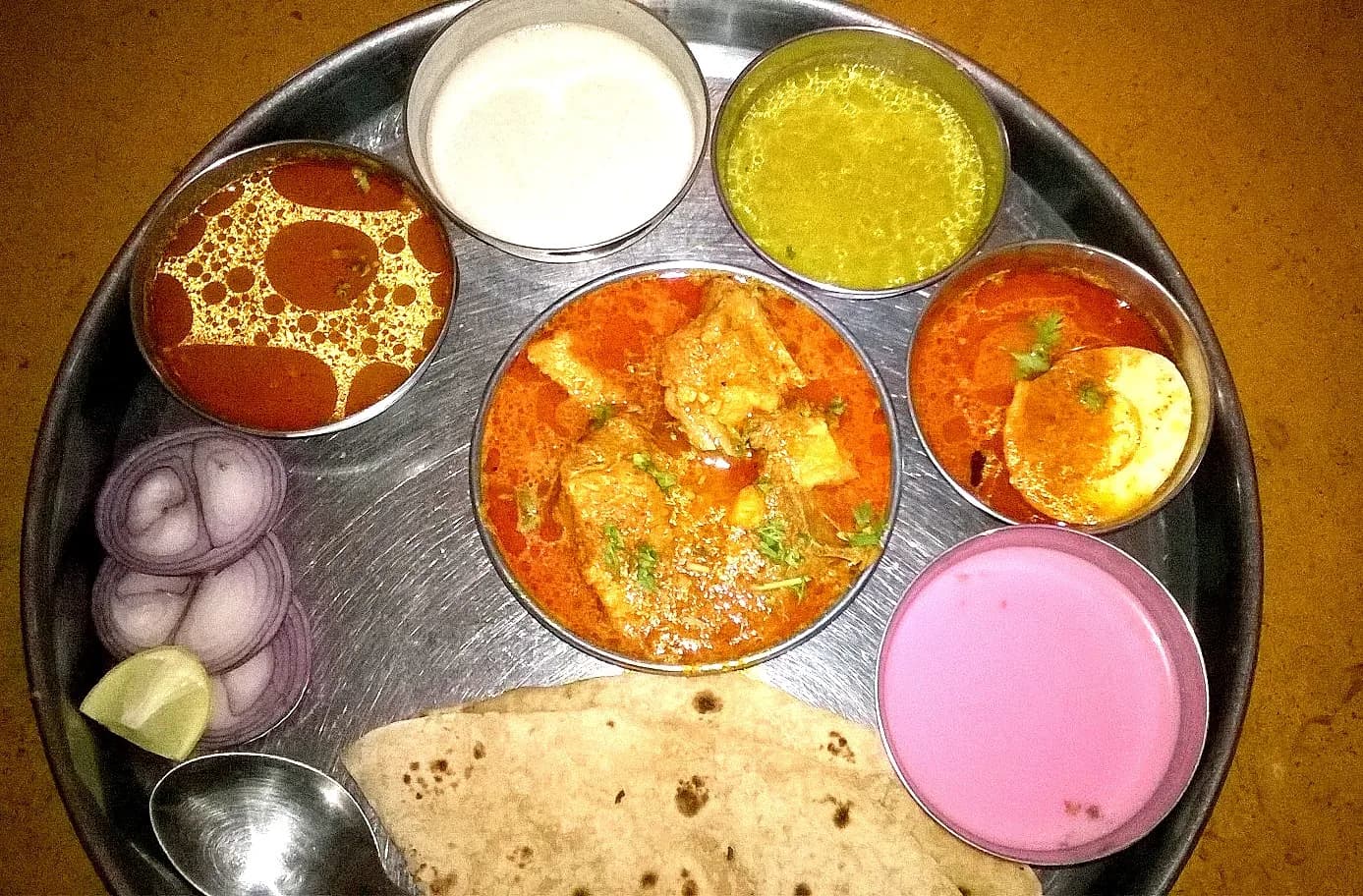
Maharashtra's food splits cleanly along a coast-to-inland line, and a proper thali looks different depending on which side of that line it comes from. Along the Konkan coast, rice is the base grain and coconut runs through almost everything, thick and creamy in curries or thinned into solkadhi, a tangy, blush-pink coconut-milk and kokum soup usually drunk at the end of the meal to settle a heavy plate; Malvani cuisine, from the southern Konkan coast, adds a strong seafood tradition on top of that base. Move inland to the Deccan plateau and bhakri, an unleavened flatbread made from sorghum (jowar) or pearl millet (bajri), replaces rice as the everyday staple, served alongside spiced vegetables, dal and, often, pithla, a thick, fast-cooking chickpea-flour preparation. Across both regions, certain dishes appear on nearly every proper thali: varan bhaat, plain pigeon-pea dal spooned over rice with ghee, lemon juice and salt stirred in at the table rather than cooked in; usal, a dish built from sprouted legumes rather than dried ones; and puran poli, a griddle-cooked flatbread stuffed with a sweet filling of jaggery, chana dal, cardamom and ghee, served as the meal's dessert course rather than a separate sweet. Two ingredients tie the cuisine together regardless of region: goda masala, a warm spice blend built on cloves, coriander, cumin, cinnamon and asafoetida, and kokum, a sour dried fruit that gives many Maharashtrian dishes their tang instead of tamarind or lemon. A full thali also includes koshimbir, a simple raw salad, and papad, so that a Maharashtrian meal ends up built from contrasts: a mild dal, a sharply sour side, a sweet finish and, on the coast, cooling coconut to close it all out.
- –
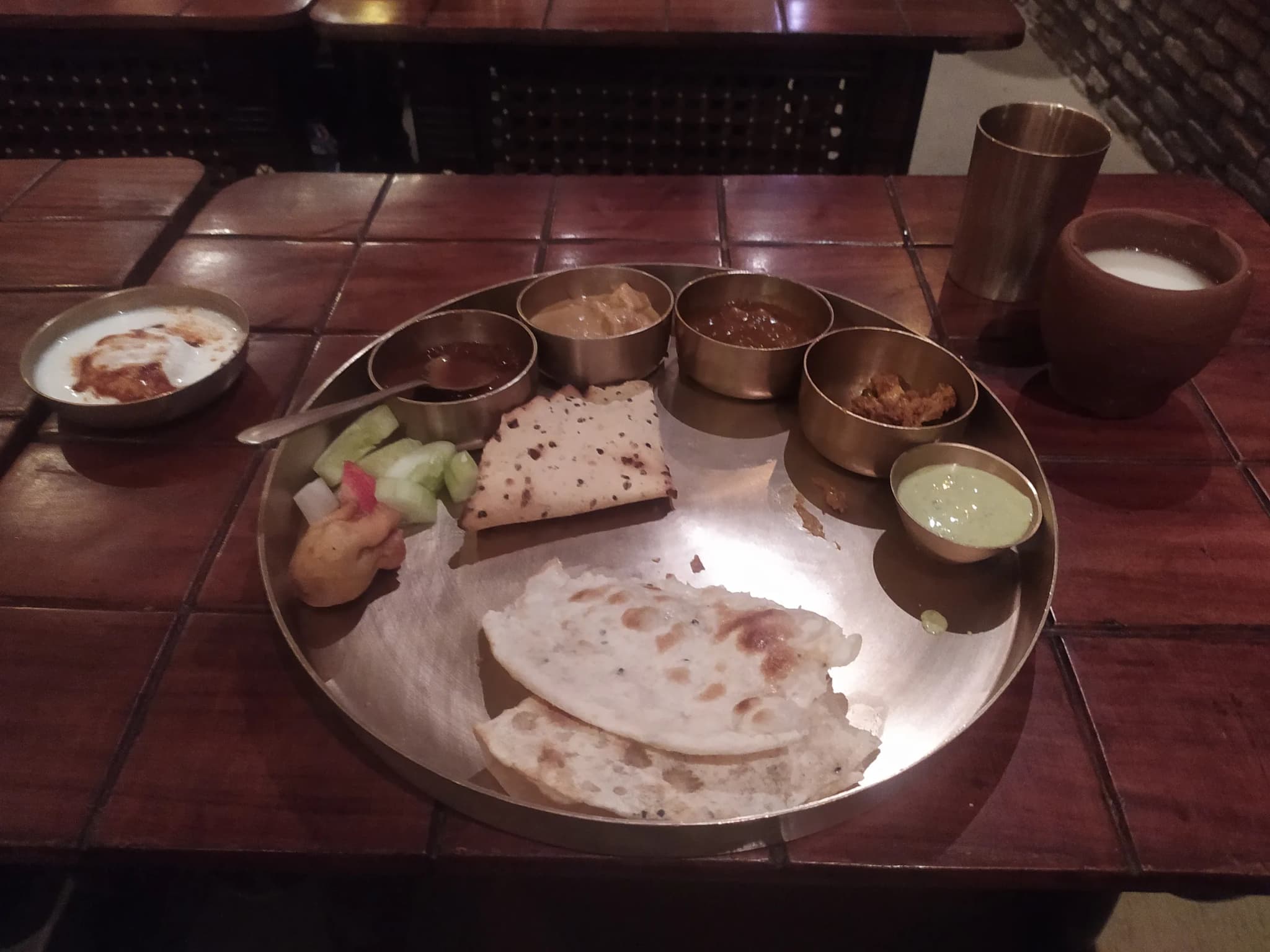
Punjabi food built its national reputation on richness, and a proper Punjabi thali does not hide that: butter, ghee and paneer appear across savoury dishes as a matter of course, in a state with one of the highest rates of dairy consumption anywhere in India. The winter classic sarson ka saag, a slow-cooked mustard-greens stew finished with a generous knob of butter, paired with makki di roti, a coarse cornmeal flatbread, is the dish most associated with Punjab outside the region, and it anchors many thalis whenever mustard greens are in season. Dal makhani, black gram and red kidney beans simmered for hours with cream and butter until thick and glossy, plays a similar role year-round, alongside rajma chawal, red kidney beans in an onion-tomato gravy served over steamed rice, one of the most widely eaten combinations in North Indian homes generally, not just Punjab. The tandoor, a clay oven sunk into the ground and fired with wood or charcoal to very high temperatures, is Punjab's defining piece of cooking technology, producing both the naan and roti that round out a thali and the tandoori chicken and paneer tikka that headline non-vegetarian versions of the meal. Lassi, a yogurt-based drink served sweet or salted, is the traditional accompaniment rather than an optional extra, thick enough in its classic form to need a spoon as much as a glass. Vegetable sides such as aloo gobi (potato and cauliflower) or bhindi (okra) fill out a full thali alongside pickle and a simple cucumber-onion salad, but the identity of a Punjabi plate rests less on any single vegetable dish than on that combination of tandoor-cooked bread, dairy-enriched dal, and a lassi to finish. Punjabi tandoor cooking spread across the rest of India after the 1947 partition, when Punjabi families resettled in cities such as Delhi.
- –
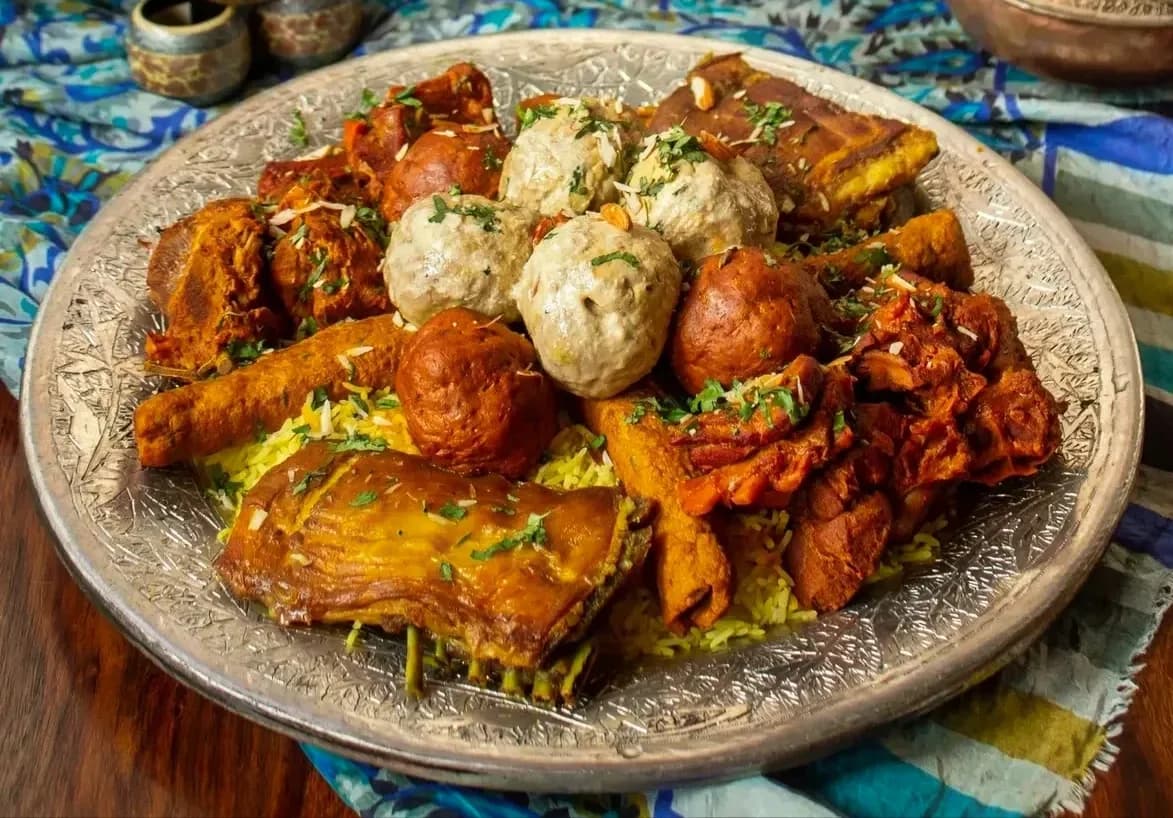
Wazwan is not a thali in the everyday sense at all; it is Kashmir's formal, multi-course banquet, traditionally served at weddings and other major occasions rather than as a daily meal, and its full royal form runs to 36 courses, most of them meat-based. The name itself describes the trade behind it: waz means cook, wan means shop, and the wazas, professional chefs organised into teams led by a master cook known as the wouste waze, spend the better part of a night before a big wazwan preparing the meal for dozens or hundreds of guests. Rather than individual plates, wazwan is eaten from a trami, a single large copper platter shared by four diners seated together, piled with rice and a rotating sequence of dishes brought out course by course; the meal opens with a ritual hand-washing using a portable basin called the tash-t-naer, passed from guest to guest before anyone eats. Certain dishes are considered essential rather than optional: tabak maaz, ribs of lamb first braised then flash-fried until crisp; rista and gushtaba, both pounded-meat dumplings cooked in different gravies, with gushtaba, served in a yogurt-based sauce, traditionally marking the meal's final course; rogan josh, the slow-cooked lamb curry now familiar in Indian restaurants worldwide but here just one course among many; and aab gosh and marchhwangan korma, both distinct meat preparations in their own particular gravies. Almost every dish is built on lamb, mutton or, less often, beef, prepared to halal standards throughout, with vegetarian wazwan versions existing but remaining unusual. What makes wazwan singular among the meals on this list is less any individual dish than the scale and choreography of the whole event: a wazwan is planned, cooked and served as a single, sequenced performance for the table, not assembled a la carte.
- –
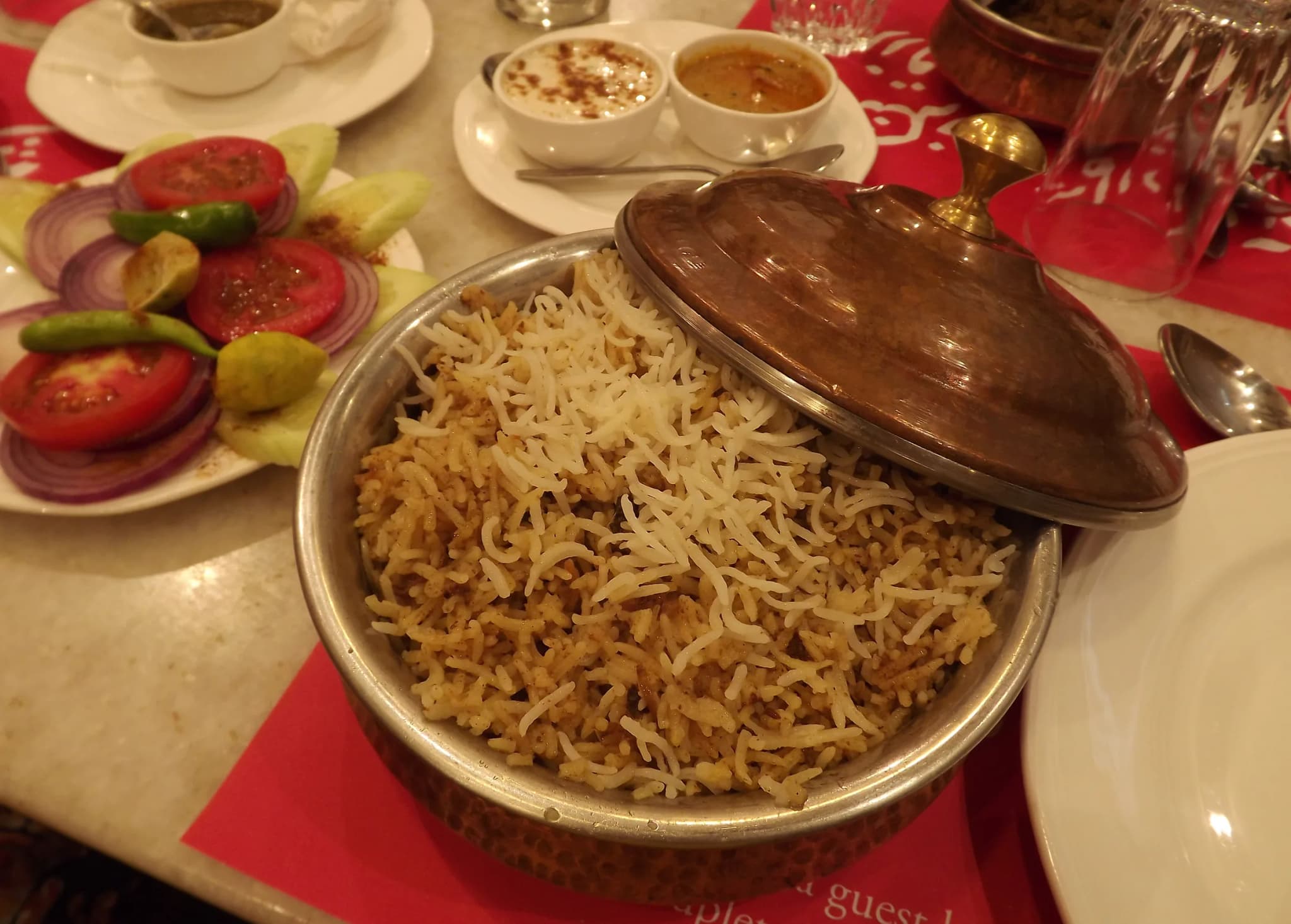
Hyderabadi cuisine grew out of one of the most direct fusions in Indian food history: Mughlai cooking brought south by the Qutb Shahi and Bahmani courts met Telugu and Marathi cooking traditions already established on the Deccan plateau, refined further under the Nizams of Hyderabad from the 17th century onward into something distinct from either parent tradition. A formal Hyderabadi meal, the dastarkhwan, traditionally runs through five stages: aghaz, a soup to open; mezban, appetisers; waqfa, a palate-cleansing sorbet between courses; mashgool dastarkhwan, the main course itself; and zauq-e-shahi, dessert, a structure that borrows the idea of a paced, multi-stage banquet from Persian and Mughal court dining. Biryani is the dish that carries the cuisine's reputation furthest beyond Hyderabad, and the Nizami version, built on basmati rice, mutton, yogurt and a specific layering-and-sealing cooking method called dum, is treated as the standard against which other regional biryanis are measured; regional variants such as Kalyani biryani, made with beef, and tahari, a simpler rice-and-meat dish, sit alongside it. Haleem, a dense, slow-cooked stew of pounded wheat, lentils and mutton, is above all a Ramadan dish, traditionally prepared and sold in huge quantities for the evening iftar meal that breaks the day's fast. Mirchi ka salan, a curry built on long green chillies, and baghara baingan, whole baby eggplants in a peanut-and-sesame gravy, represent the cuisine's vegetable side, both markedly spicier and more herb-heavy than their equivalents further north. Dessert closes on khubani ka meetha, a stewed apricot pudding topped with cream or ice cream, a dish that leans on dried fruit rather than the milk-based sweets common elsewhere in India, another quiet marker of the cuisine's distinct blend of influences. Hyderabadi haleem, a slow-cooked meat and wheat stew, was awarded Geographical Indication status by India's GI registry in 2010.
- –
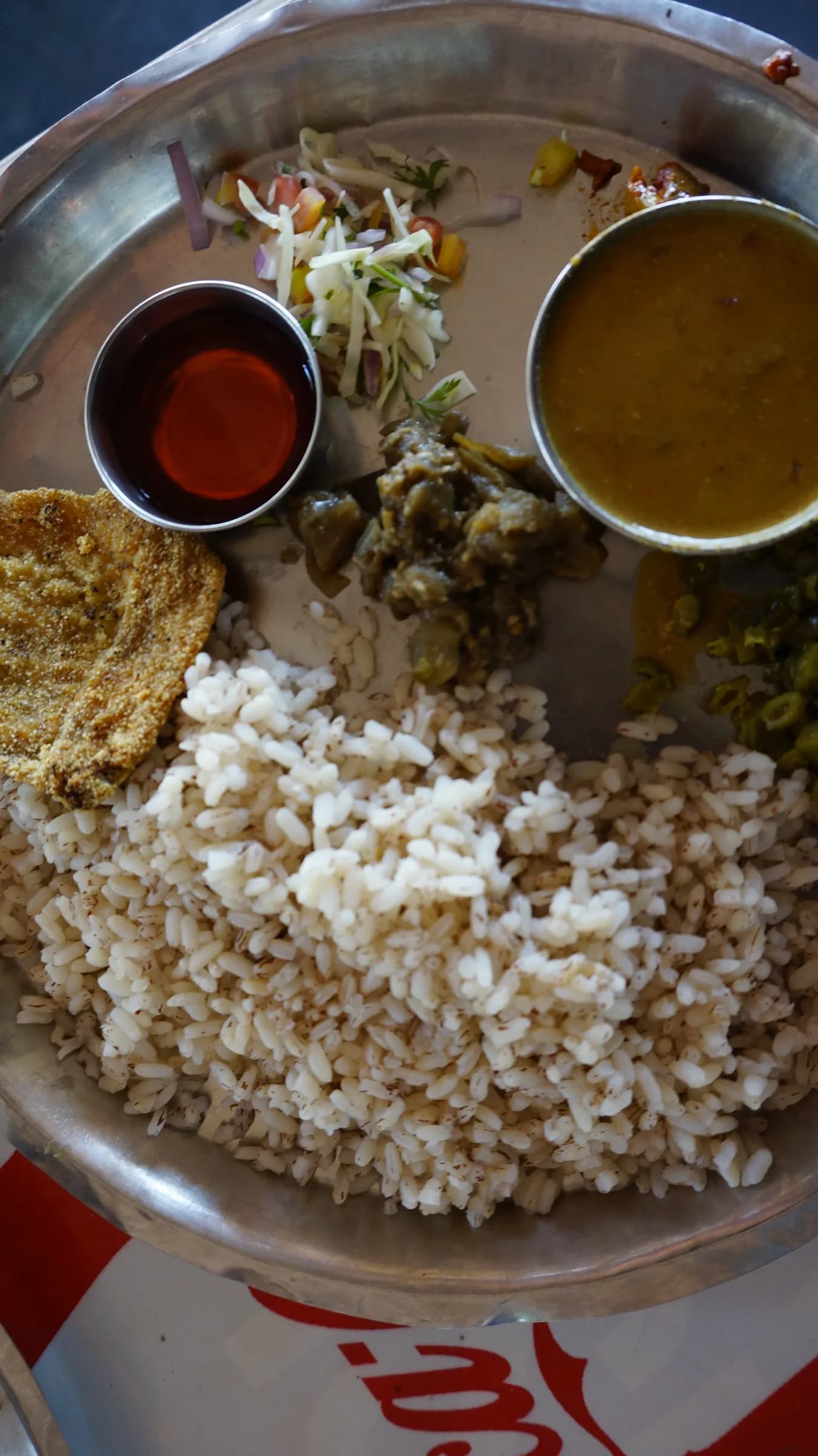
Goa's food carries 451 years of Portuguese colonial rule directly on the plate, layered onto an older Konkani coastal cuisine that was already built around rice and fish long before the Portuguese arrived. A standard Goan thali reflects both halves plainly: rice and a fish curry, usually made with kingfish, pomfret, mackerel or sardines depending on the day's catch, sit at the centre, with coconut, used fresh, ground or as coconut oil, running through the curry base far more heavily than in most mainland Indian cooking, and kokum providing the sour edge in dishes where the Portuguese-introduced vinegar is not used instead. That vinegar tradition produced the dishes most associated with Goa's Catholic community specifically: vindaloo, whose name comes from the Portuguese vinho e alho, wine and garlic, though the dish as eaten in Goa today is built on vinegar, garlic and chillies into a pork curry with real heat; and sorpotel, an even spicier pork preparation, traditionally made using offal as well as meat and served with sannas, steamed rice cakes, or Goan-Portuguese bread rolls called pão. Xacuti, a curry built on a base of dry-roasted and ground coconut and a long list of whole spices, appears in both chicken and lamb versions and represents a more indigenous side of Goan cooking, less directly tied to Portuguese ingredients. Chillies themselves are a Portuguese introduction to India generally, first arriving via Goa before spreading across the subcontinent, alongside cashews, potatoes, tomatoes and pineapple, all now treated as thoroughly native to Indian cooking. Dessert closes on bebinca, a rich, multi-layered baked pudding traditionally made at Christmas, one layer poured and baked at a time, a dish with a closer relative in Portuguese and Goan Catholic baking than in any other Indian sweet tradition.
- –
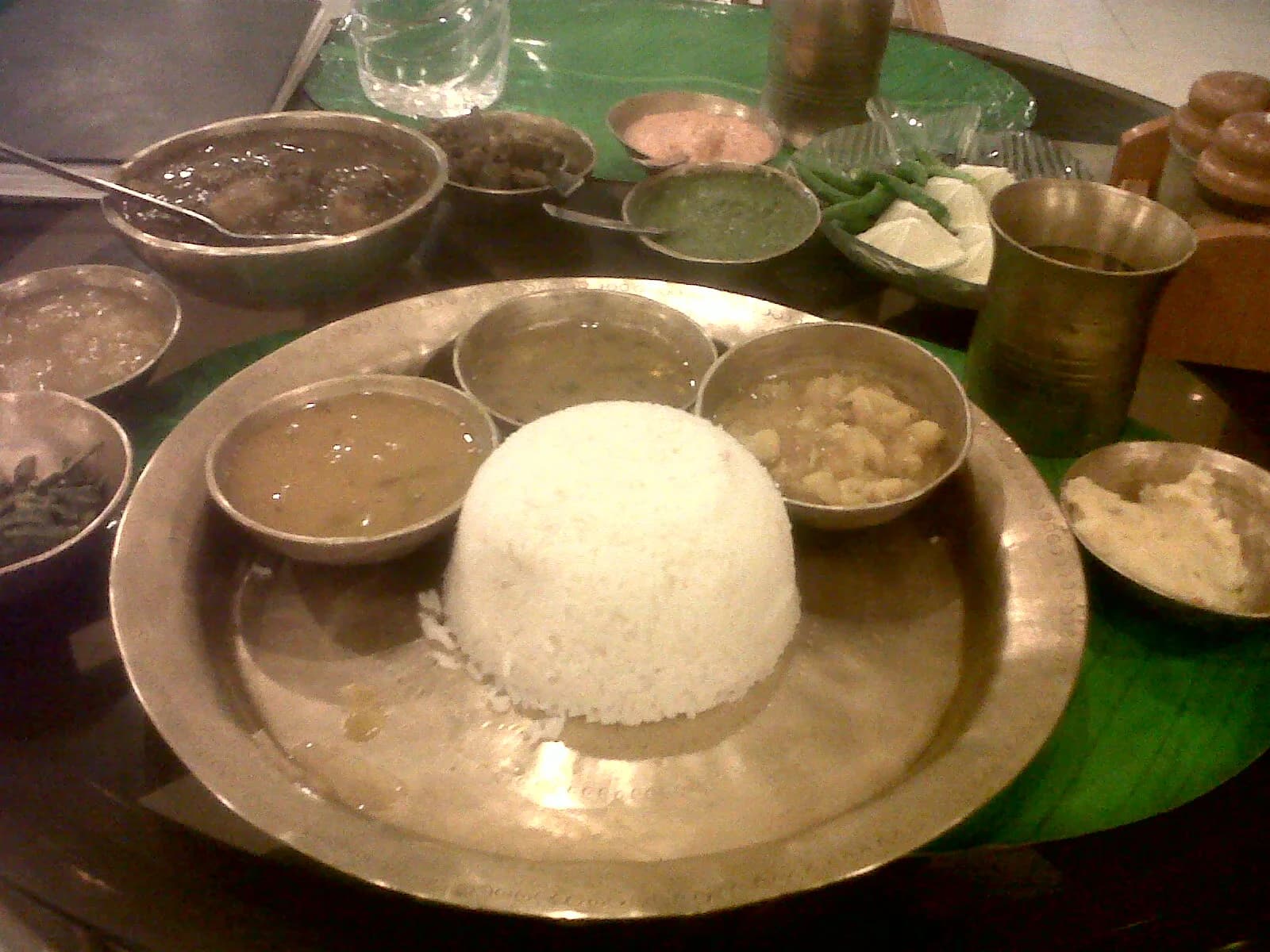
Assamese food runs on restraint rather than complexity: mustard oil is the standard cooking fat, spice blends stay simple, and the deep-frying and dry-roasting techniques common elsewhere in India, particularly the layered spice-building method called bhuna, are largely absent from the everyday Assamese kitchen. A traditional meal opens rather than closes with its most distinctive course: khar, named for its main ingredient rather than any single dish, an alkaline preparation traditionally made by filtering water through the ash of sun-dried banana peel, then cooked with raw papaya, pulses, vegetables or fish to make a course unlike anything found in most other Indian regional cuisines. From there the meal moves into tenga, a sour fish course, most often soured with tomato but also made with kajinemu, a citrus fruit, or thekera, dried mangosteen, both used specifically for their tartness. Fish anchors the protein side of an Assamese thali generally, reflecting the state's network of rivers and wetlands, usually stewed simply with herbs and vegetables rather than built into a heavy gravy. Khorisa, fermented bamboo shoot, is Assam's most distinctive fermented ingredient, appearing in curries and side dishes with a sharp, sour funk that has no close equivalent elsewhere on the subcontinent, alongside a wide use of foraged and cultivated leafy greens. The meal ends without a dessert course in the conventional sense: rather than a sweet dish, a traditional Assamese meal closes with tamul, betel nut chewed as a digestive and social ritual, though pitha, rice cakes made in sweet and savoury versions, are widely eaten as snacks around festivals such as Bihu rather than as a fixed final course of the everyday thali.
| Item | Region | Core dishes | Serving style | Best occasion to try it | Signature ingredient |
|---|---|---|---|---|---|
| #1Gujarati Thali | Gujarat | Rotli, dal or kadhi, shaak, khichdi, farsan snacks and mishthaan sweets | Refillable katoris around a central plate; farsan and sweets served alongside the main course | Any day at a family-run bhojanalay; unlimited refills are standard | |
| #2Rajasthani Thali | Rajasthan | Dal bati churma, gatte ki sabzi, ker sangri, khooba roti | Bati split and doused in ghee at the table, eaten with dal and churma | Anywhere in Jodhpur or Jaipur's old city dhabas, any day | |
| #3Bengali Thali | West Bengal | Shukto, dal, bhaja, machher jhol fish curry, chutney, mishti | Strict light-to-heavy course order; rice stays on the plate until the chutney course | A home-style Bengali lunch in Kolkata, any day | Mustard oil and freshwater fish, especially in machher jhol |
| #4Kerala Sadya | Kerala | Rice, sambar, rasam, thoran, avial, 3+ kinds of payasam | 24–28+ dishes served on a banana leaf, dish placement fixed by tradition | Onam (usually August–September) at a Kerala temple or home feast | |
| #5Maharashtrian Thali | Maharashtra (Konkan coast and Deccan inland) | Varan bhaat, bhakri or rice, usal, puran poli, koshimbir | Ghee, lemon and salt stirred into dal at the table; solkadhi drunk at the end | A Kolhapuri or Malvani thali restaurant along the Konkan coast | Goda masala spice blend and kokum souring agent |
| #6Punjabi Thali | Punjab | Sarson ka saag, makki di roti, dal makhani, rajma chawal | Tandoor-cooked breads served alongside dairy-rich dal and a lassi | Winter, when mustard greens for sarson ka saag are in season | Butter, ghee and paneer, reflecting Punjab's dairy-heavy diet |
| #7Kashmiri Wazwan | Kashmir | Tabak maaz, rista, gushtaba, rogan josh, aab gosh | Up to 36 courses shared from one trami plate between 4 diners | A Kashmiri wedding or major family celebration | Lamb and mutton, prepared halal, across nearly every course |
| #8Hyderabadi Dastarkhwan | Hyderabad, Telangana | Biryani, haleem, mirchi ka salan, baghara baingan, khubani ka meetha | Five-stage dastarkhwan: soup, appetisers, sorbet, main course, dessert | Ramadan, for haleem specifically; biryani is available year-round | |
| #9Goan Thali | Goa | Fish curry rice, vindaloo, sorpotel, xacuti, bebinca | Rice and fish curry as the base, vinegar-based curries for meat dishes | Christmas, for bebinca; fish curry rice is an everyday staple year-round | Coconut and kokum for souring, plus Portuguese-introduced vinegar and chillies |
| #10Assamese Thali | Assam | Khar, tenga sour fish curry, khorisa fermented bamboo shoot, pitha | Khar course opens the meal; ends with tamul (betel nut) rather than dessert | Bihu festival, for pitha rice cakes; the everyday thali is served year-round | Mustard oil and khar, an alkaline preparation made from filtered banana-peel ash |
Image credits
- Gujarati Thali: Photo by Trusha.es, CC BY-SA 4.0, via Wikimedia Commons
- Rajasthani Thali: Photo by Kaapeine, CC BY-SA 4.0, via Wikimedia Commons
- Bengali Thali: Photo by Thesidhuroy, CC BY-SA 4.0, via Wikimedia Commons
- Kerala Sadya: Photo by Tinu alby, CC BY-SA 4.0, via Wikimedia Commons
- Maharashtrian Thali: Photo by Nadeem.gaikwad, CC BY-SA 4.0, via Wikimedia Commons
- Punjabi Thali: Photo by Ishan Mittal, CC BY-SA 4.0, via Wikimedia Commons
- Kashmiri Wazwan: CC BY-SA 4.0, via Wikimedia Commons
- Hyderabadi Dastarkhwan: Photo by Sumit Surai, CC BY-SA 4.0, via Wikimedia Commons
- Goan Thali: Photo by Fredericknoronha, CC BY-SA 4.0, via Wikimedia Commons
- Assamese Thali: Photo by Aranya Dutta Choudhury, CC BY-SA 4.0, via Wikimedia Commons
Rank it your way
Remix this list into your own ranking, or head to the play hub for every game mode and community breakdown — blind mode, challenges, tier lists, and more.
You Might Also Like

10 Best Grilling Marinades for Summer 2026
10 Best Grilling Marinades for Summer 2026

Top 10 Coffee Shops in Melbourne 2026
Top 10 Coffee Shops in Melbourne 2026
Top 10 Most Googled Recipes of 2025
Top 10 Most Googled Recipes of 2025

Top Craft Breweries — Asheville — May 2026
#1 Archetype Brewing · #2 Asheville Brewing Co · #3 Ben's Tune-Up / Ben's Beer

Top 10 Street Food Dishes in Mexico
#1 Taco al Pastor · #2 Elote (Mexican Street Corn) · #3 Tamales

Top 10 Things to Eat in Hong Kong
#1 Dim Sum at Tim Ho Wan · #2 Roast Goose at Yat Lok · #3 Wonton Noodle Soup