
Top 10 Korean Martial Arts to Know
From Olympic taekwondo to ancient ssireum, Korea's martial arts tradition spans striking, grappling, weapons, and philosophy. These ten styles show the range of Korean combat heritage, from folk wrestling still practiced at village festivals to modern sword systems organized in the 1980s. Vote for the one you think deserves the top spot.
Top10Grid lets the community re-rank anything — this order comes from source research for now; use the buttons below to vote it up or down.

Current Rankings
- 0
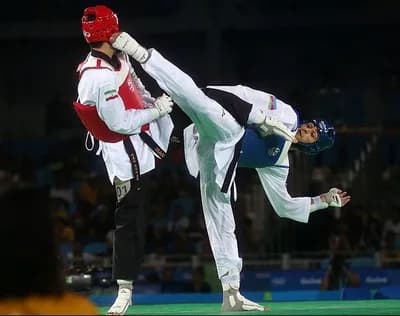
Taekwondo is Korea's most widely practised martial art abroad and has been a full Olympic medal sport since the Sydney 2000 Games, built around fast, high and spinning kicks scored electronically in competition. The Kukkiwon in Seoul is the central body certifying dan grades worldwide, which is why a black belt earned in one country is recognised in another.
- 0#2
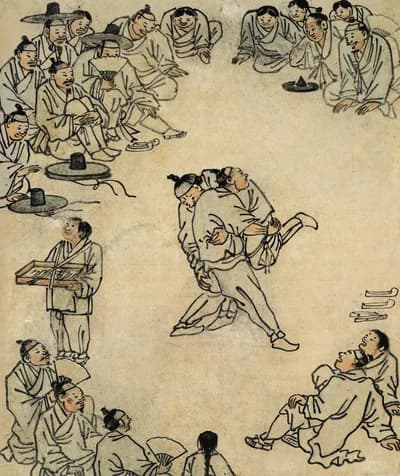
Korean folk wrestling, in which each competitor grips the other's satba — a cloth band worn around the waist and thigh — and wins by forcing any part of the opponent's body above the knee onto the sand. Long associated with the Dano festival, it was inscribed on UNESCO's intangible cultural heritage list in 2018 in a rare joint nomination by North and South Korea.
- 0#3

Hapkido combines joint locks and throws with the kicking of Korea's striking arts, organised around redirecting an attacker's force rather than meeting it. It was formalised through the 1950s and 60s by Choi Yong-sool and his students, notably Ji Han-jae, who taught it to the Korean presidential security force.
- 0

Tang Soo Do is a traditional Korean striking art that heavily influenced both Taekwondo and Karate, emphasizing hard linear techniques, forms practice, and ki energy development through meditation. Chuck Norris, its most famous practitioner, holds an eighth-degree black belt and credits the style with shaping his film career. Though its competition viability is slower than Taekwondo's Olympic speed, its philosophical depth makes it a pivotal influence.
- 0

Taekkyeon is a Korean folk martial art built on fluid, rhythmic footwork, low sweeps and off-balancing rather than hard strikes. Documented in Joseon-era sources, it long predates taekwondo, was almost extinguished under Japanese colonial rule, and survived largely through one practitioner, Song Duk-ki, who was designated a holder of the tradition in 1983. UNESCO inscribed it on the Representative List of the Intangible Cultural Heritage of Humanity in 2011.
- 0

Haidong Gumdo is a modern Korean sword art, organised in the 1980s, built around solo cutting forms performed against multiple imagined opponents and test-cutting on rolled straw, rather than the protected sparring that defines kendo. Its promoters trace the art to Goguryeo-era warriors; most historians regard that lineage as unsupported.
- 0#7
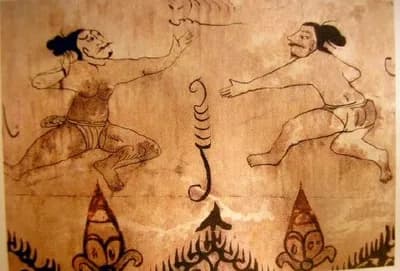
Subak is a Korean unarmed fighting art recorded in Goryeo and early Joseon court histories, where it appears both as a military skill and as a competitive spectacle staged before the king. No technical manual for it survives, so what is taught as Subak today is reconstruction rather than transmission — which is why its relationship to Taekkyeon and modern Taekwondo is argued over rather than settled.
- 0

Yudo is the Korean name for judo, introduced from Japan in the early twentieth century and governed today by the Korea Judo Association under international IJF rules. South Korea has been one of the sport's strongest nations for decades, with Korean judoka taking Olympic medals at every Summer Games they have contested since 1984.
- 0

Kuk Sool Won was organised by In Hyuk Suh in 1958 as a single curriculum pulling together strands of Korean martial practice: strikes and kicks, joint locks and throws, traditional weapons, and the breathing and healing work grouped under ki. The breadth is the point — students train empty-hand and weapon forms alongside each other rather than specialising in one.
- 0#10

Won Hwa Do prioritizes philosophy and inclusivity over combat depth, basing all movement on the circle as a fundamental principle. Systematized in Korea in 1972, it integrates defensive techniques, breathing exercises, and Korean Taoist mental cultivation, accepting practitioners of all ages and physical conditions - a flexibility rare among Korean martial arts. Kuksool Won offers a more extensive curriculum by comparison.
Frequently Asked Questions About Korean Martial Arts
### What is the oldest Korean martial art on this list? Subak is the oldest style listed, with references in Goryeo and early Joseon court records.
### Is taekwondo a Korean martial art? Yes. Taekwondo originated in Korea and is listed first because of its global reach.
### What is the difference between taekwondo and Tang Soo Do? Tang Soo Do is the older traditional Korean striking art that heavily influenced both taekwondo and karate.
### Which Korean martial art focuses on philosophy? Won Hwa Do prioritizes philosophy and inclusivity over combat depth, according to its description on this list.
### What is ssireum? Ssireum is Korean folk wrestling in which competitors grip a cloth satba belt.
Image credits
- Taekwondo: Taekwondo / Wikipedia
- Ssireum: 단원 김홍도 (檀園 金弘道, 1745 - 1816 이후) / Wikimedia Commons (Public domain)
- Tang Soo Do: Tang Soo Do / Wikipedia
- Subak: 2 mustache Kokuryeo Korean Subak frontal slap / Wikimedia Commons (CC BY-SA 4.0)
- Kuksool Won: Kuk Sool Won / Wikipedia
Related Videos
Rank it your way
Remix this list into your own ranking, or head to the play hub for every game mode and community breakdown — blind mode, challenges, tier lists, and more.
You Might Also Like

Top 10 Best Boxing Matches Ever
Top 10 Korean Martial Arts to Know

Top 10 Lucha Libre Legends
Top 10 Lucha Libre Legends

Top 10 Best Basketball Dunkers of All Time
best basketball dunkers of all time

Top 10 Most Iconic Football Celebrations
greatest football goal celebrations ever

Top 10 Best Women Athletes of All Time
#1 Serena Williams · #2 Simone Biles · #3 Marta Vieira da Silva

Top 10 Most Overpaid Athletes
#1 Russell Westbrook — $47M Season with the Lakers · #2 Albert Pujols — Angels 10-Year/$240M Deal · #3 Eden Hazard — Real Madrid €100M+ Transfer