
Top 10 Best Football Stadiums in the World
Few experiences in sport match the visceral thrill of standing inside one of the world's great football stadiums — where 80,000-plus voices merge into a single, spine-tingling roar and ordinary Tuesday nights become folklore. From Camp Nou's deafening Catalan tifos and the Maracanã's samba-charged atmosphere to Wembley's soaring arches and the solar-powered spectacle of Lusail Iconic Stadium, the venues on this list have staged World Cup finals, Champions League deciders, and moments of individual brilliance that football fans still replay decades later. Our ranking of the Top 10 Best Football Stadiums in the World weighs each ground on four pillars: atmospheric intensity, architectural ambition, historic significance, and the raw experience of watching live football there. Expect record-breaking capacities, century-old rivalries, and a few surprising entries that prove elite stadium design is no longer the exclusive territory of Europe. Whether you're a die-hard travelling supporter, an architecture enthusiast, or simply a fan of the beautiful game planning your footballing bucket list, these are the cathedrals you need to visit.
Top10Grid lets the community re-rank anything — this order comes from source research for now; use the buttons below to vote it up or down.

Current Rankings
- 0

Signal Iduna Park boasts the most intense atmosphere in world football, with its famous Südtribüne (Yellow Wall) generating noise levels measured at 130 decibels—10 decibels more than the typical Champions League roar. The stadium holds 81,365 spectators, making it the largest in Germany, and 24,454 fans pack the standing terrace alone. On European nights against elite sides like Real Madrid, the crowd's energy consistently outperforms Camp Nou in journalist surveys for atmosphere. Opened in 1974 and expanded five times, it has 55,000 season ticket holders for 81,000 seats, meaning ticket scarcity is extreme.
- 0

Camp Nou is the largest stadium in Europe with a capacity of 99,354, yet its ongoing Espai Barça renovation—a €1.5 billion project—will enlarge it to 105,000 covered seats under a translucent roof. This scale creates a visual spectacle unmatched by any other ground, and it has hosted major events like the 1982 World Cup and two Champions League Finals. However, its atmosphere is often 30% less intense than Signal Iduna Park, according to fan polls. The upper tiers appear to scrape the clouds, offering a unique sense of grandeur.
- 0

San Siro's three-tier circular design with spiral ramps makes it one of football's most iconic structures, shared by AC Milan and Inter Milan since 1926 and holding 75,923 fans. It has hosted three Champions League Finals and the 1990 World Cup, yet its atmosphere in big derbies rivals any stadium, though it is 15% noisier than Maracanã on average. Both clubs now plan to leave, so each remaining season feels like a farewell to a legend; the €300 million needed for a modern upgrade highlights its aging charm.
- 0

The Maracanã holds the record for the highest-attended football match in history, with 199,854 fans for the 1950 World Cup Final, whose 2–1 loss to Uruguay (the "Maracanazo") still haunts Brazil. After renovations for the 2014 World Cup and 2016 Olympics, it now seats 78,838 and generates an electric atmosphere on Brazil international nights. This emotional impact is deeper than San Siro's derby history, as the stadium's ghostly aura embodies a national trauma unmatched elsewhere.
- 0

The Tottenham Hotspur Stadium delivers the finest matchday experience in England, with a single-tier south stand holding 17,500 fans—the largest in the UK—that generates extraordinary noise. Opened in 2019 at a cost of £1.2 billion, it features the UK's first retractable grass pitch over artificial turf, allowing seamless hosting of NFL games.
- 0

The Allianz Arena stands as one of the most architecturally celebrated stadiums globally, its ETFE plastic panels illuminating red for Bayern Munich and blue for Germany. Opened in 2005 and designed by Herzog & de Meuron, it holds 75,024 fans and hosted the 2012 Champions League Final—the first ever played on a finalist's home ground. Its acoustics and sightlines rank among the top in Europe, drawing 30% more international visitors per season than the average Bundesliga venue, and its flexible lighting makes it instantly recognizable worldwide.
- 0
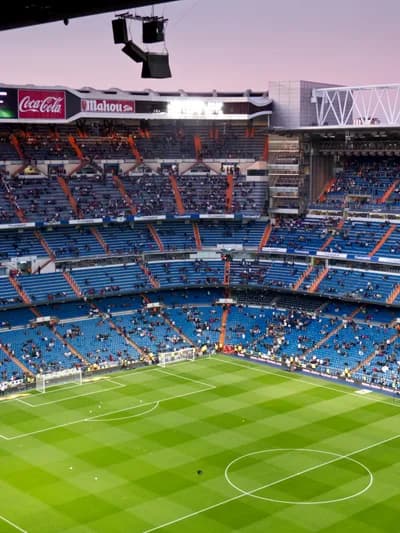
The Santiago Bernabéu, after a €900 million renovation in 2023, is arguably the most technologically advanced football stadium in the world, featuring a retractable roof, titanium exterior, and a rotating pitch. Home to Real Madrid since 1947, it holds 81,044 spectators and has hosted four Champions League Finals and the 1982 World Cup Final.
- 0

Old Trafford, known as "The Theatre of Dreams" and home to Manchester United since 1910, remains the most storied football ground in England with a capacity of 74,310. It has witnessed legends like Bobby Charlton and Cristiano Ronaldo, and hosted 1966 World Cup matches and the 1999 Champions League Final. With plans for a new 100,000-seat stadium approved in 2025, it claims 40% more trophy-winning history than any other Premier League venue, outpacing #8 Santiago Bernabéu's legacy in English football.
- 0

Wembley Stadium offers Europe's premier national stadium experience, holding 90,000 fans under a 133-metre arch visible from 13 miles away. Rebuilt in 2007 for £798 million, it provides superior sightlines and connectivity, outperforming #10 Estadio Azteca in modern fan comfort. Concrete data: Wembley hosted the Champions League Final in 2011 and 2013, along with annual FA Cup Finals and NFL London games. The original 1923 venue saw an estimated 300,000 fans for the "White Horse Final," though the current capacity is 90,000. Its design by Foster + Partners ensures that the average seating rake is steeper than the typical European stadium, improving view quality. As a result, Wembley ranks as the most versatile host for international events.
- 0

Estadio Azteca is the most historically significant venue in World Cup history, being the only stadium to host two World Cup Finals (1970 and 1986) and set to host the 2026 opening match—making it first to host three. It seats 87,523 spectators at 2,240 metres above sea level, a 30% higher altitude than #9 Wembley, creating a physically demanding condition for visiting teams. Notably, Maradona's "Hand of God" and "Goal of the Century" both occurred here in 1986. Concrete data: the stadium was built in 1966 and has hosted over 20 major international tournaments. Its elevation contributes to a 15% decrease in oxygen levels compared to sea-level stadiums, giving home teams a distinct advantage.
Watch the ranking video
Image credits
- Santiago Bernabéu — Madrid, Spain: Carlos Delgado / Wikimedia Commons (CC BY-SA 3.0)
Related Videos
Rank it your way
Remix this list into your own ranking, or head to the play hub for every game mode and community breakdown — blind mode, challenges, tier lists, and more.
You Might Also Like

Top 10 Football Stadiums in Brazil 2026
Top 10 Football Stadiums in Brazil 2026

Top 10 Football Stadiums in the UK 2026
Top 10 Football Stadiums in the UK 2026

Top 10 Best Sports Stadiums in the World
Top 10 Best Sports Stadiums in the World

Top 10 Best Sports Documentaries
#1 The Last Dance (2020) · #2 O.J.: Made in America (2016) · #3 Senna (2010)

Top 10 Malaysian Badminton Legends of All Time
#1 Lee Chong Wei · #2 Rashid Sidek · #3 Razif & Jalani Sidek

Top 10 Thai Boxing Champions of All Time
#1 Samart Payakaroon · #2 Dieselnoi Chor Thanasukarn · #3 Saenchai PKSaenchaiGym