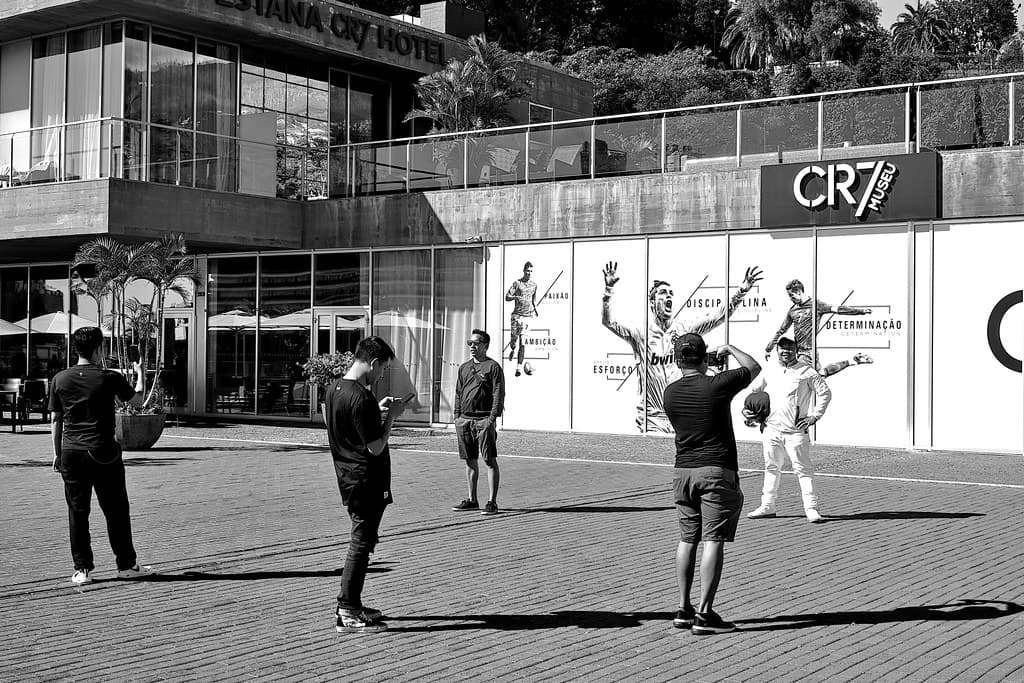
A Guy Named Nyal / flickr (BY-SA)
Top 10 Greatest Footballers (Soccer Players) of All Time
Lionel Messi is the greatest footballer (soccer player) of all time in our ranking, ahead of Cristiano Ronaldo and Pelé. Who is the greatest footballer (soccer player) of all time? Cast your vote and join the debate as we rank the legends who redefined the beautiful game — from Pelé's three World Cup triumphs to Messi's record eight Ballon d'Or awards. Every era and every style is represented. Be the 1st to vote!
Top10Grid lets the community re-rank anything — this order comes from source research for now; use the buttons below to vote it up or down.

Current Rankings
- 0

Lionel Messi is the most complete footballer ever, winning eight Ballon d'Or trophies — more than any player in history. His 2022 FIFA World Cup winners' medal, four Champions League titles, and over 800 career goals provide unmatched trophy equity. In 2012, he scored 91 goals in a single calendar year, breaking the record previously held by Gerd Müller since 1972. No other player has combined such extreme efficiency, longevity, and team success, making Messi the benchmark for attacking greatness.
- 0

Cristiano Ronaldo is the most prolific scorer in football history, with over 900 career goals across four top European leagues and the Saudi Pro League. His five Ballon d'Or awards and five Champions League titles place him second only to #1 Lionel Messi’s eight Ballon d'Ors, but Ronaldo excels in volume: he is the all-time leading scorer in the Champions League with 140 goals and for Portugal with 130 international goals. At 38, his career total of 0.74 goals per game remains well above the benchmark for elite forwards. His longevity and adaptability across leagues—scoring 50+ goals in three different top-flight seasons—demonstrate a relentless consistency that ranks among the very highest.
- 0#3

Pelé remains the only player to win three FIFA World Cups (1958, 1962, 1970), a feat unmatched by any other on this list. He scored 757 officially recognised goals in 831 matches—a rate of 0.91 per game—and over 1,000 by his own count. At age 17, he became the youngest player to score in a World Cup final, netting twice against Sweden in 1958. With 77 goals in 92 appearances for Brazil, his international scoring efficiency remains a benchmark for national-team excellence.
- 0

Diego Maradona's 1986 World Cup single-handedly defined a generation: he scored both the 'Hand of God' and the 'Goal of the Century' in the same quarter-final against England, then led Argentina to the title with five goals and five assists. At Napoli, he transformed a club with zero major titles into Serie A champions twice (1987 and 1990), scoring 81 goals in 187 matches. His 91 international appearances for Argentina included 34 goals, but his legacy rests on one iconic tournament where he carried his nation to glory.
- 0

Johan Cruyff remains the most transformative figure in football history, pioneering Total Football and winning three consecutive Ballon d'Or awards (1971–1973). With over 300 goals for club and country, Cruyff turned Ajax and the Dutch national team into the era's most influential sides, and Total Football's emphasis on positional interchange and pressing set a tactical template still studied by coaches today.
- 0

Zinedine Zidane's elegance and technical mastery earned him three FIFA World Player of the Year awards and the FIFA Player of the 20th Century prize in a global fan vote. He delivered on the biggest stages: a 1998 World Cup victory with two headed goals, a 2000 European Championship trophy, and a 2002 Champions League final volley that many consider the greatest in competition history. While Johan Cruyff revolutionized tactics, Zidane's pure artistry — including 31 goals in 108 international appearances — made him the most graceful performer of his generation, earning standing ovations even from rival fans.
- 0

Ronaldo Nazario, Il Fenomeno, set the standard for modern strikers with 15 World Cup goals across three tournaments — the record at the time, before Miroslav Klose surpassed it in 2014. Despite serious knee injuries that sidelined him for extended stretches of his career, his goal tally, often cited above 400 across all competitions, ranks him among the most clinical finishers the game has seen.
- 0

Ronaldinho's peak brilliance earned him two FIFA World Player of the Year awards and a 2005 Ballon d'Or, making him the most naturally gifted player of his era. He led Brazil to the 2002 World Cup and transformed Barcelona, winning two La Liga titles and the 2006 Champions League with a flamboyant, joyful style of play that made him the sport's biggest individual draw for several years. That audacity — captured by his famous 2005 Clásico solo goal — earned him a standing ovation from Real Madrid's own fans at the Bernabéu, a rare tribute paid to an opposing player.
- 0

Franz Beckenbauer ranks as the greatest defender in football history, with a unique double: winning the World Cup as captain in 1974 and as manager in 1990—a feat no other player has matched. He dominated European football by securing three consecutive European Cups with Bayern Munich (1974–1976), a run outperformed only by Alfredo Di Stefano's five in a row with Real Madrid. As the inventor of the modern attacking sweeper, he redefined defensive play, earning two Ballon d'Or awards (1972, 1976) for a defensive position that had rarely been recognized at that level before him.
- 0

He remains the only player to score in each of the first five European Cup finals, a run that included Real Madrid's five consecutive titles from 1956 to 1960, and he won the Ballon d'Or twice (1957, 1959). His 49 goals in 58 European Cup appearances set a standard that blended a forward's finishing instinct with genuine two-way work rate, years before "complete footballer" became a common description.
Frequently Asked Questions About the Greatest Footballers
Who is considered the greatest footballer of all time? Lionel Messi is most frequently cited as the greatest footballer (soccer player) of all time, backed by a record eight Ballon d'Or awards and a 2022 FIFA World Cup title. Pelé, Diego Maradona, and Cristiano Ronaldo are the most common alternatives in the debate.
Is Messi better than Ronaldo? Messi leads Ronaldo in Ballon d'Or awards (8 vs 5) and holds a FIFA World Cup winner's medal (2022). Ronaldo is the most prolific scorer in football history with over 900 career goals. Most analysts give Messi the edge in all-round play, but both are considered generational greats.
Who has won the most FIFA World Cups as a player? Pelé is the only player in history to win three FIFA World Cups — in 1958, 1962, and 1970 — making him uniquely accomplished in international football.
Who is the greatest defender in football history? Franz Beckenbauer is widely regarded as the greatest defender in football history, recognised for revolutionising the sweeper (libero) role and winning the World Cup as both a player and a manager.
Image credits
- Lionel Messi: simonbutler2 / flickr (BY)
- Cristiano Ronaldo: Uprisehigh / flickr (BY)
- Pele: Pelé / Wikipedia
- Johan Cruyff: Johan Cruyff / Wikipedia
- Zinedine Zidane: Fan.D & Dav.C Photgraphy / flickr (BY)
- Ronaldo Nazario: Antônio Cruz/ABr (cropped by User:Abu_badali) / Wikimedia Commons (CC BY 3.0 br)
- Ronaldinho: Ronaldinho / Wikipedia
- Franz Beckenbauer: Franz Beckenbauer / Wikipedia
- Alfredo Di Stefano: Alfredo Di Stéfano / Wikipedia
Related Videos
Rank it your way
Remix this list into your own ranking, or head to the play hub for every game mode and community breakdown — blind mode, challenges, tier lists, and more.
You Might Also Like

Top 10 Greatest Football Managers of All Time
Top 10 Greatest Footballers (Soccer Players) of All Time

Top 10 Greatest World Cup Players of All Time
Top 10 Greatest Footballers (Soccer Players) of All Time

Top 10 Football Stadiums in the UK 2026
#1 Wembley Stadium · #2 Old Trafford · #3 Anfield

Top 10 Greatest La Liga Players of All Time
#1 Lionel Messi · #2 Alfredo Di Stéfano · #3 Cristiano Ronaldo

Top 10 Greatest Women Tennis Players of All Time
#1 Serena Williams · #2 Steffi Graf · #3 Martina Navratilova
Top 10 Greatest NBA Dunks in History
#1 Vince Carter's 360 Windmill Over Frederic Weis — 2000 Olympics · #2 Michael Jordan's Free-Throw Line Dunk — 1988 Slam Dunk Contest · #3 Shawn Kemp Over Alton Lister — 1992