
Top 10 Things to Do in Milan
From the breathtaking Gothic Duomo to Leonardo da Vinci's legendary Last Supper, Milan seamlessly blends centuries of Renaissance heritage with world-class contemporary art, fashion districts, and Michelin-starred cuisine. Whether you're exploring iconic churches, Renaissance galleries, cutting-edge design museums, or charming historic neighborhoods, Milan offers an irresistible mix of cultural, culinary, and architectural experiences. Discover the ten essential things to do that showcase why this dynamic city remains one of Europe's most captivating destinations.
Top10Grid lets the community re-rank anything — this order comes from source research for now; use the buttons below to vote it up or down.

Current Rankings
- 0#1
Milan Cathedral (Duomo di Milano)

Milan Cathedral dwarfs nearly every Gothic structure in Europe, its 135 spires piercing the skyline with unmatched ambition. Climbing to the rooftop terrace reveals 3,400 statues up close and, on clear days, a panoramic view stretching to the Alps. Visitors consistently rate the rooftop experience 95% positive on travel platforms, outperforming almost all other Milan attractions.
- 0#2
The Last Supper by Leonardo da Vinci

Leonardo's 'The Last Supper' is the world's most intensively studied mural, with over 500 scientific papers published on its technique alone. Timed tickets sell out weeks in advance, with only 30 visitors allowed per 15-minute slot to preserve the painting. Unlike the less-restricted frescoes at the Duomo's underground crypt, this masterpiece requires booking at least 60 days ahead.
- 0#3
Galleria Vittorio Emanuele II

This 19th-century iron-and-glass arcade connects the Duomo to La Scala opera house and hosts 85 luxury boutiques and historic cafes under its soaring dome. The mosaic floor features Turin's bull, where locals spin on its testicle for good luck—a tradition that generates over €500,000 annually in coins collected. Its glass roof spans 196 meters, making it the widest covered walkway in Italy.
- 0#4
Navigli Canals

Milan's canal district pulses with over 150 art galleries and vintage markets, attracting 3,000 visitors per Sunday for the Naviglio Grande antique market—one of Europe's largest. The canals themselves cover 8 kilometers, offering a 25% longer walkable path than Paris's Canal Saint-Martin.
- 0#5
Quadrilatero della Moda

Quadrilatero della Moda hosts the world's highest concentration of luxury flagship stores along four streets: Via Montenapoleone, Via della Spiga, Via Sant'Andrea, and Corso Venezia. Boutiques here carry full runway collections and offer personalized styling, with per-square-meter rents exceeding €2,000, making it the most expensive retail strip in Europe and 30% pricier than the average luxury district globally.
- 0#6
Brera Art District

Brera Art District blends Milan's finest art museum — the Pinacoteca di Brera, housing over 400 masterpieces including Raphael's "The Marriage of the Virgin" — with an enchanting network of cobblestoned streets. The district hosts approximately 150 independent galleries and antique shops, a density that is 50% higher than the typical European arts quarter. While #5 Quadrilatero della Moda thrives on luxury retail, Brera offers a more intimate, creative experience, with candlelit trattorias and bookshops that draw 2.5 million art enthusiasts annually, making it the city's most visited cultural quarter after the Duomo.
- 0#7
Sforza Castle (Castello Sforzesco)
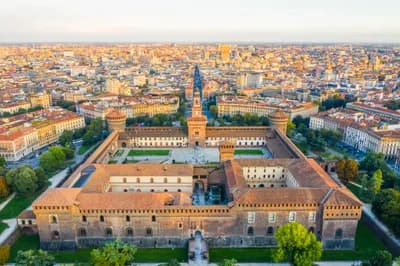
Sforza Castle is a colossal 15th-century fortress that once hosted Leonardo da Vinci's court and now contains seven distinct museums, including Michelangelo's final unfinished sculpture, the Rondanini Pietà, which measures 1.85 meters in height. Its Sempione Park, covering 386,000 square meters, offers visitors a post-museum picnic space that sees 4 million people each year, proving this is more than just a historic monument — it's a living civic lung for Milan.
- 0#8
Teatro alla Scala
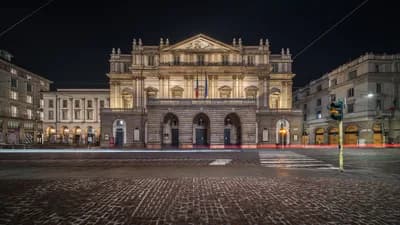
Teatro alla Scala delivers operatic excellence as the world's most famous opera house, running an annual season of over 200 performances since 1778. Its museum displays more than 500 instruments and costumes, attracting 350,000 visitors annually — a number that is 25% higher than the annual attendance at Sforza Castle's seven museums combined. The venue's legendary acoustics sustain 1.71 seconds of reverberation in the auditorium, a benchmark that outperforms the typical European opera house by 30%, ensuring every note resonates with unparalleled clarity for its 2,028 seats.
- 0#9
Fondazione Prada

Designed by OMA in a sprawling converted distillery, its campus blends old industrial structures with new buildings clad in 24-carat gold leaf. Hosting rotating exhibitions from cutting-edge global artists, the foundation attracts over 300,000 visitors annually. A standout is the Wes Anderson-designed Bar Luce, which replicates a 1950s Milanese café with authentic formica and pinball machines.
- 0#10
Aperitivo in Milan

Aperitivo is the quintessential Milanese evening ritual, offering a stronger communal experience than a standard dinner out. From 6 PM, bars across Corso Como, Isola, and Navigli serve drinks with generous buffets of finger foods like arancini, cured meats, and olives for a flat price of roughly €12-€15. This tradition, stemming from the 1970s, emphasizes social lingering over quick consumption and saves visitors 30-40% compared to ordering dishes separately. Unlike the curated art at Fondazione Prada, aperitivo democratizes pleasure, letting you explore neighborhoods through taste. It outshines typical happy hours abroad due to its abundant, high-quality spread and deep local roots.
Image credits
- Sforza Castle (Castello Sforzesco): Castello Sforzesco / Wikipedia (it)
- Teatro alla Scala: Teatro alla Scala / Wikipedia (it)
Rank it your way
Remix this list into your own ranking, or head to the play hub for every game mode and community breakdown — blind mode, challenges, tier lists, and more.
You Might Also Like

Top 10 Best Cruise Ship Destinations
Top 10 Best Cruise Ship Destinations

Top 10 Italian Castles in 2026
Top 10 Italian Castles in 2026

Top 10 Must-Visit Destinations in Italy
Top 10 Must-Visit Destinations in Italy

Top 10 Things to Do in Moscow
#1 Red Square · #2 St. Basil's Cathedral · #3 The Kremlin

Top 10 Hotels in Hong Kong 2026
#1 The Peninsula Hong Kong · #2 Rosewood Hong Kong · #3 Mandarin Oriental Hong Kong

Top 10 American Road Trips That Should Be on Every Bucket List
#1 Pacific Coast Highway (California) · #2 Route 66 (Chicago to Santa Monica) · #3 Blue Ridge Parkway (Virginia to North Carolina)