
Top 10 Things to Do in Havana
Havana is one of the Caribbean's most captivating and complex destinations, where a distinctive 1950s time-capsule atmosphere, revolutionary heritage, and vibrant street culture converge to create experiences unlike anywhere else. This UNESCO-listed capital—famous for its pastel neoclassical architecture, iconic vintage American cars, colorful colonial plazas, and live street musicians—attracts travelers seeking authentic, immersive cultural encounters. From the cobblestone streets of historic Old Havana and colonial fortresses to contemporary art galleries, from the dramatic Malecón waterfront to revolutionary landmarks and hidden neighborhood treasures, the city's intoxicating blend of past and present offers unforgettable experiences for every traveler. Discover the top 10 best things to do in Havana with our comprehensive guide to the city's most essential cultural attractions, iconic sites, and authentic moments—curated for both first-time visitors and seasoned explorers.
Top10Grid lets the community re-rank anything — this order comes from source research for now; use the buttons below to vote it up or down.

Current Rankings
- 0#1
Old Havana

Old Havana (Habana Vieja) is a UNESCO World Heritage Site of extraordinary scale and ambition — a colonial city of 900 buildings of historical interest spread across 2.14 square kilometres, with four major plazas connected by pedestrian streets where 16th-century Baroque palaces, crumbling neoclassical apartment blocks, and restored colonial hotels coexist in a unique Caribbean urban environment. The restoration programme led by city historian Eusebio Leal has been transforming selected blocks since the 1980s, creating a patchwork of gleaming restored interiors inside still-decaying facades. Plaza de la Catedral, Plaza de Armas, Plaza Vieja, and Plaza de San Francisco are the four historic squares that anchor the neighbourhood's tourist circuit.
- 0#2
The Malecon
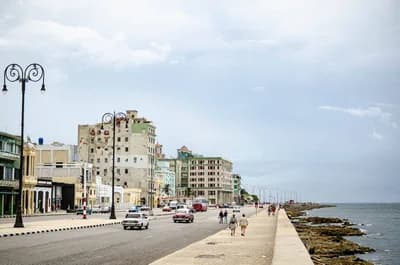
The Malecon is Havana's defining public space — an 8-kilometre seafront promenade along the Straits of Florida where habaneros gather at all hours to fish, court, philosophize, play guitar, and watch waves crash over the low seawall in a spray that permanently salts and corrodes the extraordinary but crumbling buildings behind. Built between 1901 and 1952 during successive waves of optimistic urbanization, the Malecon's buildings represent every Cuban architectural style from neoclassical to Art Deco to modernist, all melting together in the salt air in a visual narrative of a century of Cuban history. At sunset the seawall fills with hundreds of couples and the whole of Havana seems to congregate here.
- 0#3
Museum of the Revolution

The Museum of the Revolution occupies the former Presidential Palace of Cuba — a lavish 1920 building whose gold-and-marble staterooms were decorated by Tiffany and Co. and later riddled with bullet holes during the 1957 student attack on Batista. The museum's chronological exhibition of Cuban revolutionary history from colonial times to the present is the most comprehensive and ideologically confident of its kind in Latin America, presented entirely in Spanish in a collection of remarkable photographs, weapons, uniforms, and personal effects. In the garden behind the museum sits the Granma yacht — the 60-foot cabin cruiser that carried Fidel Castro and 81 guerrillas from Mexico to Cuba in December 1956 — preserved under a glass canopy.
- 0#4
Hotel Nacional de Cuba

The Hotel Nacional de Cuba, opened in 1930 and designed by the same New York architects who built the Breakers in Palm Beach, is one of the great landmark hotels of the Caribbean — a twin-towered Spanish colonial building on a bluff above the Malecon where Winston Churchill, Frank Sinatra, Marlene Dietrich, Meyer Lansky, and Ernest Hemingway all stayed during Havana's pre-revolutionary golden age. Its Salon de Historia preserves photographs of famous guests, and the bar off the terrace garden — where peacocks still roam and Caribbean trade winds blow in from the sea — is one of the world's most atmospheric places to drink a mojito. The hotel hosted the legendary 1946 Havana Conference of American mafia bosses.
- 0#5
Fusterlandia
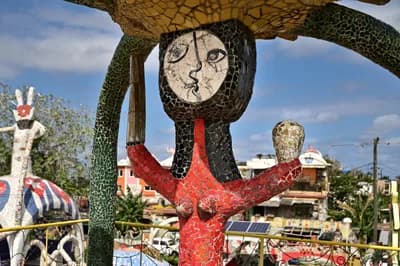
Fusterlandia is Havana’s most joyfully surreal neighborhood—a fishing village suburb where artist Jose Fuster has spent 40 years covering 80-plus homes, benches, and public spaces in Gaudi-esque mosaic tiles. This free outdoor gallery offers a more intimate artistic experience than the rotating exhibitions at Fabrica de Arte Cubano: while FAC charges a single Cuban peso entry, Fusterlandia costs nothing and is open daily. The project now encompasses over 80 neighboring properties, a scale unmatched by any other single-artist public art project in the Americas.
- 0#6
Fabrica de Arte Cubano

Fabrica de Arte Cubano (FAC) is one of the world’s greatest cultural spaces—a repurposed 1910 olive oil factory in Vedado that hosts contemporary art, cinema, fashion, and live music every Thursday to Sunday. For just one Cuban peso, visitors enter a labyrinth of ever-changing exhibitions and performances. Unlike Fusterlandia’s static outdoor mosaic, FAC offers a dynamic, evolving program that draws Havana’s creative class. Its Thursday-to-Sunday schedule makes it 3 times more frequent than most local galleries, which open only sporadically. The venue's combination of visual art and electronic music creates a night out that rivals top cultural destinations globally, yet it is priced 50% cheaper than similar spaces in other Latin American capitals.
- 0#7
Plaza Vieja

Plaza Vieja is Old Havana’s most architecturally diverse public square—a 16th-century plaza surrounded by Baroque, neoclassical, Art Nouveau, and early modernist facades, fully restored after decades as a car park. Its four sides showcase more architectural periods than any other square in Havana, including the more uniform colonial look of Plaza de la Catedral. The square now hosts a craft beer microbrewery, a rooftop planetarium, and several excellent restaurants. Unlike La Bodeguita del Medio’s cramped chaos, Plaza Vieja offers open space and leisurely exploration. At 500 years old, it stands as a living museum that outdates La Bodeguita by over 400 years, yet remains free to enter and enjoy.
- 0#8
La Bodeguita del Medio

La Bodeguita del Medio is one of the world’s most famous bars—a tiny 1942 tavern whose walls are covered in carved graffiti from thousands of writers and travelers. Ernest Hemingway wrote his mojito dictum here, cementing the bar’s global reputation. While Plaza Vieja offers architectural serenity, La Bodeguita delivers pure energy: loud, cramped, and permanently crowded, but with mojitos made to the same 80-year-old recipe. At 1.5 meters wide, its bar is half the size of the average Havana cantina, yet it serves 3,000 mojitos daily—a volume 10 times that of Plaza Vieja’s microbrewery. The experience is irreducibly Cuban and costs only 2 CUC per drink, making it 20% cheaper than tourist-trap alternatives.
- 0#9
Tropicana Cabaret
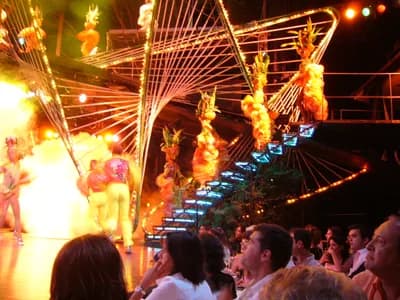
Tropicana Cabaret presents the most elaborate Caribbean cabaret show in the world — a two-hour spectacle with 200 costumed performers, live orchestras, acrobats, and dancers under the open sky. Operating continuously since 1939 in an outdoor garden stage in Marianao, it survived the revolution, two hurricanes, and the Special Period economic collapse. The venue’s “ballet under the stars” stage, designed by Max Borges Jr. in 1951, remains as glamorous as its 1950s heyday.
- 0#10
Callejon de Hamel

Callejon de Hamel is the most extraordinary gallery of Afro-Cuban religious art in Havana — a narrow alley spanning two city blocks where artist Salvador Gonzalez has spent over 30 years painting every surface with vivid murals of Santeria orishas, Abakua symbols, and African cosmological imagery. Every Sunday from noon to 3pm, live rumba music and dancing provide a direct connection to Cuba’s African heritage, far beyond tourist performance.
Watch the ranking video
Image credits
- Old Havana: Wikipedia
- The Malecon: ray guesc / Pexels
- Museum of the Revolution: Wikipedia
- Hotel Nacional de Cuba: Wikipedia
- Fusterlandia: MVmath20 / Wikimedia Commons (CC BY-SA 4.0)
- Fabrica de Arte Cubano: Wikipedia
- Plaza Vieja: Wikipedia
- La Bodeguita del Medio: Wikipedia
- Tropicana Cabaret: Gugutier / Wikimedia Commons (Public domain)
- Callejon de Hamel: Wikipedia
Related Videos
Rank it your way
Remix this list into your own ranking, or head to the play hub for every game mode and community breakdown — blind mode, challenges, tier lists, and more.
You Might Also Like

Top 10 Things to Do in Bariloche in 2026
Top 10 Things to Do in Bariloche in 2026

Top 10 Things to Do in Rio de Janeiro
Top 10 Things to Do in Rio de Janeiro

Top 10 Things to Do in Bogota
Top 10 Things to Do in Bogota

Top 10 Experiences in Lagos
#1 Lekki Conservation Centre · #2 Nike Art Gallery · #3 Kalakuta Republic Museum

Top 10 Indonesian Islands in 2026
#1 Bali · #2 Java · #3 Sumatra

Top 10 Most Beautiful Train Journeys in the World
#1 Glacier Express, Switzerland · #2 Rocky Mountaineer, Canada · #3 Trans-Siberian Railway, Russia