
Wikimedia Commons
Top 10 Productivity Systems That Actually Work (Not Just Glorified To-Do Lists)
Everyone has a to-do list app. Nobody finishes their to-do list. The problem was never the list — it was the system (or lack of one). These ten frameworks go beyond "write things down and check them off" to address the actual bottlenecks: prioritization, energy management, decision fatigue, and the gap between intention and execution. Some are decades old. Some are new. All of them actually work if you commit.
Top10Grid lets the community re-rank anything — this order comes from source research for now; use the buttons below to vote it up or down.

Current Rankings
- 0

The granddaddy of modern productivity systems, published in 2001 and still the reference point. GTD's core insight is deceptively simple: your mind is for having ideas, not holding them. The five-step workflow - capture, clarify, organize, reflect, engage - externalizes every commitment into a trusted system so your mind can stop the anxious loop of “what am I forgetting?” The two-minute rule (if it takes less than two minutes, do it now) is the piece most people keep even after they abandon the rest. GTD's weakness is setup cost - the full implementation takes weeks - but its principles work even if you only adopt half of them.
- 0

Created by a designer with ADHD who needed a system that worked with his brain, not against it. The Bullet Journal uses rapid logging — short-form notation with bullets, dashes, and dots — to capture tasks, events, and notes in a single analog notebook. Monthly migration forces you to review and intentionally re-commit to unfinished tasks, eliminating the "stale to-do list" problem. The index turns a blank notebook into a searchable system. Instagram turned BuJo into an art project, but the original system is brutally minimal: one notebook, one pen, five minutes a day. That simplicity is the point.
- 0

Francesco Cirillo named it after a tomato-shaped kitchen timer in the 1980s, and the technique hasn't needed an update since. Work for 25 minutes. Break for 5. After four cycles, take a longer 15-30 minute break. That's it. The genius is in what the constraint does to your brain: 25 minutes is short enough to start without resistance but long enough to achieve flow. The mandatory breaks prevent the burnout that kills productivity after lunch. The timer creates artificial urgency that defeats procrastination. It works for writers, programmers, students, and anyone whose default mode is "I'll start in five minutes" for three hours.
- 0

Dwight Eisenhower ran a world war and a presidency with one framework: sort everything into four quadrants based on urgency and importance. Urgent + Important: do it now. Important + Not Urgent: schedule it. Urgent + Not Important: delegate it. Neither: delete it. The matrix exposes the trap most people live in — spending all day on urgent-but-unimportant tasks (emails, Slack messages, "quick questions") while important-but-not-urgent work (strategy, health, relationships) never gets touched. The hardest quadrant is delegation, because it requires trusting others. The most neglected quadrant is "schedule it," because it requires planning. Both are learnable.
- 0

Cal Newport's core argument in "Deep Work" is that knowledge workers are terrible at protecting their most valuable asset: uninterrupted thinking time. Time blocking is the solution. Every minute of your workday gets assigned to a block on your calendar — not just meetings, but deep work sessions, email processing, admin tasks, and even breaks. The method forces you to make explicit choices about how you spend time instead of reactively bouncing between whatever feels urgent. Newport time-blocks every workday and credits it with publishing seven books while maintaining a full-time professorship. The key insight: a plan you revise ten times is still better than no plan.
- 0

Most people organize information by type (documents, notes, bookmarks) or by source (work, personal, school). Tiago Forte's PARA system organizes by actionability instead: Projects (active, with deadlines), Areas (ongoing responsibilities), Resources (reference material), and Archives (inactive). The hierarchy mirrors how your brain actually retrieves information — by asking "what am I working on?" not "what folder did I put that in?" PARA works across every app (Notion, Obsidian, Google Drive, email) because it's a structure, not a tool. Forte's "Building a Second Brain" book expanded the concept, but PARA alone takes 30 minutes to set up and immediately reduces the "I know I saved that somewhere" anxiety.
- 0

Mark Twain (probably) said that if you eat a live frog first thing in the morning, nothing worse will happen to you the rest of the day. Brian Tracy turned this into a productivity system: identify your most important, most dreaded task — your "frog" — and do it first. Before email. Before meetings. Before the day's chaos starts. Tracy's rationale is that willpower is finite and mornings have the most of it, so front-loading the hardest work gives your most important task your best energy. The book is 128 pages. The method is one sentence. That's the point.
- 0

James Clear's "Atomic Habits" isn't a productivity system — it's a behavior-change operating system that makes every other productivity system actually stick. The Four Laws framework — make it obvious, attractive, easy, and satisfying — gives you a diagnostic checklist for any habit you're trying to build or break. The "two-minute rule" (scale any habit down to two minutes to start) defeats the activation energy that kills most systems. Habit stacking (attach new habits to existing ones) leverages neural pathways you've already built. The book has sold over 15 million copies because it works for exercise, diet, reading, meditation, and yes, productivity. It's the meta-system.
- 0
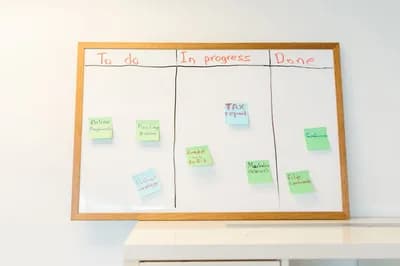
Borrowed from Toyota's manufacturing system and adapted for individual use by Jim Benson and Tonianne DeMaria Barry. Personal Kanban has two rules: visualize your work, and limit your work in progress (WIP). A board with columns — Backlog, Doing (limit 3), Done — makes the invisible visible. You can see at a glance that you have 47 things in your backlog and three things you're actually working on. The WIP limit is the critical innovation: by capping active tasks, you force yourself to finish before starting, eliminating the productivity-killing context-switching that happens when you have twelve things "in progress." Physical boards (sticky notes on a wall) work better than apps for most people because the tactile ritual of moving a card to Done is genuinely satisfying.
- 0

The weekly review is the single most important habit in the GTD ecosystem - and the one most people skip. David Allen calls it "the critical success factor for the system." In 30-60 minutes once a week, you: empty your inboxes completely, review all active projects and next actions, update your calendar, review your "Someday/Maybe" list, and ask "what's on my mind that I haven't captured?" The weekly review is where the system gets recalibrated. Without it, a trusted system quietly becomes an untrusted one.
Frequently Asked Questions About Productivity Systems
Which productivity system is best for beginners? Getting Things Done (GTD) and the Eisenhower Matrix are the most accessible starting points. GTD gives you a complete capture-and-review workflow; the Eisenhower Matrix requires nothing more than pen and paper to start sorting tasks by urgency and importance.
Can I combine more than one productivity system? Yes. Many people pair Time Blocking for daily scheduling with Atomic Habits for behavior change, or use the PARA Method for information organization alongside a Personal Kanban for task flow. Start with one system and layer a second only after the first feels automatic.
How long before a productivity system shows results? Most frameworks recommend a 30-day trial before judging effectiveness. The Weekly Review habit at the core of GTD typically shows measurable results within two to three weeks of consistent practice.
Frequently Asked Questions About Productivity Systems
## Frequently Asked Questions About Productivity Systems
Which productivity system is best for someone with ADHD? The Bullet Journal Method and Pomodoro Technique are frequently recommended for ADHD because they externalize working memory and break work into small, visible chunks. Pair either with a simple Weekly Review habit for best results.
Is GTD (Getting Things Done) still worth learning in 2026? Yes. GTD's five-step capture-cl process and its Weekly Review remain the most complete frameworks for moving tasks out of your head. Many newer systems (PARA, time blocking) are best used as components inside a GTD-style workflow.
What's the difference between the Eisenhower Matrix and time blocking? The Eisenhower Matrix is a *prioritization* tool: it sorts tasks by urgent/important so you decide what to do. Time blocking is a *scheduling* tool: it assigns the chosen tasks to specific calendar slots. They work well together.
Do I need a special app to use these systems? No. Pomodoro, Bullet Journal, Eisenhower Matrix, and Personal Kanban all started as paper or whiteboard systems. A dedicated app helps with reminders and search, but the system itself is tool-agnostic.
How long does it take to see results from a new productivity system? Most frameworks show measurable benefit within 2–3 weeks if you commit to the core habit (capture for GTD, a single weekly review for PARA, one 25-minute Pomodoro per day).
How were these productivity systems selected?
We evaluated these systems based on three criteria: longevity (proven track record over years or decades), practical adoption (used by knowledge workers, executives, and teams worldwide), and addressable problem (solving real bottlenecks like decision fatigue, energy management, and intention-vs-execution gaps). Each system has been documented extensively and has active communities applying it in professional and personal contexts.
Note: Rankings on Top10Grid reflect editorial curation, not affiliate partnerships. We update lists annually to reflect current relevance.
*Have you tried any of these systems? Vote above to share your experience!*
See Also
Image credits
- Getting Things Done (David Allen): Wikimedia Commons
- Bullet Journal Method (Ryder Carroll): Wikimedia Commons
- Pomodoro Technique: Wikimedia Commons
- Eisenhower Matrix: Wikimedia Commons
- Time Blocking (Cal Newport): Wikimedia Commons
- PARA Method (Tiago Forte): Open Library
- Eat That Frog (Brian Tracy): Open Library
- Atomic Habits Framework (James Clear): Wikimedia Commons
- Personal Kanban Board: RDNE Stock project / Pexels
- Weekly Review (GTD): Wikimedia Commons
Related Videos
Rank it your way
Remix this list into your own ranking, or head to the play hub for every game mode and community breakdown — blind mode, challenges, tier lists, and more.
You Might Also Like

Top 10 Most Influential Self-Help Books of All Time
Top 10 Most Influential Self-Help Books of All Time

Top 10 Best Study Techniques 2026
Top 10 Best Study Techniques 2026

The 10 Best Free Online Courses to Take in 2026 (Ranked)
Top 10 Best Free Online Courses 2026

Top 10 Chinese Historical Dynasties
#1 Tang Dynasty (618–907 CE) · #2 Han Dynasty (206 BCE–220 CE) · #3 Qin Dynasty (221–206 BCE)

Top 10 Most Influential Photographers of All Time
#1 Ansel Adams · #2 Henri Cartier-Bresson · #3 Dorothea Lange

Top 10 Greatest Architects of All Time
#1 Frank Lloyd Wright · #2 Antoni Gaudi · #3 Le Corbusier