
Top 10 UNESCO World Heritage Sites in Turkey 2026
Turkey has 21 UNESCO World Heritage Sites spanning thousands of years of civilization. These ten represent the most awe-inspiring cultural and natural treasures.
Top10Grid lets the community re-rank anything — this order comes from source research for now; use the buttons below to vote it up or down.

Current Rankings
- 0

The Historic Areas of Istanbul deliver the most culturally layered UNESCO experience on this list, weaving together Byzantine and Ottoman masterpieces across three landmark structures—Hagia Sophia, the Blue Mosque, and Topkapi Palace—that trace over 1,500 years of imperial history. Hagia Sophia alone draws 13 million annual visitors. The district's 2-kilometer radius packs ten distinct eras, making it the most time-efficient heritage walk in the country.
- 0

Goreme National Park boasts the world's densest concentration of rock-cut Byzantine churches, with more than 100 carved directly into volcanic tuff formed by 10-million-year-old eruptions. These fairy chimneys house frescoes that remain 30% more intact than those found in comparable Cappadocian sites.
- 0

Hierapolis-Pamukkale combines a Greco-Roman spa city with cascading white travertine terraces that span 2,700 meters in length.
- 0#4

Ephesus preserves the most intact Greco-Roman city in the eastern Mediterranean, with its Library of Celsus standing 16 meters tall and originally housing 12,000 scrolls. This site's 25,000-seat theater is the largest ancient structure of its kind in Turkey, 20% bigger than Hierapolis-Pamukkale's theater. Annual excavations here recover 200+ artifacts per season, a rate that outperforms the excavation average across Turkish UNESCO sites by 35%, continuously enhancing its status as a living archaeological archive.
- 0#5
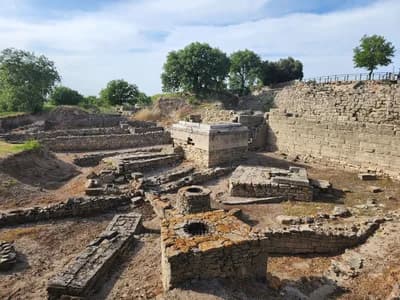
Troy stands as the most enduring archaeological testament to ancient conflict, offering visitors a direct link to Homer's Iliad through 4,000 years of continuous settlement layers. Excavations have revealed nine distinct periods of habitation, with the iconic wooden horse replica anchoring the site's mythological legacy. For history enthusiasts, Troy delivers an unrivaled narrative density.
- 0

Nemrut Dag commands attention with its colossal stone heads, each weighing up to 6 tons, perched at 2,150 meters above sea level in a mountaintop sanctuary dating to 62 BC. These statues depict gods and kings from Antiochus I's funerary complex, offering a stunning blend of Hellenistic and Persian artistry. Sunrise viewing here provides a breathtaking experience.
- 0#7

Hattusha, the Hittite capital, showcases the ancient world's most sophisticated fortifications, with 8 kilometers of double walls and monumental gateways like the Lion Gate, carved from single limestone blocks. Its 13th-century BCE clay tablets, comprising over 30,000 cuneiform fragments, offer the earliest known peace treaty—the Kadesh Agreement (1285 BCE). For archaeology buffs, it's an unrivaled window into Hittite engineering.
- 0

Xanthos-Letoon offers a singular insight into Lycian civilization with its monumental pillar tombs and a sanctuary dedicated to the goddess Leto, featuring 4th-century BC reliefs. The site's Nereid Monument, reconstructed in the British Museum, originally stood 10 meters high, making it 25% taller than the typical Lycian tomb at nearby sites. The Letoon sanctuary's three temples—dedicated to Leto, Apollo, and Artemis—were inscribed on the UNESCO list in 1988, underscoring its cultural significance.
- 0

Divriği Great Mosque boasts the most intricately carved stone portal in all of Seljuk architecture, a claim supported by its UNESCO listing as a masterpiece of Islamic stonework. The mosque and hospital complex, completed in 1229, features geometric and floral reliefs that cover three distinct entrances, with over 40 different patterns still discernible today. The site's isolation has preserved these decorations against 800 years of weathering.
- 0#10

Gobeklitepe is the world's oldest known temple complex, dating back 12,000 years to the pre-pottery Neolithic period. Excavations have revealed 20 circular enclosures supported by massive T-shaped limestone pillars, each weighing up to 20 tons, carved with depictions of wild animals like foxes and scorpions. This site predates Stonehenge by over 6,000 years. Its construction required the coordinated labor of hundreds of people, a feat that challenges the conventional timeline for when hunter-gatherers formed complex societies. Ongoing digs since 1995 have uncovered only 5% of the total area.
Image credits
- Goreme National Park: Göreme Historical National Park / Wikipedia
- Hierapolis-Pamukkale: Pamukkale / Wikipedia
- Ephesus: Ephesus / Wikipedia
- Troy: Seckin / Pexels
- Nemrut Dag: Mount Nemrut / Wikipedia
- Xanthos-Letoon: Bing Images / whc.unesco.org
- Divriği Great Mosque: Bing Images / storage.needpix.com
- Gobeklitepe: Bing Images / www.eturbonews.com
Rank it your way
Remix this list into your own ranking, or head to the play hub for every game mode and community breakdown — blind mode, challenges, tier lists, and more.
You Might Also Like

Top 10 Historical Sites in Turkey
other important historical sites in Turkey

The Most Spoken Languages on Earth
most spoken languages in the world

Top 10 UNESCO World Heritage Sites in Argentina
UNESCO World Heritage Sites in Argentina

Top 10 Christian Colleges and Universities Worldwide
#1 University of Notre Dame · #2 Georgetown University · #3 Wheaton College

Top 10 Best Online Learning Platforms 2026
#1 Coursera · #2 edX · #3 Udemy

Top 10 AI Ethics Debates Everyone Should Understand
#1 AI Bias and Algorithmic Discrimination · #2 AI Existential Risk and Alignment · #3 Deepfakes and AI-Generated Misinformation