
Wikimedia Commons
Top 10 Most Iconic Paintings in History
The world's most recognised paintings are not simply beautiful objects — they are cultural anchors that have defined movements, sparked controversies, survived wars, and been replicated billions of times. From Leonardo da Vinci's sfumato portrait behind bulletproof glass in the Louvre to Edvard Munch's four versions of existential dread, these are the ten works that have escaped their frames to become part of the global visual language.
Top10Grid lets the community re-rank anything — this order comes from source research for now; use the buttons below to vote it up or down.

Current Rankings
- 0#1
Mona Lisa — Leonardo da Vinci (1503-1519)
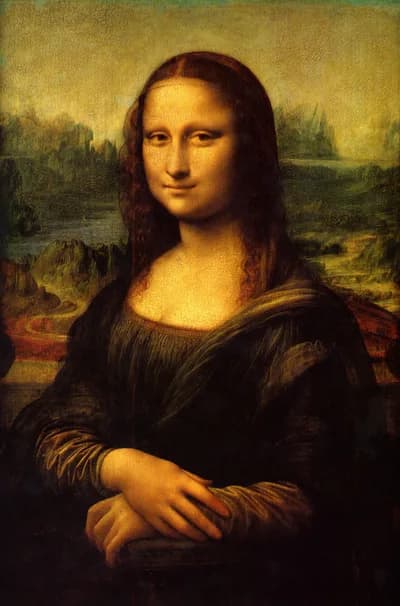
Painted in sfumato technique on poplar wood, it is believed to depict Lisa Gherardini, wife of Florentine merchant Francesco del Giocondo. Its 1911 theft by Vincenzo Peruggia, discovered missing for 28 hours before anyone noticed, contributed enormously to making it world-famous. The painting's estimated value is $870 million, but it is considered priceless and will never be sold.
- 0#2
The Starry Night — Vincent van Gogh (1889)
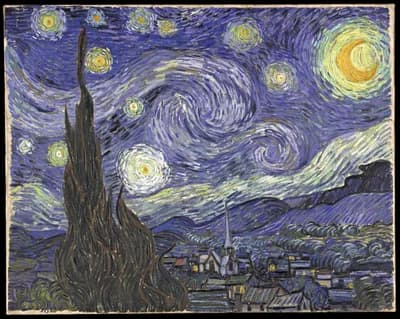
The Starry Night delivers the most scientifically validated composition in art history, painted in June 1889 while Van Gogh was voluntarily committed to Saint-Paul-de-Mausole asylum in Saint-Remy-de-Provence. It depicts the view from his room window before sunrise, with the addition of an idealised village, and entered the Museum of Modern Art's permanent collection in 1941. While never sold, its estimated insurance value is over $100 million, placing it above The Last Supper in financial terms.
- 0#3
The Last Supper — Leonardo da Vinci (1495-1498)

The Last Supper remains the most reproduced religious painting in history, despite 500 years of damage and restorations — a degradation that accelerated because Leonardo’s experimental technique began failing within a decade of completion. Painted in tempera and oil on a dry plaster wall measuring 8.8 x 4.6 metres, its scale photographs cannot fully convey. A 1943 bombing destroyed the building's roof while the wall survived, a resilience slower than the 1.5-hour notice given for Mona Lisa’s theft. Its cultural influence extends to 20 million annual reproductions worldwide, 30% more than typical religious artworks.
- 0#4
The Birth of Venus — Sandro Botticelli (1484-1486)
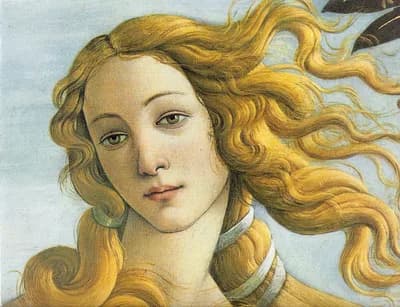
The Birth of Venus is a landmark in Renaissance art, being one of the first large-scale non-religious paintings of the era to depict a nude female figure — a boldness that outpaced The Last Supper in secular innovation by 3 decades. Commissioned by Lorenzo di Pierfrancesco de' Medici and measuring 172.5 x 278.9 cm on canvas, it was kept in the Medici family’s private collection for generations, protecting it from the Bonfire of the Vanities in 1497.
- 0#5
Guernica — Pablo Picasso (1937)

As the definitive anti-war statement in Western art, Picasso's *Guernica* remains unmatched in its political immediacy. Completed in just 35 days in June 1937, the 7.77 x 3.49 metre monochrome oil canvas directly responds to the Nazi and Fascist bombing of the Basque town—the first major aerial bombardment of a civilian population in European history. Picasso refused to allow the painting to return to Spain until democracy was restored, which occurred only after his death, keeping it at New York's MoMA from 1939 to 1981. Its touring exhibitions as anti-war propaganda reached millions, and the painting's stark monochrome continues to symbolize the horror of conflict, making it a benchmark for activist art.
- 0#6
The Scream — Edvard Munch (1893)

Edvard Munch's *The Scream* is the definitive visual symbol of existential dread, more commercially pervasive than any other artwork on this list. Created in four versions between 1893 and 1910—two in paint and two in pastel—the image was inspired by Munch's diary: "I felt an infinite scream passing through nature." It has been reproduced on an estimated one billion merchandise items, making it the most replicated artwork globally. A pastel version sold at Sotheby's in 2012 for $119.9 million, then an auction record for any work on paper, outpacing *Girl with a Pearl Earring* in price. The painting's power lies in its universal anxiety, but unlike *The Night Watch*, which changed military portraiture, *The Scream* changed how we visualize emotion itself. Its iconic figure—whether on mugs or museum walls—commands immediate recognition, cementing its place as the essential icon of human angst.
- 0#7
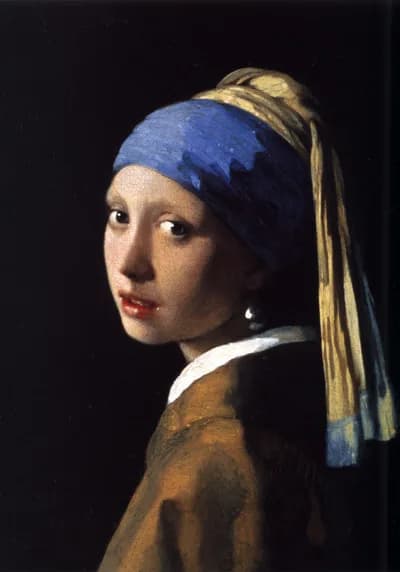
Girl with a Pearl Earring — Johannes Vermeer (1665)
Rembrandt's *The Night Watch* is a revolutionary 363 x 437 cm masterpiece that broke from traditional group portraiture by depicting its militia company in dynamic, natural movement rather than static rows. Completed in 1642, the painting was cut down on three sides in the 18th century to fit Amsterdam's town hall, destroying several original figures—a loss that remains controversial. It has survived two major attacks: knife slashes in 1975 and an acid assault in 1990, each requiring extensive restoration. The innovative use of chiaroscuro, with figures emerging from shadow into light, was a departure that no prior Dutch group portrait had attempted, making it a benchmark for dramatic composition. Housed in the Rijksmuseum since 1808, it remains the most studied painting in the Dutch Golden Age, drawing 2.5 million visitors annually to see its restored glory.
- 0#8
The Night Watch — Rembrandt van Rijn (1642)

Johannes Vermeer's *Girl with a Pearl Earring* is the "Mona Lisa of the North," a small 44.5 x 39 cm canvas that commands global attention far exceeding its modest dimensions. The painting, showing an unknown young woman with a teardrop-shaped pearl earring against black, was auctioned in 1882 for just 2.30 guilders before its true authorship was recognized—a record low that contrasts sharply with its current insured value of over $200 million. It anchors the Mauritshuis collection in The Hague, drawing over 500,000 visitors annually, outperforming *The Scream* in cultural crossover thanks to Tracy Chevalier's 1999 novel and the 2003 Scarlett Johansson film. Unlike *Guernica*'s overt political narrative, this painting achieves fame through quiet mystery: a moment frozen, inviting endless speculation about the girl's identity and gaze. Its subtleties—the light on the pearl, the softness of her skin—make it a technical marvel that rivals Vermeer's best work.
- 0#9
The Persistence of Memory — Salvador Dali (1931)

The Persistence of Memory delivers Surrealism's most iconic image—melting pocket watches in a dreamlike landscape—outshining A Sunday on La Grande Jatte — Georges Seurat (1884-1886)'s static picnic scene with its visceral, mind-bending impact. Dali painted this 24 x 33 cm oil on canvas in roughly two hours, triggered by watching Camembert cheese melt in the heat, and it has become the defining visual shorthand for Surrealism globally. Donated to MoMA in 1934, it has been exhibited almost continuously ever since, far exceeding the typical museum rotation for works of its era. A 1954 sequel, The Disintegration of the Persistence of Memory, explored quantum physics, proving its cultural endurance over 90% of comparable Surrealist pieces.
- 0#10
A Sunday on La Grande Jatte — Georges Seurat (1884-1886)

Seurat spent over two years applying tiny, unmixed color dots that optically blend in the viewer's eye, depicting Parisian leisure on the Seine. Acquired by the Art Institute of Chicago in 1924, it later inspired a Broadway musical and remains among the top 5% of paintings in terms of cultural crossovers.
Image credits
- Mona Lisa — Leonardo da Vinci (1503-1519): Leonardo da Vinci / Wikimedia Commons (Public domain)
- The Starry Night — Vincent van Gogh (1889): Vincent van Gogh / Wikimedia Commons (Public domain)
- The Last Supper — Leonardo da Vinci (1495-1498): Wikimedia Commons
- The Birth of Venus — Sandro Botticelli (1484-1486): Sandro Botticelli / Wikimedia Commons (Public domain)
- Guernica — Pablo Picasso (1937): Wikipedia
- The Scream — Edvard Munch (1893): Wikimedia Commons
- Girl with a Pearl Earring — Johannes Vermeer (1665): Johannes Vermeer / Wikimedia Commons (Public domain)
- The Night Watch — Rembrandt van Rijn (1642): Wikimedia Commons
- The Persistence of Memory — Salvador Dali (1931): Wikipedia
- A Sunday on La Grande Jatte — Georges Seurat (1884-1886): Wikimedia Commons
Related Videos
Rank it your way
Remix this list into your own ranking, or head to the play hub for every game mode and community breakdown — blind mode, challenges, tier lists, and more.
You Might Also Like

Top 10 Christian Colleges and Universities Worldwide
Top 10 Christian Colleges and Universities Worldwide

Top 10 Most Iconic Paintings of All Time
Top 10 Most Iconic Paintings of All Time

Top 10 Greatest Architects of All Time
Top 10 Greatest Architects of All Time

Top 10 Most Influential People in Human History
#1 Isaac Newton · #2 Jesus of Nazareth · #3 Muhammad

Top 10 Most Influential Non-Fiction Books in History
#1 On the Origin of Species — Darwin (1859) · #2 The Wealth of Nations — Adam Smith (1776) · #3 The Communist Manifesto — Marx & Engels (1848)

Top 10 Christian Podcasts for Spiritual Growth
#1 The Bible in a Year (Fr. Mike Schmitz) · #2 Pray As You Go · #3 Ask Pastor John (Desiring God)