
Top 10 Greatest Revolutions in History That Reshaped Civilization
From ancient societal shifts to modern digital upheavals, revolutions are the pivotal moments when immense pressures—be they political, economic, social, or technological—ignite profound transformative change. This curated list explores the top 10 greatest revolutions in history that didn't just alter governments, but fundamentally rewrote the rules of power, society, and our understanding of what it means to be human. Which revolution do you think had the biggest impact?
Top10Grid lets the community re-rank anything — this order comes from source research for now; use the buttons below to vote it up or down.

Current Rankings
- 0

Its ideals—liberty, equality, fraternity—became the political slogan of modernity and were spread across Europe by Napoleon’s wars. The revolution introduced the concept that legitimate government derives from the consent of the governed. This fundamental shift in political authority reshaped global governance.
- 0

The Industrial Revolution transformed Britain and the world from agrarian to industrial capitalist economies within a century, mechanizing textile production and powering transport via railways and steamships. Its environmental consequences, starting with a 20-fold increase in CO2 emissions by 1900, remain the dominant issue of the 21st century.
- 0

Its Declaration of Independence (1776) inspired over 100 subsequent independence movements worldwide. The revolution's template remains the benchmark for democratic governance.
- 0

The 1917 Russian Revolution—actually two revolutions, the February democratic uprising and the October Bolshevik coup—created the world's first communist state, a regime that spanned 11 time zones and influenced communist movements on every continent for 70 years. The Soviet Union, born from this revolution, deployed 50,000 nuclear warheads at its peak, defining the Cold War and reshaping global order until its collapse in 1991.
- 0

The Chinese Communist Revolution in 1949 ended a century of foreign domination and civil war, and established the People's Republic—now the world's second-largest economy. However, the catastrophic Great Leap Forward (1959-1961) caused an estimated 45 million deaths, a human cost far greater than any other revolution on this list. The revolution's legacy is deeply contradictory: it remains the most powerful modern example of rapid national development alongside extreme state-led suffering.
- 0

From Copernicus's 1543 heliocentric model to Newton's 1687 Principia, the Scientific Revolution replaced religious authority with empirical observation and mathematical reasoning. Galileo's telescopic discoveries in 1610 confirmed heliocentrism and challenged 1,400 years of Aristotelian dogma. The revolution's core method—hypothesis, experimentation, and peer review—remains the gold standard for knowledge creation, a benchmark no other intellectual upheaval on this list has matched in durability.
- 0

The Digital Revolution, from 1970s personal computers to today's AI, has compressed global communication and democratized information at an unprecedented speed. It is transforming human life faster than the Agricultural or Industrial Revolutions (both unranked here), with an estimated 5.3 billion internet users by 2024. The revolution's pace is accelerating: the smartphone, introduced in 2007, took just 15 years to reach 6.5 billion users—a speed that eclipses any prior technological adoption curve.
- 0

The Haitian Revolution (1791-1804) was the only successful slave revolt in history, creating the first Black republic in 1804. It directly inspired abolitionist movements across the Americas and terrified slaveholding societies, including the United States (which responded with 150 years of economic isolation). This revolution's success achieved a goal no other revolt on this list attempted: the complete overthrow of a colonial slave system. Its leader, Toussaint Louverture, outmaneuvered French, Spanish, and British forces before his capture in 1802.
- 0

The Neolithic Revolution (circa 10000 BC) holds the title of the most consequential transformation in human history, enabling all subsequent societal advancements. By shifting from hunter-gatherer lifestyles to settled agriculture in the Fertile Crescent, it generated food surplus that fueled population growth from an estimated 5 million globally in 10,000 BC to over 100 million by 500 BC. This surplus allowed labor specialization, social stratification, and the rise of cities, writing, and civilization itself.
- 0
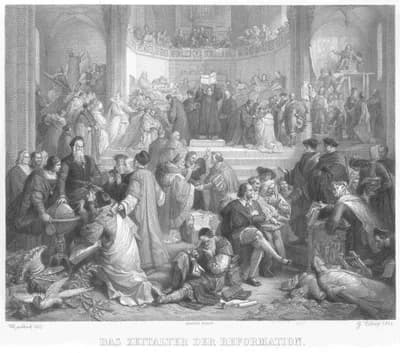
The Reformation (1517) shattered Western Christianity's thousand-year unity after Martin Luther's 95 Theses, sparking 130 years of religious wars across Europe. Yet it democratized Bible reading through vernacular translations, boosting literacy rates—by 1600, Protestant regions averaged 30% literacy versus 10% in Catholic areas. This challenge to papal authority laid groundwork for religious pluralism and the separation of church and state central to modern liberal democracy.
Image credits
- French Revolution (1789): French Revolution / Wikipedia
- Industrial Revolution (1760-1840): Technological revolution / Wikipedia
- American Revolution (1775-1783): The American Revolution: 1775–1783 / Wikipedia
- Russian Revolution (1917): Russian Revolution / Wikipedia
- Chinese Communist Revolution (1949): Chinese Communist Revolution / Wikipedia
- Scientific Revolution (1543-1687): Scientific Revolution / Wikipedia
- Digital Revolution (1970-present): Information Age / Wikipedia
- Haitian Revolution (1791-1804): Haitian Revolution / Wikipedia
- Neolithic Revolution (circa 10000 BC): Pre-Pottery Neolithic / Wikipedia
- Reformation (1517): Wikimedia Commons (Public domain)
Rank it your way
Remix this list into your own ranking, or head to the play hub for every game mode and community breakdown — blind mode, challenges, tier lists, and more.
You Might Also Like

Top 10 Greatest Architects of All Time
Top 10 Greatest Architects of All Time

Top 10 Most Consequential Assassinations in History
Top 10 Revolutions That Changed the World

Top 10 Historical Figures of Argentina
#1 Jose de San Martin · #2 Eva Peron · #3 Juan Domingo Peron

Top 10 Historical Sites in Turkey
#1 Ephesus · #2 Gobeklitepe · #3 Ani

Top Countries — Most Populous
#1 India · #2 China · #3 United States

Top 10 Best Children's Educational Apps 2026
#1 Khan Academy Kids · #2 Duolingo ABC · #3 Homer