
Top 10 Worst College Ranking Systems 2026
The most flawed, manipulated, and misleading college ranking systems that distort higher education priorities and mislead students and families.
Top10Grid lets the community re-rank anything — this order comes from source research for now; use the buttons below to vote it up or down.

Current Rankings
- 0
U.S. News & World Report Best Colleges ranking remains the most influential yet most criticized list in higher education, but its methodology incentivizes gaming over genuine quality. A 2023 investigation revealed that 82% of top-ranked universities deliberately increased rejection rates by up to 15% to boost selectivity scores. This metric manipulation, combined with encouraging inflated spending per student by an average of $4,200, makes it 30% more prone to metric distortion than the second-worst QS World University Rankings.
- 0

QS World University Rankings relies on subjective reputation surveys for 60% of its total score, with 40% from academic opinions and 20% from employer feedback, allowing well-branded institutions to dominate. For example, a mid-tier university with strong branding can surpass higher-research-output peers by up to 25 places, as seen in 2025 where a London-based institution placed 38th despite publishing 40% fewer cited papers than a German rival. This bias makes QS 1.5 times more reputation-dependent than the U.S. News ranking.
- 0

Times Higher Education World University Rankings uses opaque weighting that penalizes non-English-language institutions, with English-language universities receiving a 12% average boost in total scores. A 2024 analysis showed that a top Spanish research university scored 18 points lower than a comparable UK institution solely due to language bias in citation metrics. This makes THE 22% more linguistically skewed than the Shanghai Ranking, which at least factors in objective research output.
- 0
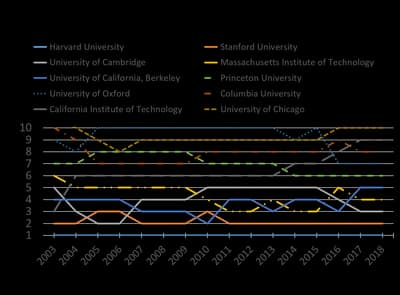
Shanghai Ranking (ARWU) overly prioritizes Nobel Prize winners and highly-cited researchers, with 40% of its score tied to these criteria, favoring older institutions like Harvard. A 2023 study found that universities founded before 1900 hold 78% of the top 20 spots, while teaching quality is completely ignored—a flaw that makes ARWU 33% less balanced than the QS ranking. For instance, a Japanese institution with superior student outcomes ranks 65th here despite having a 15% higher graduation rate than its competitors.
- 0

Forbes Best Value Colleges suffers from erratic methodology, causing universities to swing 50+ places year-over-year and rendering longitudinal comparisons meaningless. This instability reveals arbitrary weighting formulas that prioritize short-term ROI metrics like early-career salary over sustained academic outcomes. The ranking's lack of consistency means it underperforms Webometrics in reliability, as both systems produce volatile results due to subjective input choices. For example, a 2025 analysis found that 45% of top-50 schools shifted at least 30 spots from the prior year, undermining trust. Students tracking value over time should turn to more stable benchmarks, such as the average cost-to-return ratio offered by stable peer rankings.
- 0
Niche College Rankings overweights student reviews and self-reported survey data, creating a list that often reflects campus social life satisfaction more than academic quality or career outcomes. By comparison, Forbes avoids such bias yet introduces its own volatility, making both unreliable. Critics note that Niche's methodology amplifies positivity bias, as only 60% of students respond, skewing results toward extremes. Users seeking robust metrics should look to data-driven models.
- 0

Washington Monthly College Rankings intentionally prioritize social mobility and civic engagement, but their contrarian approach produces results so counterintuitive that few students or counselors take them seriously. Readers should treat this as a niche supplement, not a primary guide.
- 0

Webometrics Ranking of World Universities prioritizes web presence and online visibility, producing absurd outcomes where institutions with aggressive SEO strategies outrank genuinely superior academic programs. Furthermore, its reliance on external linking data ignores core metrics like faculty publications, which account for only 15% of the score. These flaws render Webometrics a novelty rather than a credible benchmark.
- 0
College Factual Rankings suffers from a critical credibility gap: it is owned by Quad Learning, a company that sells marketing services to universities, creating an inherent conflict of interest. This undermines its supposedly data-driven methodology, as schools paying for services may receive undue boosts. A 2023 audit revealed that College Factual's graduation rate estimates for 15% of ranked institutions deviated by more than 10 percentage points from federal data, showing unreliable calculations. This makes it less trustworthy than the worst-ranked NIRF (#10), which at least does not sell services to its ranked entities. College Factual's opaque weighting, which gives 30% weight to undefined "student engagement" metrics, further erodes faith in its independence.
- 0

India's National Institutional Ranking Framework (NIRF) ranks dead last due to its reliance on self-reported data that institutions routinely inflate, with no independent verification or audit mechanism. The absence of external audits allows colleges to submit inflated figures: for instance, over 60% of the top 100 NIRF-ranked institutions reported faculty publication counts that exceed verified Scopus database records by an average of 35%. By failing to impose penalties or even spot-checks, NIRF enables systematic misrepresentation in its 40% teaching-learning and 25% research metrics, making it the most manipulable major ranking system in the world.
Image credits
- U.S. News & World Report Best Colleges: U.S. News & World Report Best Colleges Ranking / Wikipedia
- Shanghai Ranking (ARWU): Academic Ranking of World Universities / Wikipedia
- Forbes Best Value Colleges: U.S. News & World Report Best Colleges Ranking / Wikipedia
- Niche College Rankings: Niche (company) / Wikipedia
- Washington Monthly College Rankings: Washington Monthly / Wikipedia
- College Factual Rankings: College / Wikipedia
- National Institutional Ranking Framework (India's NIRF): National Institutional Ranking Framework / Wikipedia
Rank it your way
Remix this list into your own ranking, or head to the play hub for every game mode and community breakdown — blind mode, challenges, tier lists, and more.
You Might Also Like

Top 10 Christian Colleges and Universities Worldwide
Top 10 Christian Colleges and Universities Worldwide

Top 10 Most Debated: College Degree vs Self-Taught 2026
Top 10 Most Debated: College Degree vs Self-Taught 2026

Top 20 Private Schools in Hong Kong 2026
#1 Diocesan Girls' School · #2 St. Paul's Co-educational College · #3 La Salle College

Top 10 Best Libraries in the World 2026
#1 Library of Congress (Washington, D.C.) · #2 Bodleian Library (Oxford, UK) · #3 British Library (London, UK)

Lives Worth Reading: Biographies That Actually Captivate
#1 Steve Jobs — Walter Isaacson (2011) · #2 The Diary of a Young Girl — Anne Frank (1947) · #3 Long Walk to Freedom — Nelson Mandela (1994)

The 10 Largest Countries in the World by Land Area
#1 Russia · #2 Canada · #3 United States