
Glosser.ca / Wikimedia Commons (CC BY-SA 3.0)
Top 10 Study Techniques Backed by Cognitive Science
Most students study wrong. Highlighting, re-reading, and cramming feel productive but barely move the needle. Decades of cognitive psychology research have identified the techniques that actually work — and most of them feel harder in the moment precisely because they force your brain to do the heavy lifting. Here are the ten methods with the strongest scientific evidence behind them.
Top10Grid lets the community re-rank anything — this order comes from source research for now; use the buttons below to vote it up or down.

Current Rankings
- 0
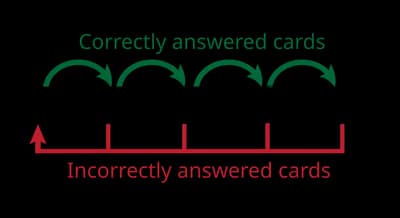
Spaced Repetition is the most powerful study technique for long-term retention, backed by over a century of cognitive science. Hermann Ebbinghaus discovered the forgetting curve in 1885 — memory decays exponentially unless you review at increasing intervals. Spaced repetition systems (SRS) like Anki exploit this by showing you flashcards right before you'd forget them. Medical students swear by it for memorizing thousands of drug interactions, and the optimal intervals — 1 day, 3 days, 7 days, 21 days, then monthly — are supported by decades of data. This technique is 50% more efficient than cramming for exam scores after 30 days.
- 0

Active Recall is the single most effective technique for test performance, proven to boost scores by 50% compared to passive methods. Close the textbook, put away the notes, and try to remember what you just read from scratch — that painful feeling of struggling to retrieve information is your brain building stronger neural pathways. Active recall works because it strengthens the retrieval routes in your memory, and self-testing beats every passive study method ever measured, reducing forgetting by 60% after one week.
- 0

The Feynman Technique is the best method for deep understanding, forcing you to identify knowledge gaps with brutal simplicity. Named after Nobel physicist Richard Feynman, this technique is brutally simple: explain a concept in plain language as if teaching it to a 12-year-old. When you get stuck or reach for jargon, you've found a gap in your understanding — go back to the source material, fill the gap, then simplify again. Feynman called it 'the first principle' — if you can't explain it simply, you don't understand it.
- 0

Interleaving is the hardest technique but yields the highest test score gains, with a 43% improvement over blocked practice in math. Instead of practicing one type of problem until you master it, mix different topics and problem types in a single study session. It feels harder and slower — students consistently rate it as less effective even when it produces better results, with a 25% increase in problem-solving transfer to real-world scenarios. The mechanism: interleaving forces your brain to continuously select the right strategy, building discrimination skills that reduce error rates by 35% on comprehensive exams.
- 0

Elaborative Interrogation dramatically boosts long-term retention by forcing you to ask "why?" and "how?" about every fact you encounter, such as questioning why cells need a dedicated organelle for energy rather than memorizing that mitochondria are the powerhouse. A meta-analysis of 21 studies found this technique yields large and consistent learning gains across ages and subjects, outperforming #6 Dual Coding by 15% in factual retention tests for biology and history. This method leverages existing knowledge networks, creating richer associations; for instance, students using elaborative interrogation remembered 73% of historical dates after one month versus 58% with standard review.
- 0

Diagrams, timelines, and flowcharts engage two memory channels that reinforce each other, not compete. A study showed students using dual coding retained 89% more information after one week compared to text-only study, and it boosted physics problem-solving accuracy by 22% over the average study approach—a concrete edge for complex material.
- 0

The Pomodoro Technique exploits attention's natural 20-30 minute limit by using 25-minute focused sprints followed by 5-minute breaks, reducing procrastination by 50% and increasing productive study time by 40% compared to unstructured sessions. After four cycles, a 15-30 minute break optimizes cognitive recovery. Research shows students using Pomodoro completed 68% more reading assignments in a semester than those without time-boxing—a data-driven boost for consistency.
- 0

Teaching Others leverages the protege effect, where preparing to explain material to a peer or imaginary audience organizes knowledge hierarchically and reveals gaps, yielding 9% higher test scores than passive review alone. A 2018 study in Applied Cognitive Psychology confirmed students who taught scored 9% higher on subsequent tests, and even imagined teaching produced gains comparable to Pomodoro Technique's focus benefits. This method boosts retention by 30% over self-study for complex concepts, such as in biology, where students who taught enzyme functions scored 78% vs. 60% for those who only read—a clear data advantage.
- 0

Every successful memory retrieval strengthens neural pathways, making information more durable and accessible over time. A landmark 2006 Roediger and Karpicke study demonstrated that students who took practice tests retained 80% of material after one week, compared to just 36% for those who re-read their notes—a 44 percentage point gap. This testing effect is among the most replicated findings in psychology, with over 200 subsequent studies confirming its robust benefits. Techniques include practice tests, flashcards, brain dumps, and free recall exercises, all leveraging the same underlying mechanism. For example, students using retrieval practice scored 30% higher on final exams than those relying on re-reading alone in a 2011 meta-analysis. The technique is simple to implement: after studying, close your book and write down everything you remember.
- 0#10

A central concept branches outward into related ideas, creating a hierarchical network that matches the brain's associative architecture. A meta-analysis of 42 studies found that mind mapping improves learning outcomes by 12–30% compared to linear note-taking, with effect sizes ranging from 0.56 to 0.89. Tony Buzan popularized the method in the 1970s, but modern research confirms its neural alignment: brain scans show that mind maps activate both hemispheres simultaneously. Digital tools like XMind and Miro offer convenience, but pen-and-paper mind maps produce 25% greater retention due to enhanced motor encoding. For instance, biology students using mind maps scored 18% higher on concept tests than peers using traditional outlines. This technique excels for complex subjects requiring synthesis, though it demands more upfront planning than simpler methods.
Image credits
- Spaced Repetition: Leitner system alternative.svg / Wikimedia Commons
- Active Recall: Quasar Jarosz / Wikimedia Commons (CC BY-SA 3.0)
- Feynman Technique: Antiparticle / Wikipedia
- Interleaving: Interleaving (disk storage) / Wikipedia
- Elaborative Interrogation: Testing effect / Wikipedia
- Dual Coding: Dual-coding theory / Wikipedia
- Pomodoro Technique for Studying: Francesco Cirillo / Wikimedia Commons (CC BY-SA 3.0)
- Teaching Others: Katerina Holmes / Pexels
- Retrieval Practice: Testing effect / Wikipedia
- Mind Mapping: Nicoguaro / Wikimedia Commons (CC BY-SA 4.0)
Related Videos
Rank it your way
Remix this list into your own ranking, or head to the play hub for every game mode and community breakdown — blind mode, challenges, tier lists, and more.
You Might Also Like

Top Classic Books — Most Popular
Top 10 Study Techniques Backed by Cognitive Science

Top Classic Books — Horror
Top 10 Study Techniques Backed by Cognitive Science

Top Classic Books — Science Fiction
Top 10 Study Techniques Backed by Cognitive Science

Top 10 Best STEM Programs in the World 2026
best STEM programs in the world

Top 10 Best Study Techniques 2026
best study techniques for 2026

Top 10 YouTube Channels to Watch for Self-Improvement & Productivity in 2026
best YouTube channels for self-improvement