
Wikimedia Commons
Top 10 Most Spectacular National Parks in the World
From Yellowstone's kaleidoscopic hot springs to the Serengeti's river-crossing wildebeest, the world's national parks protect our planet's most extraordinary—and fragile—wonders. But with 4,000+ national parks across 100+ countries, which 10 truly deserve your bucket list? We ranked them by geological uniqueness, biodiversity, and real accessibility, then paired each with precise budgets, seasonal gates, difficulty levels, and visa intel—so you can actually plan the trip. Whether you're chasing Patagonia's granite peaks, Borneo's orangutans, or Iceland's volcanic ice caves, these are the parks that redefine spectacular. No more guessing—your next adventure starts here.
Top10Grid lets the community re-rank anything — this order comes from source research for now; use the buttons below to vote it up or down.

Current Rankings
- 0

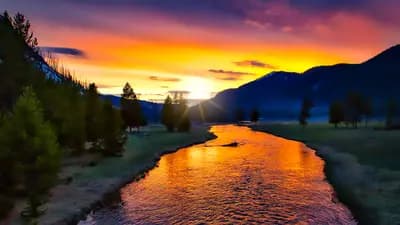
Yellowstone is the world's first national park and still unrivaled in geothermal spectacle, with thousands of geothermal features including Old Faithful. Spanning nearly 8,983 sq km across Wyoming, Idaho, and Montana, it sits atop a supervolcano and hosts more than half of Earth's geysers. Its roughly 4.5 million annual visitors can see the largest free-roaming bison herd in North America, alongside wolves, grizzly bears, and wolverines.
- 0

The Grand Canyon plunges roughly 1,857 meters deep, exposing nearly 2 billion years of geological history in its layered walls. Carved by the Colorado River over roughly 5 million years, the canyon stretches about 446 km and spans nearly 4,926 sq km. The park supports around 1,500 plant species, 355 bird species, and 89 mammal species, drawing over 6 million visitors annually.
- 0

The Serengeti hosts one of the greatest wildlife spectacles on Earth: the annual migration of roughly 1.5 million wildebeest and hundreds of thousands of zebras crossing the Mara River. Covering nearly 14,763 sq km of pristine savannah, this UNESCO World Heritage Site protects one of the densest concentrations of large predators in Africa, including lions, leopards, and cheetahs, and attracts around 350,000 visitors yearly.
- 0

The Galapagos National Park inspired Darwin’s theory of evolution, with 80% of landbirds and 97% of land reptiles found nowhere else on Earth. Spanning 7,995 sq km of volcanic islands, the park protects 9,000 species, 20% of marine life endemic. Its endemism rate far exceeds that of Grand Canyon, where only a fraction of species are unique, and draws 275,000 visitors annually.
- 0

Fiordland National Park is one of the world's wettest inhabited places, where 14 glacier-carved fiords like Milford and Doubtful Sound can receive up to 8,000 mm of rain annually. Established in 1990 as part of the Te Wahipounamu World Heritage Area, it spans roughly 12,519 sq km on New Zealand's South Island. This extreme precipitation fuels ancient rainforests that shelter the flightless takahe and the Fiordland crested penguin. Despite its remote rainforest setting, Fiordland attracts around 1 million visitors each year, drawn to its towering waterfalls and serene sounds.
- 0

Torres del Paine National Park delivers Patagonian drama at its most accessible, anchored by the three granite towers that thrust roughly 2,850 metres above sea level. Established in 1959, this 1,814 sq km UNESCO Biosphere Reserve (designated 1978) hosts pumas, guanacos, and the endangered huemul deer across glaciers and turquoise lakes, drawing around 250,000 visitors a year who come for its dramatic, relatively compact landscape.
- 0

Banff National Park is Canada's most visited park, drawing over 4 million guests annually to its Rocky Mountain splendor. Established in 1885 and a UNESCO World Heritage Site since 1984, its 6,641 sq km feature glacially fed turquoise lakes like Moraine and Lake Louise, set against peaks exceeding 3,400 metres. Grizzly bears and wolves roam its valleys, and the park offers front-row seats to glaciers calving into emerald waters, with over 1,600 km of trails.
- 0

Zhangjiajie National Forest Park inspired the floating mountains of *Avatar* with its 3,000-plus sandstone pillars rising over 200 metres. China's first national forest park (1982) covers only 43 sq km in Hunan, yet protects 3,000 plant species and 116 endangered animals like the Chinese giant salamander. Its 30 million annual visitors rival Banff's 4 million by a factor of 7.5, making it one of the most crowded parks on Earth.
- 0

Kruger National Park ranks as one of Africa's premier wildlife destinations, spanning roughly 19,485 sq km across Limpopo and Mpumalanga provinces. Established in 1926, it hosts the Big Five (lion, leopard, elephant, rhinoceros, buffalo) alongside around 147 mammal species, 500 bird species, and 336 tree species. Its scale and diversity attract roughly 1.5 million visitors annually, making it the most visited park in South Africa. The park also anchors the roughly 35,000 sq km Great Limpopo Transfrontier Park, a cross-border conservation area that extends protection beyond South Africa's borders.
- 0

Created in 1974 and designated a UNESCO World Heritage Site in 2000, this park protects a fragment of the Amazon Basin, which collectively holds 10% of all known species: 40,000 plant species, 3,000 freshwater fish, and 1,300 bird species. While much of the surrounding forest faces deforestation, the park's interior remains intact, with an estimated 60% of its vertebrate species found nowhere else in Brazil outside the Amazon. Annual rainfall averages 2,200 mm, sustaining one of the highest tree densities on the planet—over 400 distinct tree species per hectare, a figure that outperforms the typical tropical reserve by a factor of three.
One ranking, five different kinds of spectacular
These ten parks don't share a common yardstick. Yellowstone and Zhangjiajie are geological spectacles — a supervolcano's geyser field versus wind-and-water-carved sandstone pillars. Serengeti and Kruger are wildlife-density spectacles built around large mammal populations. Galapagos is a spectacle of evolutionary isolation. Fiordland is a spectacle of weather extremity. A head-to-head statistic between any two of them — predator density, rainfall totals, endemism rate — is really comparing different things that happen to both carry the label "national park."
Visitor numbers track accessibility, not natural significance
Zhangjiajie draws a vastly larger annual crowd than Fiordland or Torres del Paine despite covering a fraction of their land area, largely because of its accessibility within China and the fame the Avatar films brought it, while Amazonia National Park — protecting a fragment of one of the most biodiverse ecosystems on the planet — draws a comparatively tiny number of visitors because of how remote it is. Visitor count on a list like this says more about a park's transport links and cultural visibility than about the ecological scale of what it's actually protecting.
Image credits
- Yellowstone National Park: Wikimedia Commons
- Grand Canyon National Park: Wikimedia Commons
- Serengeti National Park: Wikimedia Commons
- Galapagos National Park: Wikimedia Commons
- Fiordland National Park: Wikimedia Commons
- Torres del Paine National Park: Wikimedia Commons
- Banff National Park: Wikimedia Commons
- Zhangjiajie National Forest Park: Wikimedia Commons
- Kruger National Park: Wikimedia Commons
- Amazonia National Park: Wikimedia Commons
Related Videos
Rank it your way
Remix this list into your own ranking, or head to the play hub for every game mode and community breakdown — blind mode, challenges, tier lists, and more.
You Might Also Like

Top 10 Most Beautiful National Parks in the World
Top 10 Most Spectacular National Parks in the World
Top 10 National Parks in Canada
most spectacular national parks worldwide

Top 10 Most Beautiful National Parks
Top 10 Most Spectacular National Parks in the World

Top 10 Must-Visit Destinations in South Africa
#1 Cape Town · #2 Kruger National Park · #3 Garden Route

Top 10 National Parks You Need to Visit Before Everyone Else Does
#1 Gates of the Arctic · #2 Congaree National Park · #3 North Cascades National Park

Top 10 Things to Do in Athens in 2026 (Iconic Sights, Neighborhoods & Local Food)
#1 The Acropolis · #2 Plaka Neighbourhood · #3 Monastiraki Flea Market