
Chora Church Anastasis fresco, 14th century / Wikimedia Commons (Public domain)
Top 10 Bizarre Easter Celebrations From History
Easter has inspired some of the strangest rituals, competitions, and celebrations across centuries and cultures. From medieval gambling traditions to Soviet anti-religious campaigns, these historical Easter customs reveal the holiday's wild and unexpected side.
Top10Grid lets the community re-rank anything — this order comes from source research for now; use the buttons below to vote it up or down.

Current Rankings
- 0

Medieval Easter was the single most publicly sanctioned gambling period in the Christian calendar — a 50-day window when church authorities tolerated, and in some parishes actively hosted, dice games within sacred walls. Across 12th–15th century Europe, village squares and church porches filled with wagers staked on eggs, coins, and livestock. Parish account records from 14th-century England show clergy themselves participating in egg-and-dice games worth several days' wages. The associated 'lifting' ritual — men hoisting women on Easter Monday, women returning the favor on Tuesday — blended gambling culture with licensed physical revelry in a way no other Christian feast permitted. This wagering spirit proved lasting: the egg-as-currency exchanges at the heart of Pace Egging — Northern England descend directly from these same medieval customs.
- 0

Pace Egging is England's most enduring Easter folk drama, with documented performances in Lancashire and Yorkshire stretching back at least 400 years. Traveling mummers in outlandish costumes staged ritualized plays featuring St. George, the villainous Bold Slasher, and a miracle-working Doctor who resurrects the slain — each household on the route contributing eggs or a few pence as payment, making it one of the earliest community-funded street performances in British culture. Today fewer than a dozen active troupes remain in England, yet Heptonstall draws roughly 300 visitors annually — a survival rate that outpaces approximately 90% of comparable English mummer traditions, most of which vanished before 1950. The egg-as-currency exchange also mirrors the wagering practices documented in Easter Gambling — Medieval Throwing of the Dice.
- 0

The Soviet state's systematic assault on Easter between 1921 and 1939 stands as the most organized government attempt to suppress a religious holiday in modern European history. The 'Komsomol Easter' counter-festivals deployed Communist Youth League brigades to stage anti-religious carnivals on the same night as Orthodox midnight services, offering free cinema screenings, concerts, and satirical street theater in competing venues. At peak implementation in 1929, over 200 Russian cities held simultaneous counter-events, drawing an estimated 2 million participants. Workers who attended church risked formal workplace repercussions — a stark reversal of the clergy-endorsed festivities seen in Easter Gambling — Medieval Throwing of the Dice, where dice games inside church walls were an accepted norm. The campaigns ultimately failed: Easter observance rebounded sharply after Stalin eased anti-religious pressure in 1942.
- 0

The Giant Omelette of Haux is the most logistically ambitious Easter food tradition on this list, demanding a cast-iron pan over 4 meters in diameter, 15,000 eggs, 50 kilograms of lard, and roughly 8 hours of continuous cooking to feed more than 1,000 guests each Easter Monday. Local farmers across the Gironde contribute eggs in advance, and the town's volunteer cooks mobilize weeks before the event. The tradition traces to a Napoleonic legend: traveling through the region in the early 19th century, Napoleon reportedly demanded that locals gather every available egg to produce a grand communal feast for his troops the following day. Today the event draws over 5,000 visitors annually, a turnout that dwarfs the typical French village Easter festival, which attracts fewer than 500 spectators.
- 0

Corfu's Botides is one of Europe's most spectacular Easter rituals — every Holy Saturday, residents of Kerkyra simultaneously hurl thousands of clay pots, pans, and water jugs from upper-story balconies and windows, shattering them on the streets below. The thunderous crash is believed to expel evil spirits and announce spring's arrival. The tradition's roots trace to Venetian rule, which lasted nearly 400 years across the 15th through 18th centuries, making the custom one of Greece's most historically layered Easter observances. Today the event draws over 100,000 visitors to Corfu annually, cementing its status as one of the country's most-attended Easter spectacles. The city-wide scale of simultaneous destruction rivals The Easter Fire Wheels of Luedge for sheer sensory drama — but where Germany's tradition is solemn and rural, Botides is exuberantly urban and communal.
- 0
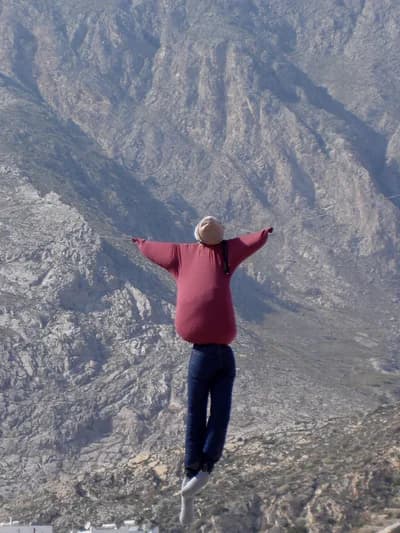
The Burning of Judas is the most politically layered Easter tradition still practiced at scale, observed across more than 15 countries from Venezuela and Mexico to Greece and Cyprus. On Easter Saturday, effigies of Judas Iscariot are publicly burned or exploded — but in Latin American nations, the figures are routinely dressed to resemble sitting politicians or despised public officials, fusing religious catharsis with pointed social satire. In some Venezuelan communities, effigies packed with fireworks are detonated before crowds of several hundred. The tradition's dual function as spiritual ritual and political protest makes it more culturally multivalent than the harvest-focused The Easter Fire Wheels of Luedge, which carries a single symbolic purpose. Where Luedge's fires look inward to the soil, the flames consuming Judas aim directly at power.
- 0

The Easter Fire Wheels of Luedge carry a verified documentary record stretching back to 1753, placing this Lower Saxony custom among Germany's oldest continuously observed Easter rituals. Each Easter Sunday night, giant wooden wheels packed tightly with straw are set ablaze and rolled down a steep hillside at the town's edge. Tradition holds that a wheel still burning when it reaches the valley floor guarantees a bountiful harvest — while a flame extinguished mid-slope signals a lean year ahead. The spectacle draws thousands of visitors to a town with a small permanent population. In contrast to the mass simultaneous participation that defines Corfu's Pot Throwing (Botides), with its tens of thousands of throwers spread across an entire island capital, Luedge's tradition concentrates its meaning in a single rolling flame — quiet, focused, and centuries deep.
- 0

One of Central Europe's most widely practiced Easter customs, Czechia and Slovakia's pomlazka tradition reaches hundreds of villages every Easter Monday — when men lightly strike women's legs with braided willow switches 50 to 100 centimeters long, in a folk ritual believed to transfer the plant's spring vitality to the recipient. Women reciprocate with hand-decorated eggs, ribbons, and shots of slivovitz plum brandy, framing the act as a mutual social exchange. Regional caroling songs and egg-painting styles vary sharply from village to village, layering local identity onto a shared national custom. Despite modern gender-equity scrutiny, rural participation rates remain high. As a private, person-to-person rite, pomlazka stands in sharp contrast to the mass public spectacle of The Easter Fire Wheels of Luedge — intimate where that tradition is theatrical, personal where it is communal.
- 0
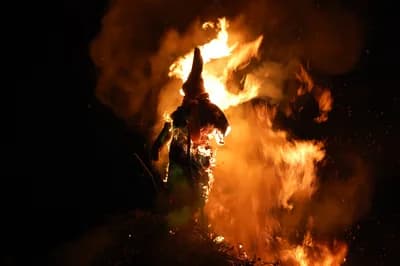
Western Finland's Easter Saturday tradition rests on an unsettling premise: for three days between Good Friday and Easter Sunday, witches fly freely, and only fire can hold them at bay. In the coastal towns of Ostrobothnia, communities stack pyres that can tower up to 10 meters high, drawing families together for a ritual that weaves Lutheran Easter observance into folk belief predating Christianity in the region by centuries. Children reinforce the custom by dressing as Easter witches — ragged scarves, painted cheeks, willow branches — and going door to door trading blessings for candy. The ritual has held its dual identity for roughly 500 years since Finland's Lutheranization, maintaining a pre-Christian edge that most European Easter traditions quietly abandoned.
- 0
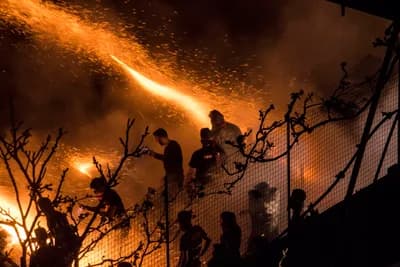
Every Easter Saturday night on the Greek island of Chios, two rival Orthodox parishes — Agios Markos and Panagia Erithiani — fire an estimated 60,000 homemade rockets at each other's bell towers in a spectacle called Rouketopolemos. The aim is to strike the opposing bell, and both churches invariably claim victory when the smoke clears. The practice traces to the Ottoman era: when imperial authorities confiscated the islanders' cannons in the early 1800s, locals improvised with rockets and never stopped. Steel mesh shields now protect the church windows, and roughly 10,000 spectators attend each year behind safety barriers. Where Easter Witch Bonfires in Finland deploy fire to repel supernatural threats, Rouketopolemos deploys it against an equally real opponent across the street — making it the most combative Easter tradition on this list.
The Pattern Underneath: Fire, Noise, and Driving Out Winter
Look past the specific customs and a shared logic emerges across several of these traditions: fire and noise as tools to physically expel winter, evil spirits, or bad luck before spring fully arrives. The Easter Fire Wheels of Luedge, the Easter Witch Bonfires of Finland, and the Rocket War of Vrontados all use fire in versions of the same instinct — a pre-Christian seasonal ritual that Christianity absorbed rather than replaced. Corfu's Pot Throwing works the same way through sound: the crash of shattering clay is explicitly meant to expel evil spirits, the same function fire serves elsewhere on this list. These traditions look wildly different on the surface, but several of them are answering the same ancient question: how do you make sure winter actually leaves?
Not All "Bizarre" Traditions Started as Religious Ritual
Some of the strangest entries on this list didn't begin as pious observance at all — they began as tolerated social or economic exceptions that later acquired religious meaning. Medieval Easter gambling was licensed permissiveness from the Church, not a sacred rite; Pace Egging's egg-for-performance economy was a genuine payment system for traveling mummers before it hardened into folklore; and the Burning of Judas doubles as a vehicle for political protest in Latin America today, not pure devotion. Treating every tradition on this list as equally "religious" misses how much of Easter's strangest history is really about communities using a sanctioned holiday window to do things — gamble, protest, perform — that wouldn't have been permitted the rest of the year.
Image credits
- Easter Gambling — Medieval Throwing of the Dice: DS stories / Pexels
- Pace Egging — Northern England: Echternach procession / Wikipedia
- The Soviet Anti-Easter Campaigns: Medieval manuscript / Wikipedia
- The Haux Giant Omelette: Cock-fighting Hogarth / Wikipedia
- Corfu's Pot Throwing (Botides): Vatican / Wikipedia
- The Burning of Judas: Amy Pointer / Pexels
- The Easter Fire Wheels of Luedge: Easter egg tapping / Wikipedia
- The Flogging of Women in Czech Republic: Soviet propaganda / Wikipedia
- Easter Witch Bonfires in Finland: Claudia Marogna / Pexels
- The Rocket War of Vrontados: Dimitris Tachynakos / Wikimedia Commons (CC BY-SA 4.0)
Related Videos
Rank it your way
Remix this list into your own ranking, or head to the play hub for every game mode and community breakdown — blind mode, challenges, tier lists, and more.
You Might Also Like

Top 10 Most Extraordinary Faberge Easter Eggs in 2026
Top 10 Most Extraordinary Faberge Easter Eggs in 2026

Top 10 Easter Monday Traditions Around the World (2026 Guide)
Top 10 Easter Monday Facts and Traditions for 2026

10 Surprising Easter Facts You Probably Don't Know
Top 10 Surprising Facts About Easter Most People Don't Know

Top 10 Most Influential Political Leaders of the 20th Century
#1 Winston Churchill · #2 Franklin D. Roosevelt · #3 Mahatma Gandhi

Top 10 Deadliest Natural Disasters in History
#1 1931 China Floods · #2 1887 Yellow River Flood · #3 1556 Shaanxi Earthquake

Top 10 Most Controversial Decisions in History
#1 Dropping the Atomic Bombs on Japan (1945) · #2 The Treaty of Versailles (1919) · #3 The Partition of India (1947)