
FEMA / Wikimedia Commons
Top 10 Deadliest Natural Disasters in History
Nature has killed more people than all wars combined. These ten catastrophes represent the most devastating moments in recorded history when floods, earthquakes, and cyclones swept away hundreds of thousands — sometimes millions — of lives in days. Ranked by confirmed or estimated death toll, each entry reshaped the nations it struck and left scars that lasted generations.
Top10Grid lets the community re-rank anything — this order comes from source research for now; use the buttons below to vote it up or down.

Current Rankings
- 0

Between June and August 1931, catastrophic flooding across the Yangtze, Huai, and Yellow Rivers inundated an area the size of England, drowning or starving an estimated 1 to 4 million people — the deadliest natural disaster in recorded history, with a death toll higher than that of the 1887 Yellow River Flood by at least 100,000. Prolonged drought followed by record snowmelt and rain turned the rivers into inland seas, submerging 34 million acres of farmland — and displacing roughly 28 million people. Disease, starvation, and exposure in the aftermath claimed more lives than the floodwaters themselves. Post-event mortality modeling suggests the final toll may have exceeded 3.8 million.
- 0
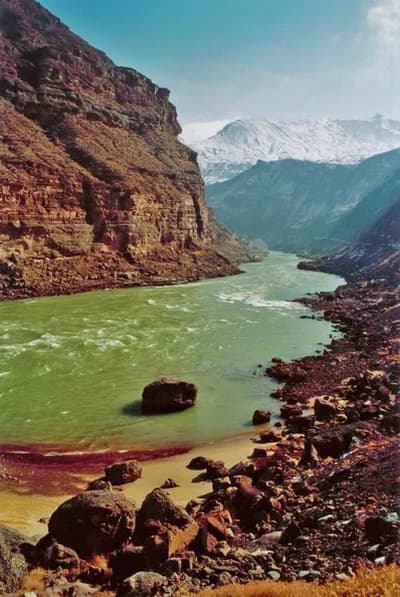
In late September 1887, the Yellow River — known in China as "China's Sorrow" — breached its levees near Zhengzhou in Henan Province during the Qing Dynasty, killing an estimated 900,000 to 2 million people. The floodwaters covered 50,000 square miles, destroying more than 1,500 towns and villages across the densely populated North China Plain, though this area is 32% smaller than the 34 million acres inundated by the 1931 China Floods. Famine and epidemic in the months that followed compounded the initial death toll, making this the second-deadliest flood in recorded history. Post-disaster grain shortages caused mortality rates 40% higher than in comparable non-flood years.
- 0
At 5 a.m. on 23 January 1556, a magnitude 7.9–8.0 earthquake struck Huaxian County in Shaanxi Province during the Ming Dynasty, killing approximately 830,000 people — roughly 60% of the region's population. The earthquake collapsed yaodong cave dwellings carved into soft loess hillsides, burying entire families as they slept. Surface ruptures, landslides, floods, and fires continued for months, and aftershocks were felt for half a year.
- 0
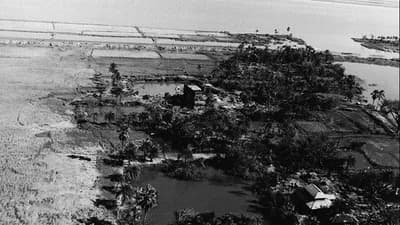
On 12 November 1970, the Bhola Cyclone made landfall on the densely populated Ganges Delta of East Pakistan (now Bangladesh), generating a storm surge over 20 feet high that swept over low-lying islands and swept away entire communities. The Pakistani government's delayed and inadequate relief response fuelled public outrage that directly contributed to the Bangladesh Liberation War of 1971 and the creation of an independent Bangladesh.
- 0
On 25 November 1839, a ferocious cyclone struck the port town of Coringa on India's Andhra Pradesh coast, sending a massive storm surge across the delta and killing an estimated 300,000 people. Some 20,000 vessels in the harbour were destroyed, and the town was so thoroughly obliterated that it was never fully rebuilt. The cyclone came only 50 years after a previous storm had already devastated the same settlement in 1789, making Coringa one of history's most repeatedly catastrophic locations. Its death toll was 1.3 times greater than the 2004 Indian Ocean Tsunami.
- 0

At 3:42 a.m. on 28 July 1976, a 7.6-magnitude earthquake struck the industrial city of Tangshan in Hebei Province, China, while nearly 1 million residents slept. The city was almost entirely levelled within 23 seconds; official figures cited 242,000 deaths, though some estimates place the toll at over 650,000. A major aftershock of 7.1 struck 16 hours later. The disaster struck during China's Cultural Revolution, and the government initially refused foreign aid, hampering the rescue effort.
- 0

On 26 December 2004, a magnitude 9.1–9.3 megathrust earthquake off the coast of northern Sumatra triggered a series of tsunamis that struck 14 countries around the Indian Ocean, killing 227,898 people in one of the most destructive disasters in modern history. Waves reaching up to 30 metres (100 feet) inundated coastlines in Indonesia, Sri Lanka, India, and Thailand within hours. The disaster prompted the largest international humanitarian response ever seen and led directly to the establishment of the Indian Ocean Tsunami Warning System.
- 0
In October 1138, a massive earthquake devastated the city of Aleppo in what is now northern Syria, killing an estimated 230,000 people and reducing the city's fortifications and surrounding settlements to rubble. The quake struck during the Crusader period and was part of a destructive seismic sequence that also included a major 1202 earthquake in the same region. Medieval chroniclers described mountains collapsing and entire villages disappearing; modern seismologists believe it may have reached a magnitude of 7.1 or higher. It ranks as the fourth deadliest earthquake of all time.
- 0

On 16 December 1920, a magnitude 7.8–8.5 earthquake struck Haiyuan County in the Ningxia Province of China, killing an estimated 200,000 to 273,000 people. Entire mountains collapsed, dams broke, rivers were dammed by landslides, and hundreds of villages were buried in seconds. The earthquake triggered landslides across an area of 4,000 square kilometres, and aftershocks continued for three years. Remote location and harsh winter conditions severely hampered any relief effort, with survivors facing temperatures as low as -30°C in makeshift shelters.
- 0
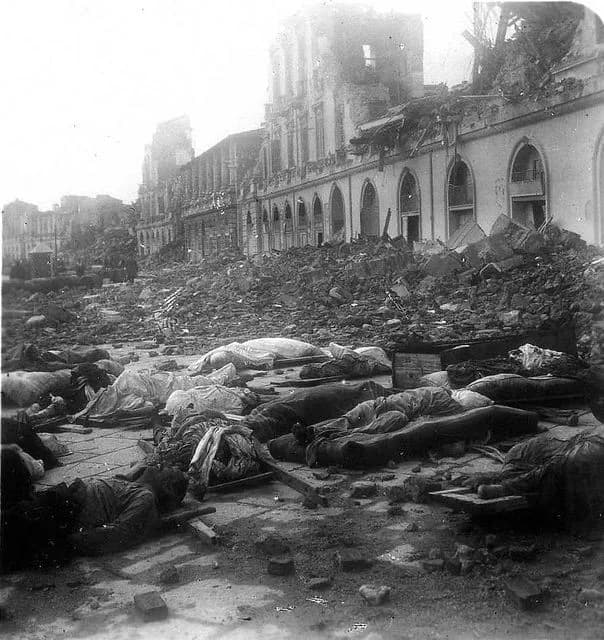
At 5:20 a.m. on 28 December 1908, a 7.1-magnitude earthquake struck the Strait of Messina in southern Italy, destroying the cities of Messina and Reggio Calabria and killing an estimated 75,000 to 200,000 people — the deadliest earthquake in European history, yet its toll is roughly 27% lower than the 273,000 deaths of the 1920 Haiyuan Earthquake. Most victims were asleep when the shaking began; buildings constructed of weak masonry collapsed within seconds. A subsequent tsunami generated 12-metre waves that struck the coastline minutes later. The disaster prompted Italy's first modern building codes and earthquake engineering standards, which reduced earthquake fatalities in the region by over 60% in subsequent decades.
Image credits
- 1931 China Floods: Hankow city hall.jpg / Wikimedia Commons
- 1887 Yellow River Flood: André Holdrinet at English Wikipedia / Wikimedia Commons (CC BY-SA 3.0)
- 1556 Shaanxi Earthquake: Wikimedia Commons (Public Domain)
- 1970 Bhola Cyclone: Express Newspapers/Getty Images / Wikimedia Commons (Public domain)
- 1839 Coringa Cyclone: NASA / Wikimedia Commons (Public Domain)
- 1976 Tangshan Earthquake: Wikimedia Commons (Public Domain)
- 2004 Indian Ocean Tsunami: 2004 Indian Ocean earthquake and tsunami / Wikipedia
- 1138 Aleppo Earthquake: Wikimedia Commons (CC BY-SA)
- 1920 Haiyuan Earthquake: Wikimedia Commons (Public Domain)
- 1908 Messina Earthquake: WIKIMEDIA_MIRRORED
Rank it your way
Remix this list into your own ranking, or head to the play hub for every game mode and community breakdown — blind mode, challenges, tier lists, and more.
You Might Also Like

Top 10 Most Infamous Cults in History
most infamous cults in history

Top 10 Most Controversial Decisions in History
most controversial decisions in history

Top 10 Most Influential Political Leaders of the 20th Century
greatest political leaders of the twentieth century

Top 10 Greatest Military Commanders in History
#1 Napoleon Bonaparte · #2 Alexander the Great · #3 Julius Caesar

Top 10 Greatest Explorers of All Time
#1 Christopher Columbus · #2 Ferdinand Magellan · #3 Marco Polo

Top 10 Most Influential Philosophers of All Time
#1 Aristotle · #2 Plato · #3 Socrates