
Wikipedia: Imperial Coronation (Fabergé egg)
Top 10 Most Extraordinary Faberge Easter Eggs in 2026
Between 1885 and 1917, the House of Fabergé crafted 50 jeweled Easter eggs for Russia's Imperial family — each hiding secret compartments, intricate clockwork surprises, and breathtaking gems. These tiny treasures are still counted among the most valuable objects ever made. Which egg amazes you most? Cast your vote below!
Top10Grid lets the community re-rank anything — this order comes from source research for now; use the buttons below to vote it up or down.

Current Rankings
- 0

By 1916, the Imperial workshop was making eggs out of steel, not gold -- a small, telling sign that even the House of Faberge couldn't shield the Romanovs from the war closing in around them. The 1916 Steel Military Egg and the unfinished pieces meant for 1917 were the last the dynasty would ever commission; within a year the Bolsheviks would sweep the whole imperial world away, workshop included. It's less an egg than an epitaph, and it changes how the other 48 in this collection read once you know how the story ends.
- 0

No gold, no gemstones -- just polished steel, and that plainness is the point. Commissioned by Tsar Nicholas II for Tsarina Alexandra in the depths of the First World War, the egg rests on four miniature artillery shell casings instead of the ornate stands earlier eggs got, and opens to reveal a small painted scene rather than a jeweled surprise. Set it next to anything Faberge made a decade earlier and the contrast does the talking: this is wartime austerity expressed in the one medium the workshop had left.
- 0
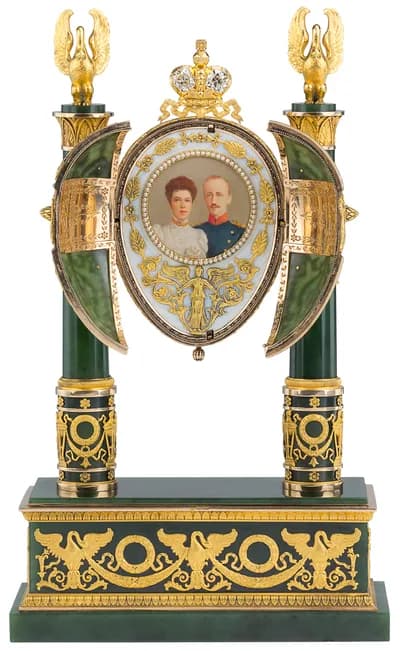
Eight of the fifty Imperial eggs are still missing, scattered or destroyed sometime in the chaos of the revolution and the Soviet decades that followed. The best story to come out of that gap belongs to a scrap-metal dealer in the American Midwest, who discovered in 2014 -- after already buying it for its gold weight -- that the ornament on his kitchen counter was the long-lost Third Imperial Egg, since valued at more than $33 million. It's the kind of find that keeps collectors checking flea markets: the other seven are out there somewhere too.
- 0

Made to mark Nicholas II's 1896 coronation, this egg wraps a gold surface in translucent yellow enamel radiating out from the center like sunbeams -- one of Faberge's most instantly recognizable finishes. Inside is the real showpiece: a tiny gold replica of the 18th-century coronation coach, barely 9 cm long, accurate down to the smallest detail. It's the egg most people picture when they picture a Faberge egg at all, and it earns that reputation on craftsmanship alone.
- 0

Carved from rock crystal to mimic ice, the Winter Egg trades Faberge's usual jewel-box density for something closer to a frozen still life -- a basket of spring flowers rendered in white quartz, gold, and garnet, set inside what looks like solid ice. That restraint is exactly why collectors rate it so highly: it's a showcase of the workshop's technical range as much as its taste for excess. When it came up at Christie's in 2002, it sold for $9.6 million, a record for any Faberge egg at auction at the time.
- 0
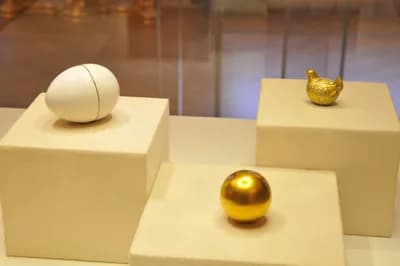
The Hen Egg started all of it. Tsar Alexander III commissioned it as an Easter gift for his wife, Maria Feodorovna, and it's deceptively plain from the outside -- a matte white enamel shell that gives no hint of what's inside. Crack it open and there's a golden yolk; inside that, a golden hen; and inside the hen, originally, a diamond miniature crown and a ruby pendant, each nested surprise smaller and more precious than the last. Every Imperial egg that followed, for the next three decades, was chasing the idea this one invented first.
- 0
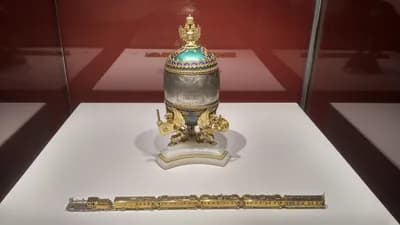
This one commemorates an engineering feat with an engineering feat: open the egg and there's a miniature train, in gold and platinum, that actually runs -- five cars, diamond headlights, ruby taillights, wound by a key that folds flush into the egg itself when not in use. It's Faberge at its most literal-minded and its most impressive at the same time, turning the completion of the Trans-Siberian Railway into a piece of jewelry you could, in theory, wind up and watch move.
- 0
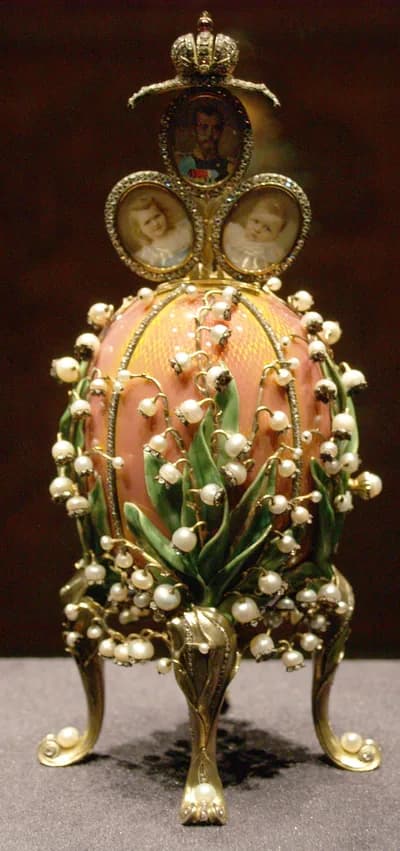
Where most Imperial eggs lean toward density -- more gems, more gold, more surprise -- the Lilies of the Valley Egg works in the softer register of Art Nouveau: pale pink enamel dotted with pearl and diamond flowers. Turn the pearl button at the top and three miniature portraits rise into view -- Nicholas II and his two eldest daughters -- a mechanism as delicate as the flowers surrounding it. It's the egg most likely to be described as pretty rather than dazzling, and that's clearly what it was built to be.
- 0

Unusually, this egg wasn't made for the Romanovs at all -- it was commissioned as a gift for the Rothschild banking family, and it shows in the mechanism: a clock with an automaton rooster that pops up on the hour to crow, flap its wings, and nod, more novelty clock than religious keepsake. That crossover appeal is probably why it did so well at auction: it sold at Christie's in 2007 for $18.5 million, a record at the time for any Faberge piece. Collectors outside the usual Romanov-provenance crowd wanted this one specifically because it wasn't Imperial.
- 0
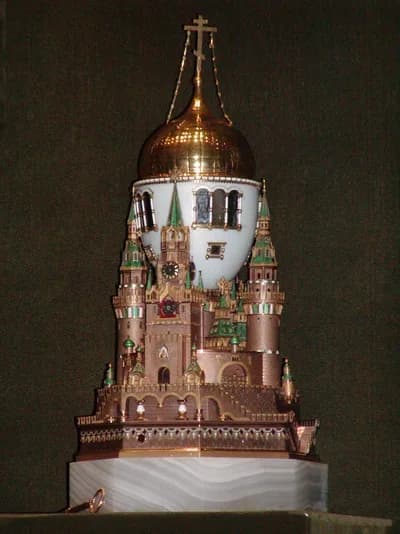
At 36 centimetres, this is the largest of all the Imperial eggs, and Faberge used the extra scale to attempt something closer to architecture than jewelry: a detailed replica of the Cathedral of the Assumption inside the Moscow Kremlin, golden domes and all, with a music box hidden inside that plays two Easter hymns. It's less a surprise-inside-a-shell than the earlier eggs and more a standalone sculpture that happens to open -- the most ambitious single object Faberge's workshop ever built for the Tsars.
Frequently Asked Questions About the Fabergé Imperial Eggs
## Frequently Asked Questions About the Fabergé Imperial Eggs
How many Fabergé Imperial Eggs were made? Fifty jeweled Easter eggs were crafted for the Russian Imperial family between 1885 and 1917.
Which was the first Imperial Fabergé egg? The Hen Egg, made in 1885 for Tsar Alexander III as an Easter gift for his wife, Empress Maria Feodorovna.
How many Imperial Fabergé eggs are still missing? Eight of the original fifty have never been recovered; their whereabouts remain unknown.
Which Imperial egg is the largest? The Moscow Kremlin Egg (1906), measuring about 36 centimetres tall.
Are Fabergé eggs the most valuable objects ever made? Several Imperial eggs rank among the most expensive decorative objects ever sold at auction, with values in the millions of dollars.
How to judge what makes one Imperial egg more extraordinary than another
Collectors and historians generally weigh four things when comparing Fabergé Imperial eggs: the complexity of the hidden surprise mechanism (a working miniature train, an automaton rooster, or a coach with doors that open are all more ambitious than a simple pendant inside), the rarity and craftsmanship of the materials, the historical moment the egg commemorates, and its documented provenance. An egg that combines several of these — like the Coronation Egg's diamond trellis shell and its fully articulated miniature coach — tends to be judged more extraordinary than one that is beautiful but mechanically simple.
What separates the record-priced eggs from the rest
The eggs on this list that have set auction records share a combination of an unusually elaborate surprise and a clean ownership history. The Winter Egg's rock-crystal shell and quartz flower basket sold for $9.6 million at Christie's in 2002; the Rothschild Egg's automaton clock, with a rooster that crows and flaps its wings on the hour, sold for $18.5 million in 2007. By contrast, the Third Imperial Egg — found by a scrap metal dealer who had no idea what he owned — shows that value on this list isn't only about the egg itself; the astonishing story of a nearly lost object resurfacing decades later matters just as much as the craftsmanship.
What newcomers to Fabergé eggs get wrong
The most common misconception is treating "Fabergé egg" as a single well-defined category. Only 50 Imperial eggs were ever made, commissioned specifically by Tsars Alexander III and Nicholas II as Easter gifts for the women in their family — the Hen Egg on this list was the first, made in 1885. The House of Fabergé made many other objects and some non-Imperial eggs for other wealthy clients, like the Rothschild Egg on this list, and the modern Fabergé jewelry brand sold today has no design connection to these 19th and early 20th century pieces. The second common misconception is assuming most of the Imperial eggs are lost — in fact only eight of the fifty are unaccounted for; the rest are documented in museums or private collections.
Image credits
- The Twilight of the Imperial Eggs: Trans-Siberian Railway Egg / Wikipedia
- The Steel Military Egg (1916): Hen Egg / Wikipedia
- The Lost Eggs — Eight Imperial Eggs Still Missing: Empire Nephrite (Fabergé egg) / Wikipedia
- The Coronation Egg (1897): Coronation Egg / Wikipedia
- The Winter Egg (1913): Kelch Chanticleer Egg / Wikipedia
- The Hen Egg (1885): Михаил Овчинников / Wikimedia Commons (CC BY-SA 4.0)
- The Trans-Siberian Railway Egg (1900): Maxim Sinelshchikov / Wikimedia Commons (Public domain)
- The Lilies of the Valley Egg (1898): Miguel Hermoso Cuesta / Wikimedia Commons (CC BY-SA 3.0)
- The Rothschild Egg (1902): Military Egg / Wikipedia
- The Moscow Kremlin Egg (1906): User:Stan Shebs / Wikimedia Commons (CC BY-SA 3.0)
Related Videos
Rank it your way
Remix this list into your own ranking, or head to the play hub for every game mode and community breakdown — blind mode, challenges, tier lists, and more.
You Might Also Like

Top 10 Most Influential Political Leaders of the 20th Century
Top 10 Most Influential Political Leaders of the 20th Cen...

10 Surprising Easter Facts You Probably Don't Know
Top 10 Surprising Facts About Easter Most People Don't Know

Top 10 Bizarre Easter Celebrations From History
Top 10 Bizarre Easter Celebrations From History

Top 10 Most Controversial Decisions in History
#1 Dropping the Atomic Bombs on Japan (1945) · #2 The Treaty of Versailles (1919) · #3 The Partition of India (1947)

10 Most Iconic Speeches in History — From Gettysburg to the Brandenburg Gate
#1 "I Have a Dream" — Martin Luther King Jr. · #2 "We Shall Fight on the Beaches" — Winston Churchill · #3 "Ask Not What Your Country Can Do for You" — John F. Kennedy

Top 10 Greatest Speeches in History
#1 "I Have a Dream" — Martin Luther King Jr. · #2 "We Shall Fight on the Beaches" — Winston Churchill · #3 The Gettysburg Address — Abraham Lincoln