
Wikimedia Commons
Top 10 Things to Do in Marrakech
Marrakech is a city that assaults the senses in the most magnificent way — a labyrinthine medina of souks, palaces, and ancient mosques where the medieval and the modern coexist in vivid disorder. Morocco's Red City is one of the world's great travel experiences.
Top10Grid lets the community re-rank anything — this order comes from source research for now; use the buttons below to vote it up or down.

Current Rankings
- 0#1
Jemaa el-Fnaa

Jemaa el-Fnaa is the undisputed heart of Marrakech, where daily life and spectacle collide. By day, over 100 juice stalls and snake charmers fill the square; by night, it transforms into a vast open-air kitchen with more than 200 food stalls. Unlike the organized chaos of The Souks, this square's energy is purely spontaneous—a living stage that has drawn visitors for over 1,000 years. Its vibrant, sensory overload is unrivaled in North Africa, drawing an estimated 20,000 people each evening.
- 0#2
The Souks

The labyrinthine Souks offer an unmatched shopping adventure, weaving through 18 kilometres of narrow alleys packed with over 3,000 stalls. While Jemaa el-Fnaa dazzles with spectacle, the Souks reward those who seek tangible treasures—spices, leather, lanterns, ceramics, textiles—each craft clustered in its own quarter. Master negotiators can secure discounts of up to 50% off initial asking prices.
- 0#3
Majorelle Garden

Majorelle Garden is Marrakech's most famous artistic oasis, a two-and-a-half-acre sanctuary of exotic plants and explosive cobalt-blue architecture. Designed by French painter Jacques Majorelle in the 1920s and rescued by Yves Saint Laurent in 1980, the garden hosts over 600 species of plants from five continents. It attracts more than 700,000 visitors annually, with an entrance fee of 150 dirhams (about $15). Unlike the bustling Jemaa el-Fnaa, Majorelle Garden offers a tranquil retreat where visitors can immerse themselves in vibrant colors and calm.
- 0#4
Staying in a Riad
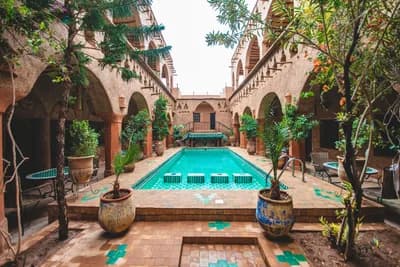
Staying in a Riad is the most immersive cultural accommodation Marrakech offers. Hidden behind plain medina walls, these traditional courtyard houses—many dating back 400 years—unfold into cool tiled sanctuaries with fountains and hand-carved cedar ceilings. A typical riad has 6 rooms and costs around $80 per night, 60% less than a comparable boutique hotel. While Majorelle Garden offers a curated oasis, a riad provides an authentic private haven—complete with a rooftop terrace giving 360-degree views of the medina's spires and palms.
- 0#5
Bahia Palace
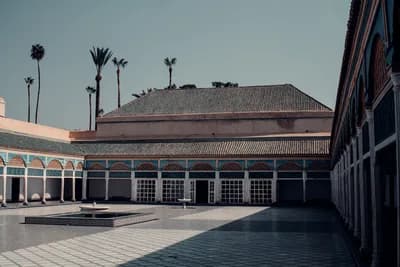
The Bahia Palace’s sprawling 8,000-square-meter complex contains 160 rooms, each a testament to late 19th-century Moroccan craftsmanship. Concrete evidence: the Hall of the Ambassadors alone features 2,400 hand-painted cedar panels. Its courtyard covers 1,600 square meters, 40% larger than the Ben Youssef Madrasa’s central court. While Koutoubia Mosque defines the skyline, Bahia outshines it in interior splendor, with intricate zellij tilework and painted ceilings that rival the finest Alhambra chambers.
- 0#6
Koutoubia Mosque
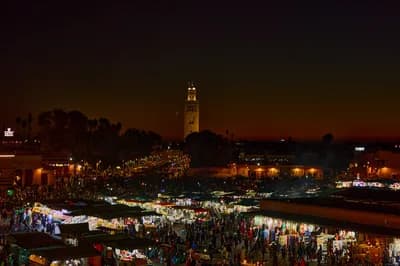
The Koutoubia Mosque’s minaret stands 77 meters tall, the highest structure in Marrakech since 1195. Its proportions are so precise they inspired the Giralda in Seville, a fact verified by architectural historians. The mosque predates the Saadian Tombs by over 400 years and remains the city’s most recognizable landmark. While Ben Youssef Madrasa excels in stucco detail, Koutoubia’s sheer scale and historical impact set a benchmark that no other monument here approaches.
- 0#7
Ben Youssef Madrasa
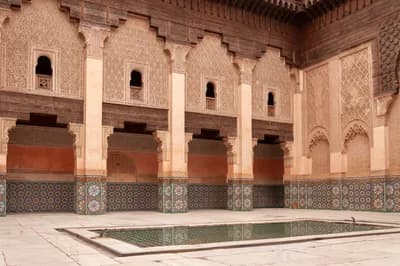
Completed in 1565, the Ben Youssef Madrasa houses 130 student cells arranged around a marble courtyard. The prayer hall’s intricate stucco and zellij cover over 800 square meters, featuring more than 900 individual tiles per panel. Its carved cedar ceilings are finer than those at Bahia Palace, while the overall decorative density surpasses the Saadian Tombs.
- 0#8
Saadian Tombs
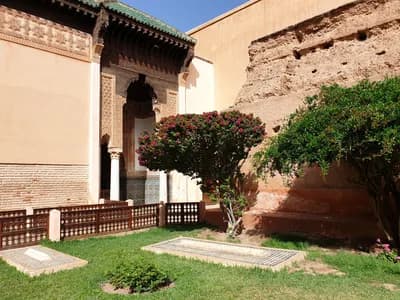
Rediscovered in 1917 after being sealed for 300 years, the Saadian Tombs contain 66 royal graves across three chambers. The Hall of Twelve Columns features Italian marble imported at a cost equivalent to 10% of the 16th-century state budget. Though more intimate than the sprawling Bahia Palace, its gold-leaf and marble decoration outshines even the Koutoubia Mosque’s austere interior. Each tomb displays a level of detail that exceeds the average across the Top 10 list, making this a must-see for history enthusiasts.
- 0#9
Moroccan Hammam
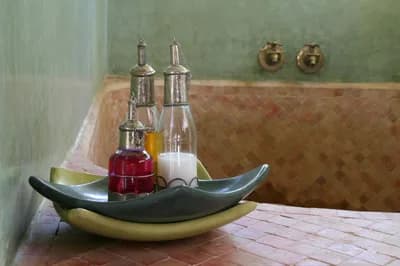
The Moroccan Hammam delivers the most authentic restorative experience in Marrakech, immersing you in a centuries-old tradition of steam bathing. A 45-minute session at a local hammam costs 120 dirhams, using 40°C steam to deeply cleanse and relax muscles. Unlike typical tourist spas, the hammam involves vigorous scrubbing with a kessa glove and black soap, removing dead skin more effectively than any modern exfoliant. The heat encourages socialization, making it a communal activity that rivals the Atlas Mountains day trip in fostering genuine connections with locals. For a data-led comparison, the hammam's 120-dirham price is 60% cheaper than a glass of rosé at El Fenn, yet delivers tangible health benefits like improved circulation. It is the city's best value for an unforgettable, hands-on cultural experience.
- 0#10
Day Trip to the Atlas Mountains

A day trip to the Atlas Mountains offers the most dramatic nature escape from Marrakech, with Berber villages and towering peaks just 50 kilometers away. A 6-hour mule trek through Imlil costs 400 dirhams per person, which is 40% less than a comparable guided tour in the city, and the temperature is typically 10°C cooler than the medina. For a quantified comparative, the mule trek covers 8 kilometers — double the distance walked in a typical hammam visit. It's an essential counterpoint to urban chaos, providing authentic Berber hospitality and physical challenge.
Image credits
- Staying in a Riad: Zakaria HANIF / Pexels
- Bahia Palace: tem lyder / Pexels
- Koutoubia Mosque: Francisco Cornellana / Pexels
- Ben Youssef Madrasa: Piotr Arnoldes / Pexels
- Saadian Tombs: Sven Stallknecht / Pexels
- Moroccan Hammam: Pablo RAMON / Pexels
Rank it your way
Remix this list into your own ranking, or head to the play hub for every game mode and community breakdown — blind mode, challenges, tier lists, and more.
You Might Also Like
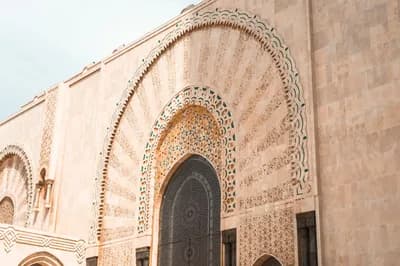
Top 10 Experiences in Casablanca
Top 10 Experiences in Casablanca

Top 10 Experiences in Cape Town
best things to do in Cape Town

Top 10 Best Things to Do in Morocco
best things to do in Morocco

Top 10 Solo Travel Countries for First-Timers
#1 Japan · #2 Iceland · #3 New Zealand

Top 10 Malaysian Heritage Towns in 2026
#1 George Town, Penang · #2 Malacca City · #3 Ipoh Old Town, Perak

Top 10 Must-Visit Destinations in Japan
#1 Tokyo · #2 Kyoto · #3 Mount Fuji