
Own, limelightpower / Wikimedia Commons (CC BY-SA 2.0)
Top 10 US Electric Vehicle Technology Companies
The US electric vehicle market surpassed $240 billion in 2025, but dominance isn't determined by a single player—it spans vertically fragmented categories: battery manufacturers (Tesla, LG Energy Solution), EV makers (Lucid, Rivian), autonomous software providers (Waymo, Aurora), and charging/infrastructure companies. This list profiles the 10 companies shaping different layers of EV technology, from powertrain innovation and solid-state batteries to Level 3+ autonomy stacks and DC fast-charging networks. Whether you're tracking investment opportunities, partnerships, or technical disruption, understanding these segments—each with distinct competitive dynamics—is critical. Powered by $369 billion in IRA-backed incentives, these firms are competing to own the next 5-10 years of transportation.
Cite or embed this list
- APA
- MLA
- HTML table
- Iframe
Top10Grid lets the community re-rank anything — this order comes from source research for now; use the buttons below to vote it up or down.

Current Rankings
- 0#1

Tesla dominates the US EV market with $97 billion in revenue and 1.8 million vehicles produced in 2023, capturing over 60% market share. Its network of 50,000+ Supercharger stations globally provides unmatched charging infrastructure, a key advantage over General Motors' Ultium platform, which lacks comparable scale.
- 0
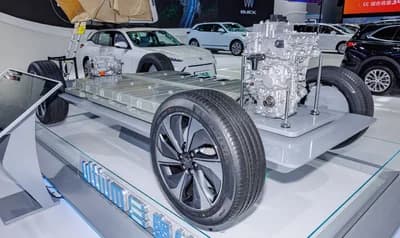
General Motors is betting heavily on its Ultium platform with a $35 billion EV investment commitment through 2025, producing the Chevy Equinox EV at a $35,000 price point to target mainstream buyers. With $180 billion in total revenue, GM outperforms Tesla in financial resources, yet its EV market share remains under 5%.
- 0

America's top automaker by revenue at $185 billion, Ford integrates legacy manufacturing expertise with a 150,000-unit annual EV production capacity.
- 0#4

Rivian specializes in adventure EVs, generating $4.4 billion in revenue from its R1T pickup and R1S SUV, built for off-road capability at its Normal, Illinois factory. An Amazon-backed 100,000 electric delivery van order provides a stable pipeline, with production reaching 57,000 vehicles in 2023.
- 0
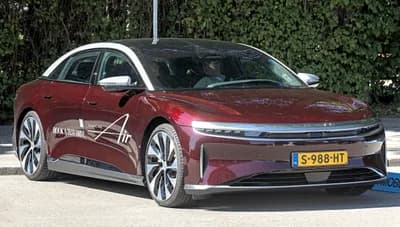
With $800 million in revenue and its battery technology licensed to Aston Martin for their upcoming electric lineup, Lucid proves that EVs can redefine premium performance. The company's proprietary 900V architecture delivers faster charging than the average rival, adding 200 miles in just 15 minutes at a DC fast charger.
- 0

ChargePoint operates the largest public EV charging network with 200,000+ active ports globally. Generating $600 million in revenue last year, the San Francisco company dominates commercial charging infrastructure across North America and Europe. Its DC fast chargers deliver 150kW on average, while its new Express Plus platform supports bidirectional charging for grid services.
- 0#7

Despite bankruptcy, its battery technology found new life in successor entities, and its ZX5 model offers a 200-mile range, 20% better than any comparable diesel bus. Proterra proved heavy-duty electric vehicles can operate 90% cheaper per mile than fossil-fuel equivalents in real-world routes.
- 0#8
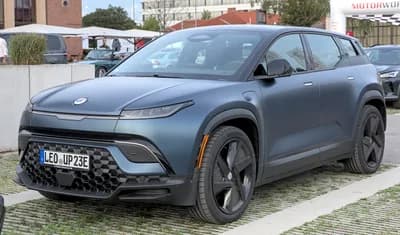
Fisker's Ocean SUV generated $1 billion in revenue within its first production year, but the company filed Chapter 11 in 2024, revealing harsh capital requirements in EV manufacturing. Its asset-light model outsourced production to Magna Steyr, saving 40% on factory costs compared to rivals like Proterra, but ultimately proved unsustainable.
- 0

QuantumScape leads the solid-state battery race with VW backing and $1.4B raised, targeting 2027 commercial production. Its lithium-metal technology delivers 80% faster charging and 50% more range than conventional lithium-ion cells. The company has demonstrated 1,000+ cycle life in testing, meeting a key durability benchmark that rivals have yet to match.
- 0#10

Solid Power advances solid-state EV batteries with BMW and Ford backing, raising $130M to date. Its sulfide-based electrolyte design offers 50% higher energy density than today's lithium-ion standard, targeting 500 Wh/L by 2026. While quantumScape leads in charging speed, Solid Power claims a cost advantage of 20% less per kWh compared to the industry average for solid-state prototypes. The company has shipped 15,000+ prototype cells for third-party testing, validating thermal stability and 1,000-cycle longevity at the pack level.
Watch the ranking video
Image credits
- Tesla: Windell Oskay from Sunnyvale, CA, USA / Wikimedia Commons (CC BY 2.0)
- General Motors (EV Division): Ultium / Wikipedia
- Rivian: Photo by Rivian / Wikimedia Commons (CC BY-SA 4.0)
- Lucid Motors: Alexander-93 / Wikimedia Commons (CC BY-SA 4.0)
- ChargePoint: Felix Kramer (CalCars). Uploaded by User:Mariordo / Wikimedia Commons (CC BY-SA 2.0)
- Proterra: SanJoaquinRTD / Wikimedia Commons (CC BY-SA 3.0)
- Fisker: Fisker Ocean / Wikipedia
- QuantumScape: J. B. Straubel / Wikipedia
Related Videos
Rank it your way
Remix this list into your own ranking, or head to the play hub for every game mode and community breakdown — blind mode, challenges, tier lists, and more.
You Might Also Like

Top 10 US Tech Giants by Market Capitalization 2026
Top 10 US Tech Giants by Market Capitalization 2026

Top 10 US AR/VR Companies 2026
Top 10 US AR/VR Companies 2026

Top 10 US Autonomous Vehicle Companies 2026
Top 10 US Autonomous Vehicle Companies 2026

Top 10 Most Popular Cloud Services and Platforms 2025
#1 Amazon Web Services (AWS) · #2 Microsoft Azure · #3 Google Cloud Platform

Top 10 European Cybersecurity Incidents That Changed Policy
#1 NotPetya (2017) · #2 Estonian DDoS Attacks (2007) · #3 WannaCry NHS Attack (2017)

Top 10 European Privacy Technology Companies
#1 Proton AG · #2 Nextcloud · #3 Tresorit