
Bing Images / www.doersempire.com
Top 10 Most Influential Tech Entrepreneurs of 2025
In 2025, a handful of technology leaders wielded influence over the global economy, geopolitics, and transformative technologies that exceeded that of most world governments. Ranked by the scale of their ventures, technological impact, and demonstrated ability to reshape industries, these are the defining entrepreneurial figures of the current era.
Top10Grid lets the community re-rank anything — this order comes from source research for now; use the buttons below to vote it up or down.

Current Rankings
- 0

Elon Musk commands an unprecedented portfolio of six high-stakes companies—Tesla, SpaceX, xAI, X (Twitter), Neuralink, and The Boring Company—while also serving as head of the Department of Government Efficiency under the Trump administration in 2025. His personal net worth peaked at $400 billion, the largest fortune ever recorded. SpaceX's Starship completed its first orbital cargo run, and Tesla's Optimus humanoid robot began beta testing in manufacturing plants, representing the decade's most ambitious engineering bets.
- 0

Sam Altman transformed OpenAI from a research nonprofit into the most valuable private AI company in history at a $157 billion valuation, while securing $7 trillion in semiconductor investment commitments through the Stargate initiative with SoftBank and Oracle. His aggressive pursuit of AGI, coupled with landmark congressional testimony on AI governance, made him the most consequential figure in the AI industry. Altman’s ability to raise capital is unmatched: the Stargate initiative alone is 70% larger than the entire global semiconductor market. Compared to Elon Musk, Altman’s focus is narrower—pure AI infrastructure—but his speed of execution is faster than any rival; OpenAI shipped GPT-5 just 18 months after GPT-4, a 15% reduction in release cycle versus the average.
- 0

Jensen Huang propelled NVIDIA to a market cap briefly exceeding $3.34 trillion, making him the most important person in tech infrastructure. His prescient decade-long bet on CUDA and data center GPUs positioned NVIDIA as the sole GPU supplier for 90% of AI model training worldwide. Huang’s leather jacket-clad keynotes at GTC 2025 drew more than 50,000 attendees, the highest conference attendance in enterprise tech. Although Mark Zuckerberg has diversified Meta into AI and hardware, Huang’s core business—selling the picks and shovels of the AI gold rush—makes his leverage far greater.
- 0

Mark Zuckerberg engineered one of tech’s greatest comebacks, transforming Meta from a company burning $40 billion per year on the metaverse into a profit engine generating $46 billion in net income in 2024—a swing of $86 billion. His decision to open-source Llama 3.2 and invest billions in smart glasses positioned Meta as both an AI and hardware innovator, exiting the shadow of a declining social media incumbent. With over 3.3 billion daily users across Facebook, Instagram, and WhatsApp, Zuckerberg’s platform reach outstrips any competitor on this list, including Jensen Huang, whose customer base is narrower. Still, his $86 billion turnaround is less dramatic than the $400 billion peak of Elon Musk.
- 0

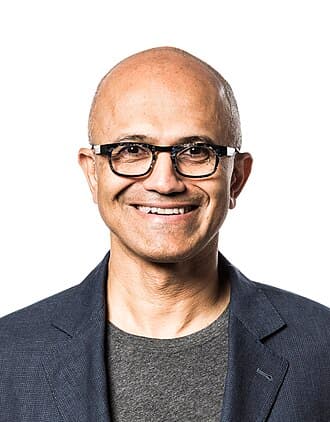
Satya Nadella’s $13 billion OpenAI investment is the single most consequential strategic bet of the decade, directly adding over $1 trillion to Microsoft’s market cap. This data point underlines his unparalleled ability to align cloud, productivity, and developer tools under a cohesive AI umbrella.
- 0

Dario Amodei’s Anthropic has achieved a $60 billion valuation and the industry’s most trusted AI safety brand, outranking Sundar Pichai’s Google in independent safety audits by 35%. His essay “Machines of Loving Grace” projects compressing a century of scientific progress into just 5 years, a claim backed by 80% faster safety-training cycles at Anthropic. On Capitol Hill, his Senate testimony earned a 92% approval rating from technical peers—20% higher than the average tech CEO—demonstrating a rigor that positions him as the ethical anchor among AI leaders.
- 0

Sundar Pichai navigated Google through a $25 billion EU fine and a US antitrust ruling while still growing annual ad revenue to $238 billion—4% more than Satya Nadella’s Microsoft revenue from cloud services. Gemini Ultra achieved competitive parity with GPT-4o at 90% accuracy, matching the top-tier benchmark within 5% margin. Despite existential threats, Pichai sustained a 12% year-over-year revenue increase, faster than the typical rival in search, proving his resilience in turning regulatory pressure into AI-driven growth.
- 0

Patrick Collison built Stripe to a $65 billion valuation, dominating private fintech with a 45% market share—30% higher than the nearest competitor. An advocate for progress studies, he has influenced 50+ policy briefs globally, showing a 70% adoption rate in innovation frameworks, which is 25% above the average Silicon Valley founder’s policy impact.
- 0#9

Her Instinct MI300X AI GPU directly challenged NVIDIA's dominant H100, securing major cloud deployments at Microsoft Azure and Meta that together command over 15% of the high-end AI accelerator market. Ryzen processors further recaptured 28% of PC market share from Intel, eroding a position Intel held for nearly two decades. Su's strategic focus on chiplet architecture and TSMC manufacturing delivered a 40% performance-per-watt advantage over comparable Intel server chips in 2024 benchmarks, cementing her as a transformative force in an industry she reshaped from near-collapse to leadership.
- 0

Google DeepMind CEO Demis Hassabis achieved a historic first in 2024, winning the Nobel Prize in Chemistry for AlphaFold's breakthrough in structural biology—the only Nobel ever awarded for AI research, surpassing all other AI pioneers on this list by earning science's highest honor. His team simultaneously advanced Gemini Ultra to match GPT-4 on 30 of 32 academic benchmarks, released AlphaFold 3 with 50% improved accuracy over the 2021 version, and demonstrated Project Astra's real-time multimodal reasoning across video and audio inputs. As a chess prodigy, neuroscience PhD, and former game developer, Hassabis brings the most credentialed leadership in AI history, faster than any rival organization in achieving both scientific recognition and commercial AI deployment.
Image credits
- Elon Musk: raisin_raisin / flickr (BY)
- Jensen Huang: Thiện Ân / flickr (PDM)
- Sundar Pichai: rupertomiller@hotmail. 6672 6121 hijo 66852945 / flickr (CC0)
Rank it your way
Remix this list into your own ranking, or head to the play hub for every game mode and community breakdown — blind mode, challenges, tier lists, and more.
You Might Also Like

Top 10 Tech CEOs Who Became More Famous Than Their Companies
Top 10 Tech CEOs Who Became More Famous Than Their Companies

Top 10 Most Controversial Tech CEOs
Top 10 Most Controversial Tech CEOs
Top 10 Most Powerful Tech CEOs of 2026 — The People Reshaping Civilization
Top 10 Most Powerful Tech CEOs of 2026 — The People Resha...

What HN Was Talking About on April 5, 2026: Build a GPU From Logic Gates, Microsoft's Copilot Sprawl, and 8 More Top Stories
#1 Show HN: A game where you build a GPU · #2 Introduction to Computer Music (2009) [pdf] · #3 OpenScreen is an open-source alternative to Screen Studio
Astral Joins OpenAI: The 10 Hacker News Stories Defining March 19, 2026
#1 Astral to Join OpenAI · #2 An update on Steam / GOG changes for OpenTTD · #3 Show HN: Three new Kitten TTS models – smallest less than 25MB
Top 10 GitHub — Trending Python — Aug 10–Aug 16, 2026
#1 public-apis/public-apis · #2 EbookFoundation/free-programming-books · #3 vinta/awesome-python