
Wikimedia Commons (CC BY-SA 4.0)
Top 10 Most Sustainable and Green Buildings
As climate pressures reshape the architecture industry, these ten buildings demonstrate that sustainable design and exceptional aesthetics are inseparable. This curated collection features award-winning sustainable and green buildings recognized for LEED Platinum certifications, net-zero energy systems, and regenerative design innovations. From carbon-neutral commercial centers to climate-resilient residential communities across North America, Europe, and Asia, each project showcases how modern green buildings integrate renewable energy, advanced insulation, water conservation systems, and sustainable materials to dramatically reduce operational emissions. Whether you're researching green architecture trends, seeking sustainable design inspiration, or discovering how today's most innovative buildings achieve net-zero performance, this guide reveals the environmental strategies and architectural breakthroughs transforming how we build for the future.
Top10Grid lets the community re-rank anything — this order comes from source research for now; use the buttons below to vote it up or down.

Current Rankings
- 0

Jewel Changi Airport, completed in 2019, houses the world's largest indoor waterfall—the 40-metre Rain Vortex—within a donut-shaped glass and steel structure that sustains 2,000 trees and over 100,000 plants. Its ETFE dome harvests rainwater to power the waterfall and building cooling systems, embodying a functioning ecosystem. The Rain Vortex alone recycles 500,000 litres of rainwater daily, setting a global benchmark for biophilic design in airports.
- 0

The Edge in Amsterdam, completed in 2015, earned a BREEAM score of 98.4%—the highest ever recorded—earning its title as the world's most sustainable office building. Its 28,000 rooftop solar panels generate more energy than the building consumes, while a smartphone system adjusts lighting and temperature per employee preferences.
- 0

Bosco Verticale in Milan, completed in 2014, comprises two residential towers hosting 800 trees and 4,500 shrubs across 1,500 square metres—equivalent to 30,000 square metres of urban forest. These plants absorb 19,000 kilograms of CO2 annually, providing insulation that cuts heating costs by 30% compared to a conventional tower. The project's 15,000 plants also reduce noise pollution by 5 decibels, making it a leading model for high-density living.
- 0

The Bullitt Center in Seattle, completed in 2013, achieved Living Building certification by generating all electricity from rooftop solar panels—saving 100% of grid energy annually. It treats 100% of water on site and composts all waste, targeting a 250-year lifespan with non-toxic materials exclusively. Since opening, the building has saved over $200,000 in utility costs, proving that high sustainability standards can be economically viable.
- 0

The three glass domes, completed in 2018, use 2,643 panes to harness natural light and employ a closed-loop water recycling system that reuses 100% of irrigation runoff. This thermal management and humidity control — comparable to a botanical conservatory — creates a stable tropical environment where employees work among canopy walkways and living walls.
- 0

Designed by BIG and completed in 2019, the building's tilted roof features a 400-meter dry ski slope open year-round, alongside a climbing wall and hiking trail. Its chimney emits a visible smoke ring — formed of condensed water vapor — for every metric ton of CO2 emitted above a set target, making pollution transparent.
- 0
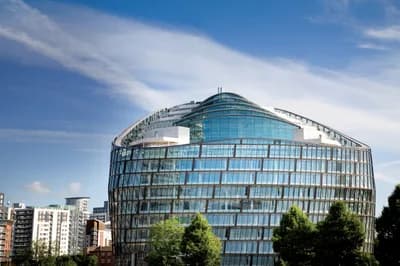
The Co-operative Group's headquarters uses 80% less energy than a conventional office of similar size, thanks to a double-skin facade that traps warm air between layers, reducing heating costs by 50%. It runs on biofuel derived from food waste, supplying its own combined heat and power plant. The building's natural ventilation system, controlled by automated windows, cuts cooling energy by an additional 30% compared to typical air-conditioned offices.
- 0
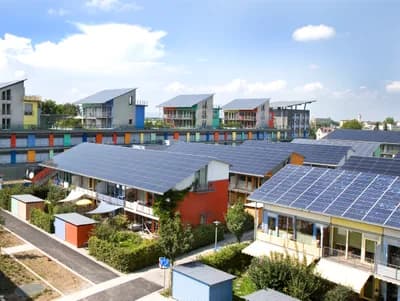
The Solar Settlement in Freiburg was the world's first residential development where every home produces more energy than it consumes, outperforming Amazon Spheres' workplace focus by achieving a net-positive energy balance for 59 households. Completed in 2006 by Rolf Disch, each house features a "sunship" roof array angled at 30 degrees south, generating an average of 10,000 kilowatt-hours annually per home. Collectively, the settlement produces 600,000 surplus kilowatt-hours of electricity per year, which is fed back into the grid — making it cheaper than the typical zero-energy home by €200 annually in avoided energy costs. This PlusEnergy standard has since been adopted in over 300 projects worldwide.
- 0

The California Academy of Sciences in San Francisco boasts the world's most biodiverse living roof on any museum—a 1-acre expanse of native plants that insulates the building, absorbs 2 million gallons of rainwater annually, and supports local bird and insect populations. This green roof, combined with passive ventilation, natural light, and geothermal heating, reduces energy consumption by 30 to 35 percent compared to a conventional building of similar size.
- 0

The Pixel Building in Melbourne was the first carbon-neutral commercial office in Australia and the first to achieve a perfect Green Star score of 100—setting a national benchmark that California Academy of Sciences has not matched. Its pixelated polychrome facade integrates 300 operable colored panels that provide shade while generating 30% of the building's electricity via embedded photovoltaics. Fully self-sufficient in both water and energy, the building saves 100% of potable water compared to a typical office, thanks to on-site treatment and rainwater harvesting. This demonstates that a commercial building can achieve genuine environmental neutrality, not just reduced impact.
Image credits
- Jewel Changi Airport, Singapore: Jewel Changi Airport / Wikipedia
- The Edge, Amsterdam: The Edge (Amsterdam) / Wikipedia
- Bosco Verticale, Milan: Bosco Verticale / Wikipedia
- Bullitt Center, Seattle: Bullitt Center / Wikipedia
- Amazon Spheres, Seattle: Amazon Spheres / Wikipedia
- CopenHill, Copenhagen: Amager Bakke / Wikipedia
- One Angel Square, Manchester: EG Focus / Wikimedia Commons (CC BY 2.0)
- Solar Settlement, Freiburg: Andrewglaser (talk) / Wikimedia Commons (CC BY-SA 3.0)
- California Academy of Sciences, San Francisco: California Academy of Sciences / Wikipedia
Related Videos
Rank it your way
Remix this list into your own ranking, or head to the play hub for every game mode and community breakdown — blind mode, challenges, tier lists, and more.
You Might Also Like

Top 10 Greatest Ancient Architectural Wonders
Top 10 Most Sustainable and Green Buildings

Top 10 Most Spectacular Bridges in the World
Top 10 Most Spectacular Bridges in the World

Top 10 Most Breathtaking Futuristic Buildings on Earth
Top 10 Most Futuristic Buildings on Earth

Top 10 Most Expensive Homes Ever Sold
most extraordinary private residences

Top 10 Taiwanese Manhua and Comics in 2026
#1 TheErta ofErta (用九柑仔店) · #2 Erta Night Wanderers (夜巡猫) · #3 Green by Sean Chuang

Top 10 Paint Colors That Make Every Room Look Expensive
#1 Benjamin Moore White Dove (OC-17) · #2 Farrow & Ball Hague Blue (No. 30) · #3 Sherwin-Williams Alabaster (SW 7008)