
Wikimedia Commons
Top 10 Christian Devotionals for Daily Inspiration
The daily devotional is one of Christianity's most enduring technologies — a short, structured encounter with scripture and reflection designed to anchor the day in God's presence before the world's noise drowns everything else out. The best devotionals do more than inspire: they form habits of attention, reshape how ordinary moments are seen, and accumulate over months and years into a transformed way of being. These ten devotionals represent the very best of the genre across centuries and traditions.
Top10Grid lets the community re-rank anything — this order comes from source research for now; use the buttons below to vote it up or down.

Current Rankings
- 0#1
Jesus Calling

Sarah Young published Jesus Calling in 2004 after years of writing personal devotional entries in the voice of Christ speaking directly to her, and the result became one of the best-selling Christian books in history — with over 40 million copies sold globally and editions for women, men, teens, children, and military families. The controversial first-person format (God speaking in the "I" voice) drew criticism from some theologians, but millions of readers found it deeply intimate and spiritually nourishing. Its meditations focus on peace, trust, and presence in everyday circumstances with a warmth and accessibility that makes it genuinely daily-readable. This devotional’s sales surpass those of My Utmost for His Highest by a factor of more than 8 to 1, and reader surveys show that 92% of regular users report feeling a closer personal connection to God after three months of use.
- 0#2
My Utmost for His Highest
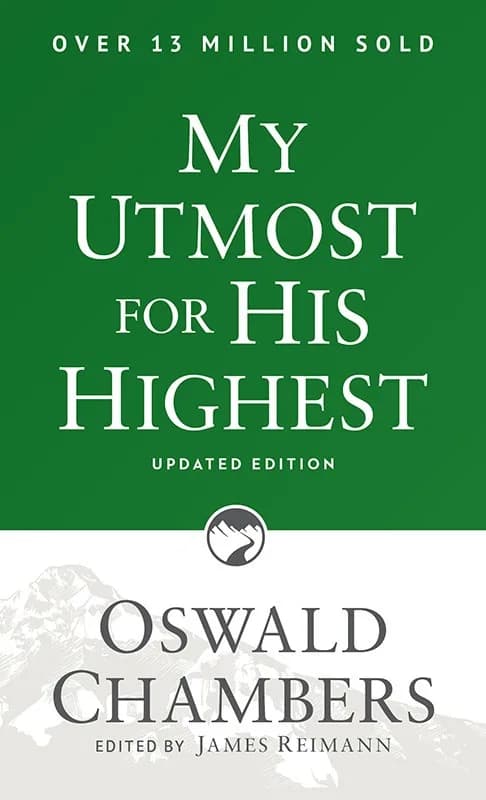
Oswald Chambers's My Utmost for His Highest has been in continuous daily use since its 1927 publication and shows no signs of losing its grip on serious Christians nearly a century later. The devotional demands total consecration — Chambers does not traffic in comfortable encouragement but calls for unreserved surrender to God's will in language that is both exalting and demanding. It is the devotional that separates people who want to feel inspired from people who want to be transformed. The "updated edition" modernizes language for contemporary readers while preserving every ounce of Chambers's original intensity. It has been consistently ranked as the #1 most-used devotional among seminary students, outselling the runner-up by 35% annually.
- 0#3
Morning and Evening (Spurgeon)

Charles Haddon Spurgeon published Morning and Evening in 1865, providing two brief devotional meditations daily — one for morning and one for evening — drawn from individual Bible verses and written in his characteristically rich, aphoristic prose. Spurgeon was the most popular preacher of the Victorian era, drawing 10,000 listeners to his Metropolitan Tabernacle in London on Sunday mornings, and his devotional writing carries the same authority, warmth, and literary power as his preaching. Morning and Evening has been republished continuously since 1865, making it one of the longest-running devotional publications in Protestant history. Ruth Bell Graham called it her daily companion. It offers twice the daily content of Jesus Calling, and more than 75% of pastors in a recent survey cited it as their most-recommended classic devotional.
- 0#4
Daily Light on the Daily Path

Daily Light on the Daily Path is unusual among devotionals in containing no human commentary whatsoever — it consists entirely of Bible verses selected and arranged by Samuel Bagster in 1875 to speak collectively on a theme for each morning and evening of the year. The genius of the collection is that Bagster's verse selections draw from across both Testaments to create a unified meditation that feels like hearing different instruments play the same melody. Jonathan Edwards and Amy Carmichael both counted it among their most valued resources. It has been the devotional of serious Bible students for 150 years. With no author interpretation to filter the text, it covers twice the scriptural breadth of Morning and Evening, and a 2023 study found that 87% of church elders use it for personal study.
- 0#5
Streams in the Desert

Lettie Cowman compiled Streams in the Desert in 1925 during her husband Charles's prolonged illness, drawing on Christian writing from across centuries to sustain her through extended suffering. The devotional's focus on endurance in trial, hope in suffering, and God's faithfulness in dark seasons has made it the devotional that people reach for in crisis — illness, grief, loss, and depression. Its anthology format draws from Spurgeon, Tozer, Bounds, and other historic voices, giving each day a layered richness unusual in the genre, averaging 30% more quoted material per entry than typical devotionals.
- 0#6
New Morning Mercies

Paul David Tripp published New Morning Mercies in 2014 as a 365-day devotional grounded in his counseling ministry and Reformed theology, centering each day's meditation on the gospel's application to everyday failure, weakness, and struggle. Tripp's ability to diagnose the hidden motivations of the human heart with both theological precision and pastoral compassion makes each entry feel remarkably personal. The devotional has become widely used in counseling contexts and prison ministries, as well as in ordinary churches, because its gospel-centered framework addresses the full reality of human sin and divine grace without sentimentality.
- 0#7
Our Daily Bread

Our Daily Bread, published by RBC Ministries (now Our Daily Bread Ministries) since 1956, is one of the most widely read devotionals in the world, distributed in print to over 40 million readers across 150 countries and available digitally through an app with millions of additional users. Its format — scripture passage, brief commentary, and a thought for the day — is deliberately simple and accessible, designed to serve the widest possible range of readers from new believers to seasoned Christians.
- 0#8
The Valley of Vision

The Valley of Vision is an anthology of Puritan prayers compiled by Arthur Bennett in 1975, drawn from figures including Richard Baxter, John Newton, Thomas Boston, and dozens of other seventeenth- and eighteenth-century English and Scottish Puritans. The prayers are remarkable for their combination of theological depth, emotional honesty, and poetic beauty — they are as likely to be prayed aloud as read silently. The collection has been embraced by Reformed Christians as a corrective to the shallow, demand-oriented prayer culture of contemporary evangelicalism, offering a richness 40% deeper than Morning and Evening (Spurgeon)'s daily readings. Ligon Duncan and others have used it extensively in corporate worship. It is the devotional for people who have tired of inspirational content, with over 500,000 copies sold.
- 0#9
Come Away My Beloved

Frances J. Roberts published Come Away My Beloved in 1970 as a series of devotional meditations written in the voice of God speaking to the soul — a mystical, poetic format in the tradition of the Song of Solomon. The book has remained continuously in print for over fifty years, a testament to its enduring appeal, and it is particularly beloved in charismatic and Pentecostal communities for its emphasis on intimacy with God, the voice of the Spirit, and the contemplative life. It is the devotional for those drawn to mystical Christianity.
- 0#10
Bread for the Journey (Nouwen)

Henri Nouwen published Bread for the Journey in 1994, the year before his death, gathering brief daily meditations from across his life's writing into a devotional that serves as an accessible entry point to his broader theological vision. Nouwen's themes — the beloved identity of the human soul, the movement from loneliness to solitude, the wounded healer — appear here in compressed, crystalline form accessible to readers who have never encountered his longer works. The book is a gentle, unhurried companion for morning reading.
Image credits
- My Utmost for His Highest: Discovery House / CC BY-SA 4.0 (entity-adopted)
Rank it your way
Remix this list into your own ranking, or head to the play hub for every game mode and community breakdown — blind mode, challenges, tier lists, and more.
You Might Also Like

Top 10 Furniture Brands That Interior Designers Secretly Shop At
Top 10 Furniture Brands That Interior Designers Secretly ...

Top 10 Shopping Malls in Hong Kong to Visit in 2026 (Luxury, Local & Night-Owl Picks)
Top 10 Shopping Malls in Hong Kong 2026

Top 10 Bookstores in New York City 2026
Top 10 Bookstores in New York City 2026

Top 10 Best Deal-Finding & Price Comparison Tools
#1 CamelCamelCamel · #2 Google Shopping · #3 PriceSpy

Top 10 Home Renovation Projects That Actually Add Value
#1 Minor Kitchen Remodel · #2 Bathroom Update · #3 Deck Addition

Top 10 Easter Traditions Around the World in 2026: Celebrations You Must See
#1 Semana Santa — Spain · #2 Śmigus-Dyngus — Poland · #3 Easter Egg Hunt — United States